
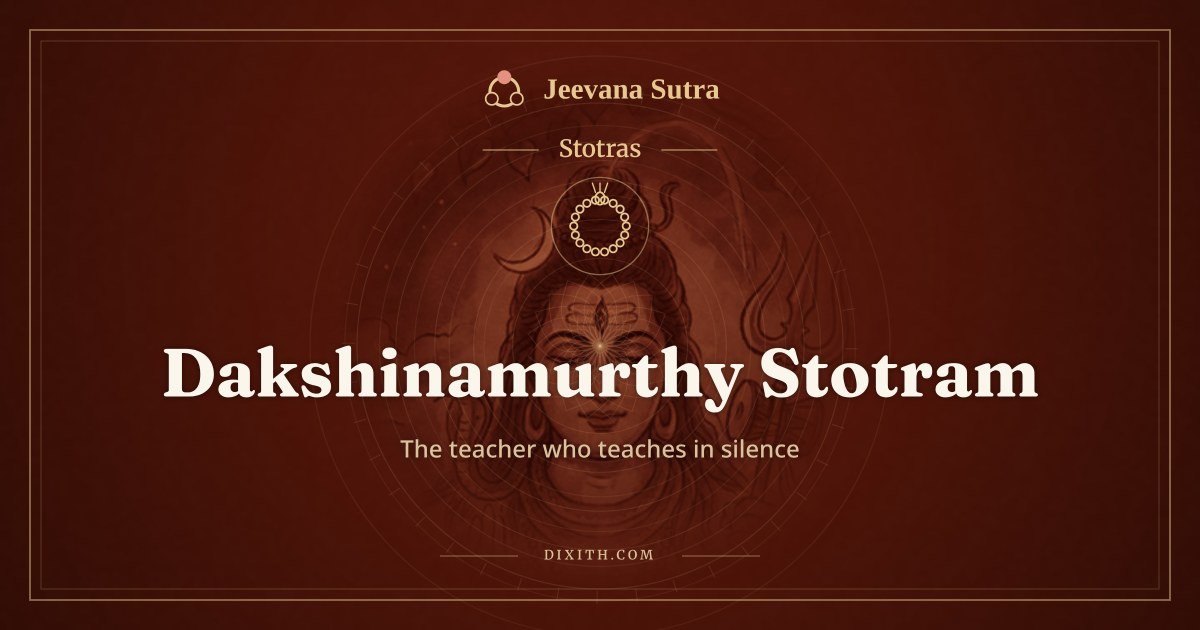
Dakshinamurti is Shiva as the teacher, seated at the foot of a banyan tree and facing south. Around him sit aged sages as his disciples, while the teacher himself is young. He does not speak: holding his hand in the chinmudra, he teaches through silence, and the doubts of his disciples fall away.
The ten verses of the hymn explain the Advaita teaching that the Self alone is all, through images such as a city seen in a mirror, the sprout within a seed, a lamp inside a pot pierced with holes, and the eclipsed sun and moon. Every verse ends with a salutation to that Guru, Sri Dakshinamurti. We have also given the invocation and the eight meditation verses recited before the hymn.
Meaning of the verses
He who in the beginning created Brahma and who delivered the Vedas to him, that God who lights up the mind with knowledge of the Self: seeking liberation, I take refuge in Him.
Young, he reveals the truth of the supreme Brahman by a silent exposition, surrounded by aged sages, his disciples, steadfast in Brahman. I praise Dakshinamurti, chief among teachers, his hand held in the chinmudra, bliss in form, delighting in his own Self, his face serene and glad.
Seated on the ground near the banyan tree, he gives knowledge to all the sages gathered close by. I bow to the god Dakshinamurti, teacher and lord of the three worlds, skilled in cutting away the sorrow of birth and death.
How wonderful! At the foot of the banyan tree the disciples are old and the teacher is young. The teacher’s exposition is silence, and yet the doubts of the disciples are cut away.
Salutation to Dakshinamurti, the treasury of all learning, the physician of those who suffer from the disease of worldly existence, the teacher of all the worlds.
Om. Salutation to Dakshinamurti, who is the meaning of the syllable Om, whose one form is pure knowledge, who is spotless and wholly at peace.
Salutation to Dakshinamurti, consciousness in its fullness, the great Lord, who dwells at the foot of the banyan tree, whose form is existence, consciousness and bliss.
Salutation to Dakshinamurti, who appears divided into three forms as the Lord, the teacher and the Self, and whose body pervades everything like space.
Through the gesture of joining thumb and forefinger, Shiva shows the yogis the meaning of the Upanishads, the oneness of Brahman and the individual self, by that very union.- 1
He sees the universe, which lies within himself like a city seen in a mirror, as though it had arisen outside through maya, just as a dream seems outside in sleep. At the moment of awakening he directly realises his own Self, one without a second. To him, the Guru in form, Sri Dakshinamurti, this salutation. - 2
This world, undifferentiated at first like the sprout within a seed, is then painted in many colours by the variety of space and time that maya fashions. Like a magician, or like a great yogi, he unfolds it by his own will. To him, the Guru in form, Sri Dakshinamurti, this salutation. - 3
His shining, which is existence itself, appears in objects that are in themselves unreal. He teaches those who come to him directly through the Vedic words “Tat tvam asi”, “That thou art”. Once he is realised there is no return to the ocean of worldly existence. To him, the Guru in form, Sri Dakshinamurti, this salutation. - 4
Like the light of a great lamp set inside a pot pierced with many holes, his knowledge streams outward through the doors of the eye and the other senses. He alone shines as “I know”, and this entire world shines only after him. To him, the Guru in form, Sri Dakshinamurti, this salutation. - 5
Debaters who take the body, the breath, the senses, the fickle intellect, or the void to be the “I” are badly deluded, like women, children, the blind and the dull. To him who destroys this great delusion conjured by the play of maya’s power, the Guru in form, Sri Dakshinamurti, this salutation. - 6
Covered by maya like the sun and moon swallowed by Rahu at an eclipse, the person in deep sleep, when the senses are withdrawn, remains as pure existence alone. On waking he recognises himself: “I was asleep until now.” To him who is thus recognised, the Guru in form, Sri Dakshinamurti, this salutation. - 7
Through childhood and the other ages, through waking and the other states, through every condition that comes and goes, the Self continues unbroken, always shining within as “I”. By his auspicious gesture he reveals this Self to those who worship him. To him, the Guru in form, Sri Dakshinamurti, this salutation. - 8
Whirled about by maya, this person, in dream or in waking, sees the world divided into cause and effect, owner and owned, disciple and teacher, father and son and so on. To him who is that very person, the Guru in form, Sri Dakshinamurti, this salutation. - 9
Earth, water, fire, wind, space, the sun, the moon and the person (the one who sacrifices, or the individual soul): this world of moving and unmoving things shines as his eightfold form alone. For those who reflect, nothing exists apart from that supreme, all-pervading Lord. To him, the Guru in form, Sri Dakshinamurti, this salutation. - 10
Since this hymn makes clear the truth that all is the Self, by hearing it, reflecting on its meaning, meditating on it and chanting it, lordship arises of itself, together with the great glory of being the Self of all. Further, unobstructed sovereignty, unfolding in eight forms (the eight powers), is attained.
About this hymn
Tradition holds that Adi Shankaracharya composed this hymn. Its classic commentary is the Manasollasa, ascribed to Shankaracharya’s disciple Sureshvaracharya. Because its ten verses gather the main ideas of Advaita Vedanta, many read it as a treatise in miniature.
The ten verses are in the shardulavikridita metre. All but the tenth end with “to that Guru, Sri Dakshinamurti, this salutation”, and the tenth states the fruit of reciting. The mirror city of the first verse, the lamp in the pierced pot of the fourth, Rahu and the eclipse in the sixth and the eightfold form in the ninth are its best known images.
The opening “Om yo brahmanam” is verse 6.18 of the Shvetashvatara Upanishad. The eight meditation verses that follow are customarily recited before the hymn. They are traditional verses, however, and cannot be said with confidence to be Shankara’s.
The fifth verse refutes schools of its day that took the body, breath, senses, intellect or the void to be the self, such as the Charvakas and the Buddhists. Likening them to women, children, the blind and the dull is a comparison in the idiom of its time. The hymn belongs to an age of vigorous debate between schools.
The hymn is also widely known as the Dakshinamurti Ashtakam. Counted, though, it has ten verses: nine end with the salutation, and the tenth tells the fruit of reciting. An ashtakam is a hymn of eight verses, often with a closing verse on its fruit, so this one has a verse more. The name is a customary one, not an exact count.
On the text: we have printed compounds joined rather than split. We have used the vignanam.org copy as our base. Other printings differ slightly in a few words.
Sources: several. Where readings differ, the difference is noted here.
For life today
As the seventh verse says, childhood, youth and age, waking, dream and sleep all change, yet the awareness “I” runs through them all. We meet this simply when we turn the pages of an old photo album. The face, the height and the hair are all different, and still we say, “That is me.”
Dakshinamurti’s silent teaching is familiar too. In a hospital corridor, simply sitting beside an anxious family sometimes says more than many explanations.
Noticed a mistake or a different reading? Tell us.

Leave a comment