
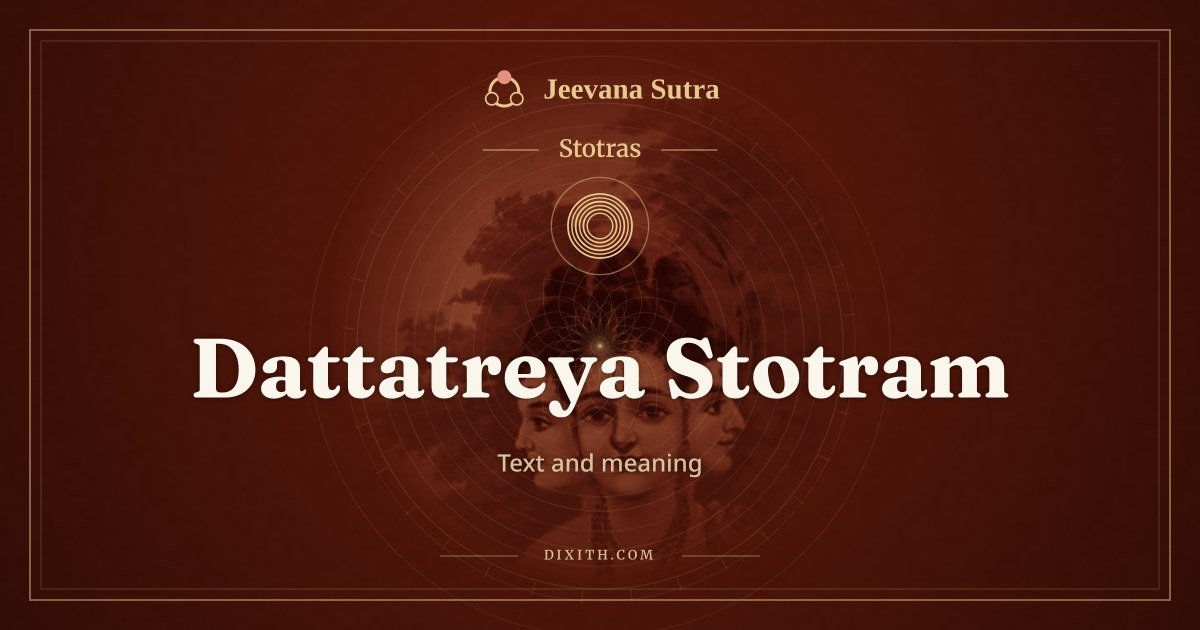
This hymn, which opens with the meditation verse “jaṭādharaṃ pāṇḍuraṅgam”, is widely loved among devotees of Datta. Tradition says it was sung by the sage Narada. Every verse ends with the refrain “dattātreya namo’stu te”, “Dattatreya, salutations to you”.
The hymn praises Dattatreya, son of Atri and Anasuya, as Brahma, Vishnu and Shiva in one form. It pictures him as the sky-clad avadhuta, as the yogi who begs with a golden bowl in his hand, and as the Supreme Brahman itself.
Meaning of the verses
He wears matted locks, he is pale white with sacred ash, he holds a trident in his hand, he is a treasury of compassion, the god who removes all diseases: Dattatreya I worship.
Of this hymn-mantra to Sri Dattatreya, the seer is the revered Narada, the metre is anushtubh, and the deity is Sri Datta, the Supreme Self. It is employed in japa for the pleasure of Sri Datta.- 1
You who create the world and are the cause of its keeping and its dissolution, you who are free of the noose of worldly existence: Dattatreya, salutations to you. - 2
Destroyer of old age and birth, purifier of the body, O sky-clad one, embodiment of mercy: Dattatreya, salutations to you. - 3
You whose body shines like camphor, who bear the form of Brahma (or of Brahman), who know the Vedas and the shastras fully: Dattatreya, salutations to you. - 4
You who are without short or tall, thin or stout, without name or lineage, the one light shining in the five elements: Dattatreya, salutations to you. - 5
Enjoyer of the sacrifice, the sacrifice itself, bearer of the form of sacrifice, lover of sacrifice, the perfected one: Dattatreya, salutations to you. - 6
Brahma at the beginning, Hari in the middle, and at the end the god Sadashiva: to you whose form is these three, Dattatreya, salutations. - 7
Abode of enjoyments and enjoyment itself, worthy to be reached through yoga, upholder of all, O conqueror of the senses, O master of knowledge: Dattatreya, salutations to you. - 8
Sky-clad, divine, bearer of a divine form, O Supreme Brahman who is ever risen and shining: Dattatreya, salutations to you. - 9
You who dwell in Jambudvipa, in the great holy place of Matapura (Mahur in present-day Maharashtra), O god victorious among the good: Dattatreya, salutations to you. - 10
He goes begging from house to house and village to village, a golden bowl in his hand, and his alms hold food of many flavours. Dattatreya, salutations to you. - 11
His hand-gesture is knowledge of Brahman itself, and the sky and the earth are his clothing. You who are awareness, dense and whole: Dattatreya, salutations to you. - 12
O avadhuta, ever blissful, whose nature is the Supreme Brahman, who lives in a body as one who is bodiless: Dattatreya, salutations to you. - 13
O truth embodied, of right conduct, devoted to truth and dharma, O refuge of truth, beyond the reach of the senses: Dattatreya, salutations to you. - 14
Trident in one hand, mace in the other, a garland of forest flowers on your fair neck, wearing the sacred thread, O Brahman: Dattatreya, salutations to you. - 15
You whose nature is both the perishable and the imperishable, higher than the highest, you whose praise leads to liberation: Dattatreya, salutations to you. - 16
O Datta, rich in learning, lord of Lakshmi, O Datta whose form is the very Self, you who are both with qualities and beyond them: Dattatreya, salutations to you. - 17
This hymn destroys enemies and gives knowledge and realised wisdom. Through it all sin is put to rest. Dattatreya, salutations to you. - 18
This great and divine hymn brings Datta before one’s eyes. It was sung by Narada through the grace of Dattatreya.
About this hymn
The colophon calls this hymn “composed by Narada, in the Narada Purana”. Many have observed, however, that it is not found in the printed Narada Purana, so it is best described as said to come from that Purana. It is widely recited in the Datta tradition, especially in Maharashtra and Karnataka.
Tradition holds Dattatreya to be the son of the sage Atri and Anasuya, and Brahma, Vishnu and Shiva in a single form, as verse 6 says. He is the sky-clad avadhuta, a knower bound by no social rule. In the dhyana verse “pāṇḍuraṅga” means pale white, smeared with ash, and does not refer to Vitthala of Pandharpur. The Matapura of verse 9 is Mahur in Maharashtra, traditionally Datta’s abode.
After the dhyana verse and the viniyoga come sixteen verses in anushtubh and two verses of phalashruti. Verse 6 has a variant reading “madhye viṣṇu” with the same sense. The word “dattamuktiparastotra” in verse 15 is obscure. We have read it as a single vocative compound and give the tentative sense “you whose praise leads to liberation”; other readings are possible.
The dhyana verse calls Datta the remover of all diseases. Prayer and chanting do not take the place of medical treatment.
Sources: several. Where readings differ, the difference is noted here.
For life today
Almost any form we open asks first for name, family, height and weight. Verse 4 calls Datta one who is neither short nor tall, thin nor stout, and has no name or lineage. Those boxes must still be filled in, but the line gently reminds us that a person is not measured by them.
Noticed a mistake or a different reading? Tell us.
Leave a comment