
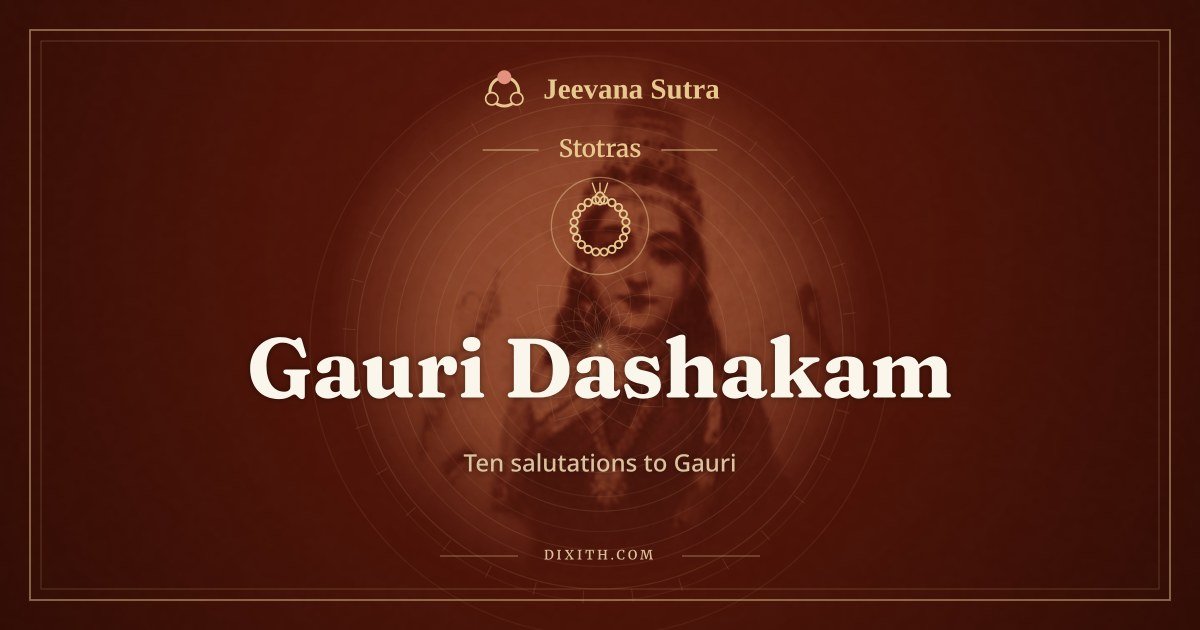
Dashaka means a set of ten. All ten verses of this hymn end with the same line: I praise Mother Gauri, the lotus-eyed. The three lines before it each describe one aspect of her.
Gauri appears here as the power that creates, sustains and withdraws the world, as the supreme reality that yogis seek, and as the consort of Shiva. The eleventh verse states the reward for one who recites in the morning.
Meaning of the verses
- 1
I praise Mother Gauri, the lotus-eyed, who in sport brings forth, sustains and withdraws all the worlds, whom yogis who have gone beyond the world long seek within, and whose mass of radiance is like a row of rising suns. - 2
I praise Mother Gauri, the lotus-eyed, who in the minds of those established in withdrawal of the senses, meditation and samadhi ever brings about the height of peace. She is made of being, knowledge and bliss, and yet takes a bodily form. - 3
I praise Mother Gauri, the lotus-eyed, whose gentle smiling face delights Shiva, the wearer of the moon, whose heavy dark tresses are adorned with the crescent, and whose pair of lotus feet are worshipped by Indra, Upendra and others. - 4
I praise Mother Gauri, the lotus-eyed, who shines in the form of the letters from A to Ksha, who in every being gives birth to the multitude of beings, who is made of the bliss of the Word-Brahman, and whose lustre is like lightning. - 5
I praise Mother Gauri, the lotus-eyed, who rises along the path from the muladhara, pervades the opening at the crown and the regions of sun and moon, and glows in her play. Her form is subtler than the subtle and her nature is happiness. - 6
The eternal, pure, indivisible and one Lord of the world is witness to her acts of creation and dissolution. I praise Mother Gauri, the lotus-eyed, wife of Shiva, who delights in the sport of protecting the universe. - 7
I praise Mother Gauri, the lotus-eyed, in whose womb the undivided cosmic egg dissolved and from which it rose and appeared again and again, and who roams with her husband on the silver mountain, Kailasa. - 8
I praise Mother Gauri, the lotus-eyed, in whom everything, moving and unmoving, is woven through and through like a garland of beads on a thread, and who is reached by the path of knowledge of the Self. - 9
I praise Mother Gauri, the lotus-eyed, auspicious, who alone pervades the worlds through many forms of power and plays there as she wills, and who is a wish-fulfilling creeper for those who bow to her. - 10
I praise Mother Gauri, the lotus-eyed and beautiful, who destroys the distress caused by the snare of desire for those absorbed in meditation on her lotus feet, and who bears half the body of the Lord. - 11
It is said that the daughter of the mountain surely grants mastery of speech, excellent wealth and devotion to Shiva to one who, pure in mind, with concentration and devotion, recites this Gauri Dashakam every morning.
About this hymn
Tradition ascribes this hymn to Shankara Bhagavatpada. We do not present that as certain, and we give no date of composition.
The last line is the same in all ten verses: Gaurim ambam amburuhakshim aham ide. We give its sense at the end of each verse. The eleventh verse is a phalashruti without this refrain. It speaks of mastery of speech, wealth and devotion to Shiva, and not of the cure of disease.
In verse four, adikshanta means the alphabet from A to Ksha. Commentators take verse five to point to the path of kundalini yoga.
We give the text as it stands on the website of the Sringeri Sharada Peetham. In verse three the word chandrapida occurs twice. We take the first as Shiva, the wearer of the moon, and the second as the crescent ornament in the Goddess’s hair. This is one possible reading, and other explanations may exist.
Source: the stotra section of the Sringeri Sri Sharada Peetham website (sringeri.net). Where readings differ, the difference is noted here.
For life today
A mother lays her hand on the forehead of a child lying with fever. The touch says nothing, yet the child is comforted. The call Amba in the refrain of Gauri Dashakam brings to mind the memory of such a touch.
Tradition holds that repeating the same line ten times settles the mind gradually. Prayer and chanting do not replace medical treatment, and a fever still calls for seeing a doctor.
Noticed a mistake or a different reading? Tell us.



Leave a comment