
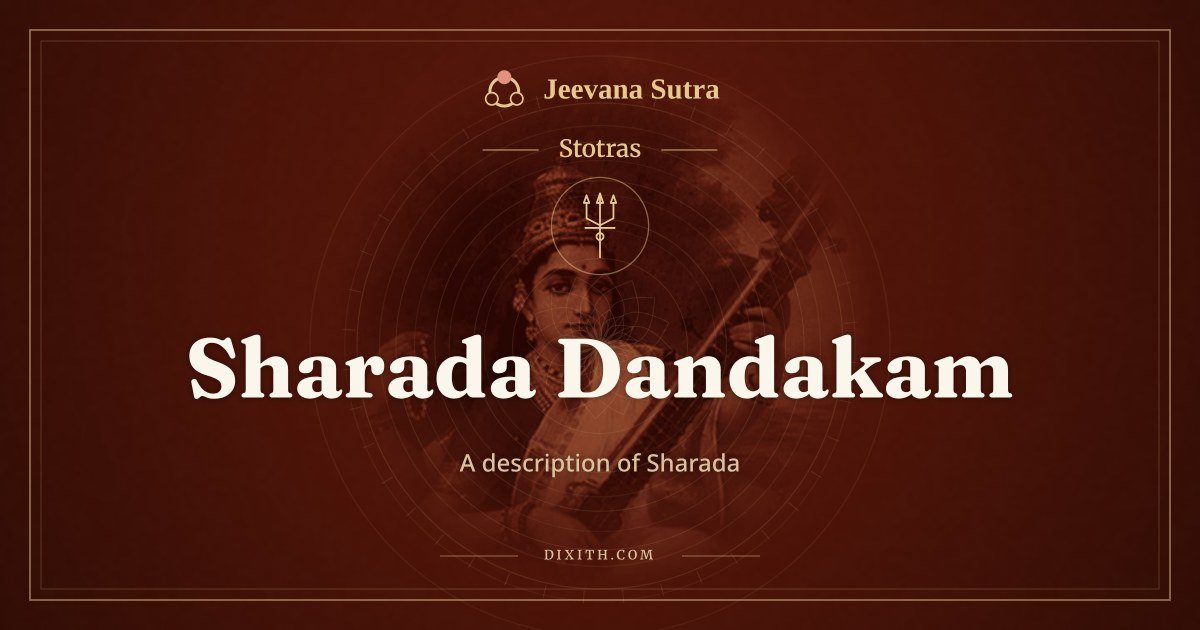
The Sharada Dandakam is a hymn in the dandaka form praising Sharadamba of Sringeri. It opens with one prelude verse, followed by a prose like poem of six parts in long compounds.
The six parts are the source’s paragraphs. We named them Dandaka 1 to 6 only for easy reading. The meanings are not word by word but a connected summary of each part.
Meaning of the verses
Victory to you, who dwell on the Sringa hill, goddess of beauty, who live on the Tunga bank and break sorrow.
Victory to the mother who delights in dwelling on the Sringa hill, on the bank of the Tunga, which shines with high waves like the Ganga. She wears a cloth like an autumn cloud and is the shore of the sea of compassion. Here come her red lotus feet, the gleam of her nails, the power to wash away the mud of sin of those who bow, and the sound of her anklets proclaiming her vow of protection. She drives off the foes of the gods, has a glance even Lakshmi longs for, and has smooth shins that outshine Kama’s quiver. Her mercy rises to protect the helpless and the afflicted.
This part describes her cloth and lower body. Her thighs are covered by a fine cloth that outdoes the whiteness of jasmine, the moon, the milk ocean, mist, camphor and swans. The thighs are likened to the trunk of Indra’s elephant and banana stems. In bearing the faults of all who take refuge in her she surpasses the Earth itself. The slender waist is compared to the sky, and the line of fine hair between the three folds of the belly seems like the Yamuna come to join the triple stream. The jewels of the gods’ crowns wave a lamp offering at her feet, worshipped by all.
The third part covers her bosom, arms and gifts. A pearl necklace shines on breasts like golden pots full of nectar, so white that one wonders if it is specks of butter from milk. She shines with divine jewels and is an ocean of good qualities. She holds out her two lotus hands in order to give dharma and the other aims of life. Her arms, adorned with ruby armlets, give beyond even the wish creeper, and she is honoured by Brahma.
The fourth part describes her neck, face and nose. Her neck and lips shine like a conch and coral born of the ocean of beauty, and the gods are servants at her feet. Her gentle smile seems the moonlight of her face, and her cheeks gleam as if Brahma made a jewelled mirror so he could see his own face. A jasmine garland is in her hair, and she bends slightly under the weight of her bosom. This part also names her sesame flower nose ornament and her being the wife of the lotus born.
The fifth part describes her eyes, forehead and hair. Her face is lit by lotus like eyes whose dark pupils are like bees come to drink the nectar of mercy, and her teeth outshine jasmine. Her brows curve like the creeper bow of Kama, and a musk mark shines on her forehead. She thrills at Brahma’s embrace, and her hair, full of jasmine and malati flowers, looks like a sky strewn with stars. She is the path of unfeigned mercy and a guest in the minds of yogis.
In the last part description turns into prayer. It calls her Sharada, who carries us over the ocean of sorrow, praised by Narada and others, fulfiller of the wishes of all worlds, who held back hosts of demons, split the mine of delusion, ferried all devotees across, and who is the form of all gods, all brahmins, all worlds, all scriptures and all things. Then it asks: protect us, deluded by maya, make us servants of your lotus feet, who but you does us good, place your foot on our heads, shine always in our minds, save us from the sorrowful cycle of birth, and give lasting understanding and joy. It ends with repeated bows.
About this hymn
The source does not name the author. The text itself shows Sringeri, the Tunga bank, and Sharada as the wife of the lotus born Brahma. We do not guess a date or composer.
The dandaka is a form with no fixed metre in which long compounds follow one another. Here each part carries on with a fresh run of epithets and ends in a form of address. The parts move in order from the feet up to the crown.
The six parts are the source’s paragraphs. We called them Dandaka 1 to 6 only for ease of reading.
The text was available on the Sringeri Sri Sharada Peetham website in Devanagari only. We converted it to Kannada script and removed the compound hyphens. We made no other correction, and the text stands as in the source.
Source: the stotra section of the Sringeri Sri Sharada Peetham website (sringeri.net). Where readings differ, the difference is noted here.
For life today
On the timetable board of a small station each line is one stop. This hymn too travels from the feet to the crown, pausing to look at each stop.
As we find the commas to catch our breath in a long sentence, a long road in life also needs places to pause.
Noticed a mistake or a different reading? Tell us.


Leave a comment