
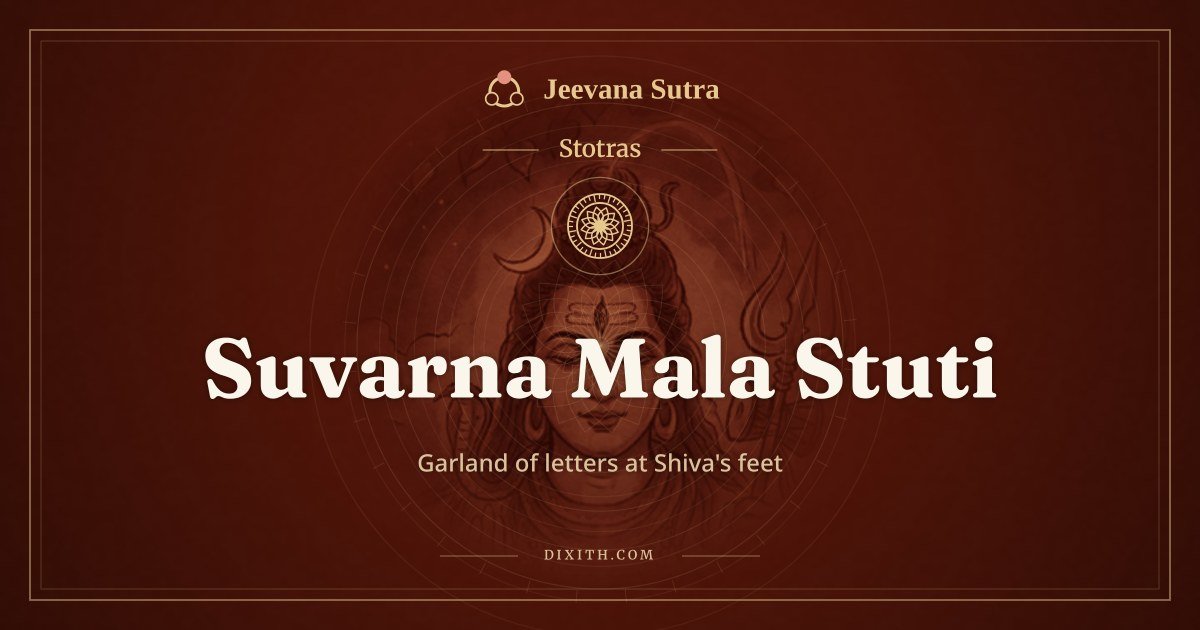
Suvarna Mala Stuti means a hymn like a garland of gold. It has fifty verses, and each one ends with the same refrain of surrender at the feet of Shiva.
The verses begin in the order of the alphabet. First come the vowels, then the consonants in sequence up to the letter ksha. So each letter joins the garland as one more flower. Praise, prayer and the Advaita vision of oneness follow one after another.
Meaning of the verses
- 1
O Lord, somehow I purify my tongue with tiny traces of your qualities. Refrain: O Sadashiva who are with Amba, O Shambhu, O Shankara, your two feet are my refuge. - 2
O Lord, expert in breaking the pride of Indra, dear to the sage Tandu, Lord of Chandi. Your feet are my refuge. - 3
You are clad in the skin of an elephant. O Lord, your blazing eye took away the body of Kama, the enemy of Shambara. - 4
O Isha, lord of the mountain, lord of men, supreme Lord, great Lord, adorned with snakes that dwell in holes. - 5
O Lord, whose left side is embraced by Uma, of divine and auspicious form. - 6
Accept me, ignorant and without protector. Take my sin far away. - 7
O swan in the mind-lake of the foremost sages, cause of the creation, preservation and dissolution of all that moves and does not move. - 8
Your crown is the moon, lord of the stars. You ride the great bull and wear rudraksha beads. - 9
I offer at your feet the pair of letters ḷ and ḹ, which find no place in this garland, like a flower without a stalk, O Lord. The text of this verse may be unclear, so this is the gist. - 10
We worship you, O Mrida, as the one Being of which the Shruti speaks. Refrain: O Samba Sadashiva, your feet are my refuge. - 11
You grant oneness to your own devotees. The verse adds that the sustainer of the world is the witness here, but its sense is not entirely clear. - 12
Maya, which points to you through the sound Om, is a benefactor to us, O Mrida. - 13
Indifference to sense objects and the state of having the sky as one garment both show clearly in you alone, O Lord. - 14
Grant me purity of mind and true devotion to you, O Lord. - 15
Though free of every limiting adjunct, you are the world itself in all forms, whole and separate, O Lord. - 16
O ocean of compassion, indifference towards me, your servant, does not befit you. - 17
Break up my company with the wicked. Join me always to the company of the good. - 18
You swallowed the poison for the good of the world. Who here is your equal? - 19
Your body is white as camphor. In the thick knot of your matted hair you hold Ganga bound, O Lord. - 20
The unbroken awareness that shines in all bodies, that is you. - 21
Bind firmly the restless monkey of my heart, which roams among the trees of sense objects, O Lord. - 22
Wonderful, O Shiva, even the shade of Sthanu removes the burning distress of those who bow. Sthanu also means a tree stump, and it is a name of Shiva. The text may be unclear. - 23
Victory to you, who dwell on Kailasa, lord of the Pramatha hosts, worshipped by the brahmins. - 24
You dance to sounds like jhanuta, jhankinu and jhanutakkitataka, O great dancer. - 25
Give me knowledge free of distraction and veiling. You alone are my guru, O Lord. Refrain: your feet are my refuge. - 26
The twang of your bow splits the hearts of your foes like a thunderbolt. - 27
Your Maya is like the shape of the letter ṭha, empty outside and empty within. - 28
Your sinless pair of feet outdoes even the pomp of the lotus. - 29
Your hands shine with the drum, the rosary, the trident and the skull of Brahma, O Lord. - 30
The text of this verse is unclear. The gist: for people here, the way of taking refuge in you gives what is auspicious. The verse also refers to the letter ṇa. - 31
A person who chants your mantra well soon crosses the ocean of worldly existence. - 32
The verse says: let a “thoo” of reproach fall upon the mouth of one in whose mouth your name is not. - 33
Who other than me deserves pity, and who other than you is compassionate? Tell me, O Lord. - 34
Skilled in establishing dharma, three-eyed, O guru, you taught a lesson to the sacrifice of Daksha. - 35
Once, surely, the man Arjuna struck you with his bow, his mind set on the kill, O Lord. This refers to the story of Shiva in the form of a hunter. - 36
Not even Brahma, the unborn, is able to measure your form. You are beyond the highest, O Lord. - 37
O eternal Lord, the fruit of a human birth here is service at your feet. - 38
Grant strength, health and long life, and also a lasting delight in your qualities, O Lord. - 39
O Lord, Bharga, remover of fear, master of the beings, whose body is adorned with sacred ash. - 40
O husband of the daughter of the Himalaya, your greatness is not contained even in the Shrutis. - 41
The one whom yogis worship in their hearts through the limbs of yoga beginning with yama and niyama, that is you. - 42
As a snake appears in a rope and silver in a shell, so the worlds appear in you, O Lord. - 43
Having received the discus by your grace, he protects the whole world. Vishnu is understood to be meant, though the verse does not name him. - 44
The text of this verse is unclear. The gist: you are the one who defeated the asuras, with the earth as chariot and with bow, string and arrow. It seems to refer to the story of the destruction of the three cities. - 45
O Sharva, O God, best of all, giver of all, remover of the pride of the wicked. - 46
O remover of the six enemies, the six waves and the six changes. O gracious-faced one, father of Shanmukha, O Lord. - 47
The Shruti gives the mark of Brahman as truth, knowledge and infinity. You are the one known by that mark. - 48
The songs of divine singers such as Haha and Huhu take your great deeds for their theme, O Lord. - 49
No word begins with the letter ḷa in use, but the word mangala ends with it. So let auspiciousness be always here, O Lord. - 50
One who longs for the moment of service at your feet will spend his days as if they were moments, O Shiva. Refrain: O Samba Sadashiva, your feet are my refuge.
About this hymn
The source says nothing about the author or the date of this hymn, so we name no one.
We give all fifty verses of the source. Each begins with two lines of praise and ends with the refrain Samba Sadashiva Shambho Shankara, Sharanam Me Tava Charanayugam. It means: O Sadashiva who are with Amba, O Shambhu, O Shankara, your two feet are my refuge. We have not repeated it in every meaning.
The verses begin with the vowels, then the consonants in order up to ksha. In places the letter and the verse do not fit the Kannada alphabet directly, for example the letter jna comes twice. We give the text as the source has it.
The text of verses 9, 11, 22, 30 and 44 looks unclear. There we keep the source text and give the gist. Verse 38 is a prayer for health. Prayer and chanting do not replace medical treatment.
Source: the stotra section of the Sringeri Sri Sharada Peetham website (sringeri.net). Where readings differ, the difference is noted here.
For life today
We have all watched a garland being strung. One flower is threaded, then another, and the garland grows flower by flower. No single flower is the whole garland, but together they become a garland fit for the neck of the Lord.
This hymn grows in the same way: one letter, one verse, one prayer at a time, on a single thread. It reminds us that our own days, too, can go on threading small tasks one by one on a single thread of trust.
Noticed a mistake or a different reading? Tell us.
Leave a comment