
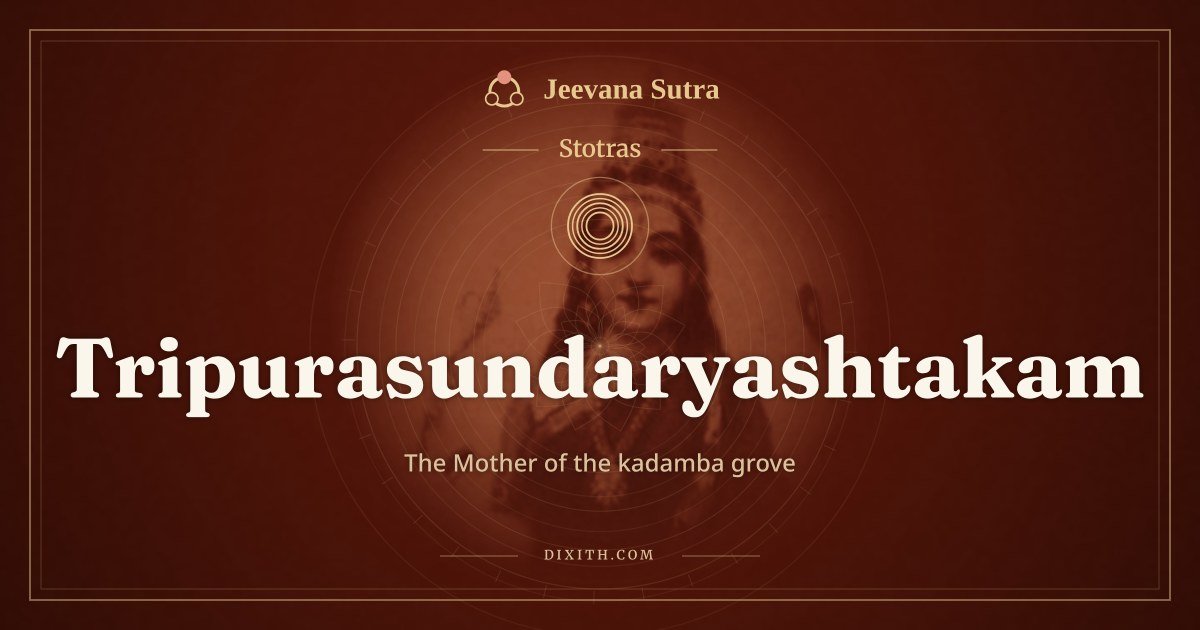
This is an ashtaka of eight verses in praise of Tripurasundari. The picture of the Goddess dwelling in a grove of kadamba trees opens many of the verses. She is described here as dark like a fresh rain cloud.
The first, second, fourth and sixth verses close with the same refrain of surrender to Tripurasundari, wife of the three-eyed Lord. The seventh is a meditation for the time of japa, and the eighth shows the wives of the gods serving her.
Meaning of the verses
- 1
I take refuge in Tripurasundari, who roams the kadamba grove and delights the host of sages as a cloud delights peacocks. Her hips outdo the mountains, and the women of the gods serve her. Her eyes are like fresh lotuses, her colour dark like a new rain cloud, and she is the wife of the three-eyed Lord. - 2
She dwells in the kadamba grove and holds a golden veena. She wears a necklace of priceless gems, and the glow of wine shines on her face. She grants the wealth of compassion and moves in pure radiance. I take refuge in Tripurasundari, wife of the three-eyed Lord. - 3
She makes the kadamba grove her house, a garland shines on her breast, and her slender waist is likened to a mountain, though this phrase is doubtful, see About. She shines on the shore of great compassion, her cheeks are red with the flush of wine, her speech is sweet song, and her colour is deep cloud blue. By some such Goddess, as if in play, we have been clad in armour. - 4
She is in the middle of the kadamba grove, seated in a golden circle, dwelling in the six lotuses of the body, a lightning flash that is ever steady. She surpasses the hibiscus in redness and wears the shining moon as her crest jewel. I take refuge in Tripurasundari, wife of the three-eyed Lord. - 5
She holds a veena against her breast, is adorned with curling locks, dwells in the lotus, and hates the crooked in mind. Her eyes are red with wine, she bewilders even Shiva, foe of Kama, she is the daughter of the sage Matanga, and her speech is sweet. I take refuge in her. - 6
One should meditate on her as a flower newly in bloom, wearing a blue garment flecked with drops of red, holding a cup of wine. Her eyes roll with the flush of wine, her heavy breasts lift her form, her hair-knot has come loose, and she is dark in colour. I take refuge in Tripurasundari, wife of the three-eyed Lord. - 7
I remember Ambika at the time of japa. She is anointed with kumkuma, musk shines on her forehead, her glance carries a gentle smile, and she holds bow, arrow, noose and goad. She charms all people, wears red garlands and garments, and glows like the hibiscus. - 8
Indra’s wife is her hairdresser, Brahma’s wife is busy rubbing sandal paste on her, and Mukunda’s wife Lakshmi dresses her in ornaments. The wives of the gods are her maidservants. I worship such a Bhuvanambika.
About this hymn
Tradition ascribes this ashtaka to Shankara Bhagavatpada. Our source says nothing about its date, so we give none.
Here the Goddess is pictured as dark in colour, with a face flushed with wine, and in the Matangi aspect holding a veena. This is the style of meditation verse found in the tradition of Devi worship. The sixth verse gives a way of meditating and the seventh a remembrance for the time of japa.
The reading of the word kushopamitashailaya in the second line of the third verse is uncertain. We have given one possible sense, a slender waist likened to a mountain. The grammar of this verse also differs from the rest, for all its descriptive words are in the instrumental case.
The Kannada version of this text on the Kannada page may have been converted mechanically from Devanagari, so small spelling slips may remain there.
Source: the stotra section of the Sringeri Sri Sharada Peetham website (sringeri.net). Where readings differ, the difference is noted here.
For life today
When we carry a lamp from room to room at dusk, the dark of one room fades and the next one lights up. The lamp is the same and the flame is the same. Only the place changes.
In the refrain of this ashtaka the description changes from verse to verse, but the feeling of taking refuge stays the same. Our day too moves from task to task. If we have the habit of carrying one steady place with us, each new task begins in that same light.
Noticed a mistake or a different reading? Tell us.



Leave a comment