
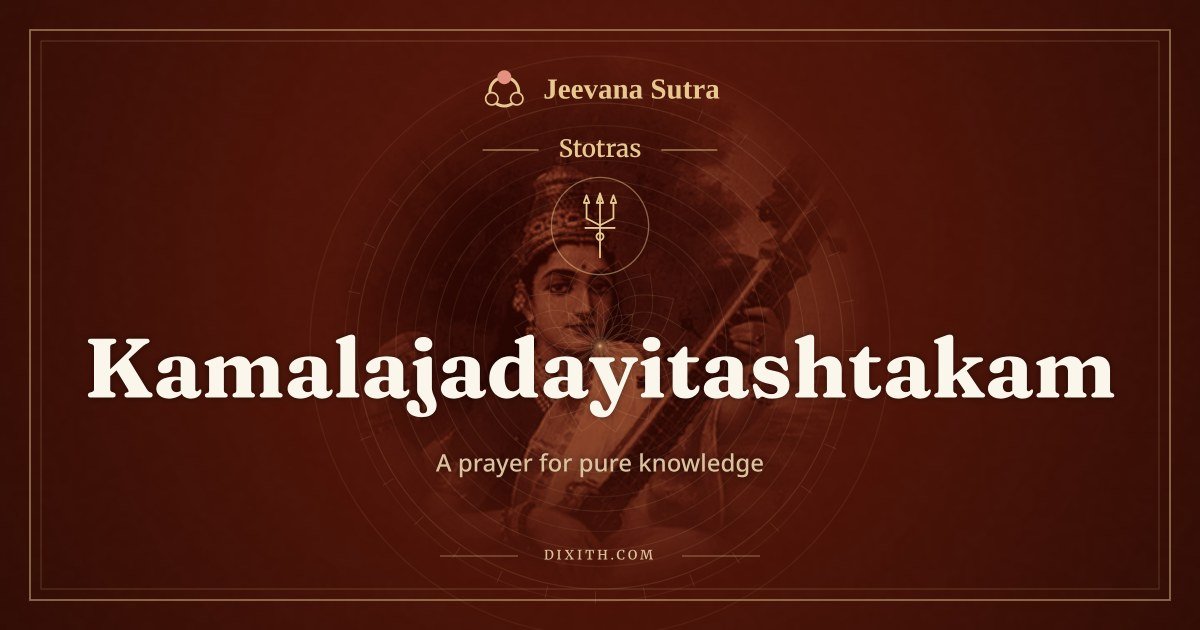
The Kamalajadayitashtakam is an eight verse hymn praising Sharadamba, who dwells at Sringeri on the bank of the Tunga. Kamalaja is Brahma, born of the lotus, and Kamalajadayita is his consort, Sharada.
The last line is the same in all eight verses: grant me pure knowledge and a pure mind, O consort of Brahma, and quickly. Before that refrain each verse adds one picture of the Goddess and one more request.
Meaning of the verses
- 1
O dweller on the Sringeri hill, whose lotus feet are served by sages led by Shuka, whose bodily radiance dims the moon and Indra’s white elephant, mother of speech, worshipped gladly by Shiva, Vishnu and the chief gods, give me pure knowledge and a pure mind, quickly. - 2
At the start of the Kali age, begged by the great gods, Shiva, lord of Parvati, came in the form of an ascetic wishing to strengthen the Vedic path. He installed an image of you on the Sringa hill and worshipped with many hymns. You, wearing the half moon in your hair, give me pure knowledge and a pure mind, quickly. - 3
Destroy the mass of sins I made over many births, soon give me a store of merit, faith in God, respect for the scriptures and the words of the guru, and firm devotion. Let respect stay firm toward the gods, teachers and the twice born, and among your devotees. Give me pure knowledge and a pure mind, quickly. - 4
O Goddess whose lotus hands shine with the knowledge mudra, the rosary and the pot of nectar, skilled in giving knowledge quickly even to the dull, the deaf and the mute who bow to you, uproot swiftly the inner foes born with me, desire and the rest, and give me pure knowledge and a pure mind, quickly. - 5
Give a steady mind for the duties proper to me, bodily strength for that, long life, fame known in the three worlds, and distaste for the path of sin. Give good company and the chance to hear good stories always, O ocean of mercy, and give pure knowledge and a pure mind, quickly. - 6
Mother, I have never worshipped your lotus feet with many flowers in devotion, and I, dull and lazy, cannot sing your virtues in fine verse. Though I am speechless and without service, show me a matchless mercy as a mother does to a child, and give pure knowledge and a pure mind, quickly. - 7
Quickly grant me the auspicious wealth beginning with calm, the discernment of the eternal from what is other than it, dispassion and the wish for liberation. O Goddess served by Lakshmi and Parvati, whose feet are worshipped by the lotus hands of great yogis such as Vidyatirtha, give pure knowledge and a pure mind, quickly. - 8
Quickly grant me, whose self is being and awareness, listening, reflection and deep meditation, and make this mind rest always gladly in nirvikalpa samadhi, free of mental constructs. O Goddess seated on the royal seat of the Sri Chakra in the shining shrine on the lap of the Tunga bank, give pure knowledge and a pure mind, quickly.
About this hymn
The source does not name the author. What the text itself shows is Sringeri, the Tunga bank, an ascetic form in which Shiva came, the worship by yogis such as Vidyatirtha, and the seat of the Sri Chakra.
The requests climb step by step: first knowledge, faith and devotion, then health and good company, and last discernment, dispassion and meditation. This mirrors the order of practice in the Advaita tradition.
The metre is sragdhara, with 21 syllables in each line made of three groups of seven. Because the fourth line is the same in all eight verses, the hymn is easy to learn by heart.
The text was available on the Sringeri Sri Sharada Peetham website in Devanagari only. We converted it to Kannada script and removed the compound hyphens. We made no other correction, and the text stands as in the source.
Source: the stotra section of the Sringeri Sri Sharada Peetham website (sringeri.net). Where readings differ, the difference is noted here.
For life today
When we open the kitchen window in the morning, light comes in. We need do nothing else, only open it. The request of this hymn is the same: to keep the window of the mind open for a clear mind.
The honesty of the sixth verse teaches too. To ask while admitting that our worship has been scanty is the beginning of humility.
Noticed a mistake or a different reading? Tell us.



Leave a comment