
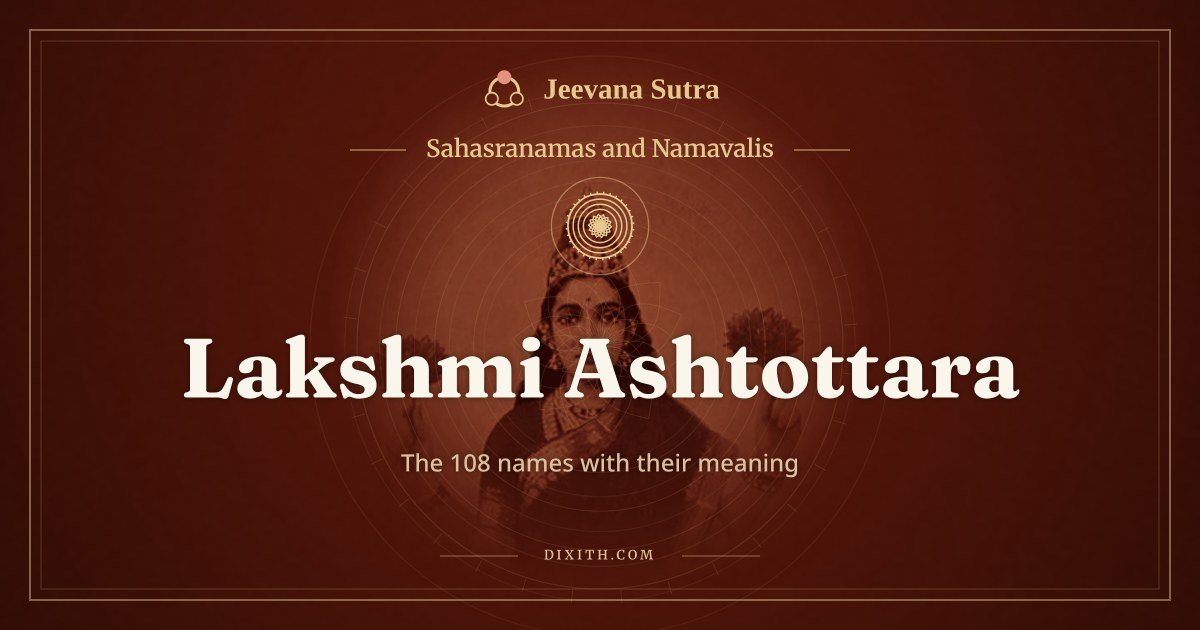
This namavali, which opens with Om Prakrityai namah, is recited on Fridays, at the Varamahalakshmi vrata and at the Lakshmi puja of Deepavali. In many homes a pinch of kumkuma or a flower is offered with each name.
The same hundred and eight names also exist in verse as the Sri Lakshmi Ashtottara Shatanama Stotram, which has its own page on this site. Here we give the namavali form used for archana, with the names in groups of ten and a meaning for each. The lotus, the moon and the ocean of milk are images that return again and again in this list.
Meaning of the names
Names 1 to 10
Primal nature, the source from which all arises.
She who is also the many forms that nature unfolds into.
Knowledge itself.
She who brings good to all beings.
Faith embodied.
Splendour and prosperity embodied.
The fragrant one, and the form of the wish-granting cow.
She whose nature is the Supreme Self.
Speech itself.
She who dwells in the lotus.
Names 11 to 20
She who is like the lotus.
The pure one.
She who is svaha, the word spoken when offering oblations to the gods.
She who is svadha, the word spoken when making offerings to the ancestors.
She who is nectar.
The blessed one.
She who shines like gold.
Goddess of fortune and auspiciousness, who watches over her devotees.
Ever flourishing.
The radiant one. The word also means the night.
Names 21 to 30
She who is Aditi, mother of the gods.
She who is Diti, mother of the daityas too, mother of all creation.
The shining one.
She who is the earth, giver of wealth.
She who holds all riches.
She of the lotus.
The lovely, the beloved.
Patience embodied, forbearing as the earth.
She who rose from the ocean of milk.
She who is ever intent on grace.
Names 31 to 40
Intelligence itself.
The sinless one.
Beloved of Hari.
She who is free of sorrow and dispels it.
The immortal, nectar itself.
The radiant. This name also appears as the twenty-third.
Destroyer of the sorrows of the world.
The abode of dharma.
Compassion embodied.
Mother of the worlds.
Names 41 to 50
Lover of the lotus.
She who holds a lotus in her hand.
The lotus-eyed.
Lovely as the lotus.
She who arose from the lotus.
The lotus-faced.
Beloved of Padmanabha, Vishnu.
She who delights, and who delights in Vishnu.
She who wears a garland of lotuses.
The shining goddess.
Names 51 to 60
She who is adorned with lotuses.
She who has the fragrance of the lotus.
She of holy fragrance.
Ever gracious and pleased.
She whose face is turned towards granting grace.
Light and lustre itself.
The moon-faced.
She who is cool and bright as the moon.
Sister of the moon, for both rose from the ocean of milk.
The four-armed.
Names 61 to 70
She who has the form of the moon.
She who shines with splendour.
Cool as the moon.
She who gives rise to joy.
Nourishment itself.
The auspicious one.
She who brings about what is good.
The true one, faithful and virtuous.
The stainless one.
Mother of the universe.
Names 71 to 80
Contentment itself.
Destroyer of poverty.
She who is a lotus pool of love.
The tranquil one.
She who wears white garlands and white garments.
She who is fortune, beauty and all that is auspicious.
She who shines like the sun.
She who dwells in the bilva tree, which the Sri Sukta also names as hers.
The beautifully formed, the excellent one.
The renowned one.
Names 81 to 90
She who is the earth that bears all wealth.
She of graceful limbs, and generous.
Graceful as a doe, and golden in colour.
She who wears a golden garland.
She who gives wealth and grain.
Success itself, who brings undertakings to fruit.
She who embodies a woman’s gentleness.
Giver of what is good.
She who dwells in the palaces of kings and brings them joy.
Lakshmi who grants boons.
Names 91 to 100
Giver of riches.
The auspicious one.
She who is surrounded by a rampart of gold.
Daughter of the ocean.
Victory itself.
The auspicious goddess.
She who dwells on the chest of Vishnu.
Consort of Vishnu.
She whose eyes are full of grace.
She who takes her place beside Narayana.
Names 101 to 108
She who drives away poverty.
The goddess. This name also appears as the fiftieth.
She who wards off every trouble.
She who is the nine Durgas.
She who is Mahakali.
She who is the very nature of Brahma, Vishnu and Shiva.
She who knows past, present and future.
Sovereign of the worlds.
About this namavali
The names of this namavali are those that appear in verse in the Sri Lakshmi Ashtottara Shatanama Stotram. That hymn is framed as Ishvara’s teaching to the Devi, and its source text is not firmly known. A page with its meaning is on this site separately.
For names 28 and 29 our source also gives the variants Kamakshi and Krodhasambhava. We print the more common Kshama and Kshirodasambhava, the same choice we made on the stotra page. Dipta (23 and 36) and Devi (50 and 102) each occur twice, and we have left them so.
Bilvanilaya, Hiranmayi, Hiranyaprakara, Harini, Hemamalini and Padmamaladhara recall the images of the Sri Sukta in the appendix to the Rig Veda. The closing names, Navadurga, Mahakali and Bhuvaneshvari, see Lakshmi as one power of the Great Goddess.
Sources: several. Where readings differ, the difference is noted here.
For life today
Alongside Dhanadhanyakari and Vasuprada, this list also holds Tushti, Pushti, Shraddha and Kshama. In the custom of inviting the neighbours for turmeric and kumkuma on the day of the Varamahalakshmi vrata, and sending them home with a bagina of gifts, it is that second kind of Lakshmi who is seen: the joy of sharing.
Noticed a mistake or a different reading? Tell us.
Leave a comment