
ಏಳೂ ಚಕ್ರಗಳು · ಮುಂದಿನದು: ಸ್ವಾಧಿಷ್ಠಾನ
ಆಕೆ ಮಲಗಿದ್ದಾಳೆ.
ಕಮಲದ ದಂಟಿನೊಳಗಿನ ನೂಲಿನಷ್ಟೇ ಸೂಕ್ಷ್ಮವಾದ ಆಕೆ, ತಾನಾಗಿಯೇ ಮೂಡಿದ ಪುಟ್ಟ ಸ್ವಯಂಭೂ ಲಿಂಗಕ್ಕೆ ಮೂರೂವರೆ ಸುತ್ತು ಸುತ್ತಿಕೊಂಡು ಮಲಗಿದ್ದಾಳೆ. ಲಿಂಗದ ತುದಿಯ ರಂಧ್ರದ ಮೇಲೆ ಆಕೆ ಬಾಯಿಯಿಟ್ಟಿದ್ದಾಳೆ. ಹೊಸ ಮಿಂಚಿನ ಸೆಳಕಿನಂತೆ ಆಕೆ ಹೊಳೆಯುತ್ತಾಳೆ; ಜೇನುನೊಣಗಳ ಹಿಂಡು ಝೇಂಕರಿಸುವಂತೆ ಮೆಲ್ಲಗೆ ಗುನುಗುತ್ತಿದ್ದಾಳೆ.
ಇವಳೇ ಕುಂಡಲಿನಿ. ಚಕ್ರಗಳಲ್ಲಿ ಎಲ್ಲಕ್ಕಿಂತ ಕೆಳಗಿರುವ ಈ ಮೂಲಾಧಾರ ಕಮಲವೇ ಆಕೆಯ ನೆಲೆ. ಸೌಂದರ್ಯ ಲಹರಿಯಲ್ಲಿ ಕುಂಡಲಿನಿಯ ಪ್ರತಿಯೊಂದು ಏರುವಿಕೆಯೂ ಇಲ್ಲಿಂದಲೇ ಶುರು; ಪ್ರತಿಯೊಂದು ಮರಳುವಿಕೆಯೂ ಇಲ್ಲಿಗೇ ಮುಗಿಯುತ್ತದೆ.
ಈ ಪುಟದಲ್ಲಿಹೆಸರು · ಇದು ಎಲ್ಲಿದೆ? · ಗ್ರಂಥಗಳು ವರ್ಣಿಸುವ ಕಮಲದ ರೂಪ · ಷಟ್ಚಕ್ರ ನಿರೂಪಣ ಏನು ಹೇಳುತ್ತದೆ? · ಸೌಂದರ್ಯ ಲಹರೀ ಏನು ಹೇಳುತ್ತದೆ? · ಲಲಿತಾ ಸಹಸ್ರನಾಮ ಏನು ಹೇಳುತ್ತದೆ? · ಎರಡು ಗ್ರಂಥಗಳು, ಒಂದೇ ಕಮಲ · ಅಂತರಂಗದ ಬದುಕಿಗೆ ಇದರ ಅರ್ಥವೇನು? · ದೇಹದ ಈ ಜಾಗದಲ್ಲಿ ಏನಿದೆ? · ಆಕರಗಳು
ಹೆಸರು
ಮೂಲ ಎಂದರೆ ಬೇರು. ಆಧಾರ ಎಂದರೆ ಆಸರೆ. ಮೂಲಾಧಾರ ಎಂದರೆ ಬೇರಿನ ಆಸರೆ ಎಂದರ್ಥ. ಸುಷುಮ್ನಾ ನಾಡಿಯುದ್ದಕ್ಕೂ ಮೇಲಕ್ಕೇಳುವ ಆರೂ ಕಮಲಗಳಿಗೆ ಇದು ಬೇರು, ಅವು ನೆಲೆನಿಂತಿರುವ ನೆಲವೂ ಹೌದು.
ಇದು ಎಲ್ಲಿದೆ?
ಷಟ್ಚಕ್ರ ನಿರೂಪಣ ಗ್ರಂಥವು ಇದನ್ನು ಸುಷುಮ್ನೆಯ ತೀರಾ ಕೆಳಭಾಗದಲ್ಲಿ, ಅಂದರೆ ‘ಜನನಾಂಗಗಳ ಕೆಳಗೆ ಹಾಗೂ ಗುದದ ಮೇಲೆ’ ಇರಿಸುತ್ತದೆ (ಶ್ಲೋಕ 4). ನೆಲದ ಮೇಲೆ ಚಕ್ಕಳಮಕ್ಕಳ ಹಾಕಿ ಕುಳಿತಾಗ, ನಮ್ಮ ದೇಹದ ಈ ಭಾಗವೇ ನೆಲಕ್ಕೆ ಎಲ್ಲಕ್ಕಿಂತ ಹತ್ತಿರದಲ್ಲಿರುತ್ತದೆ.
ಈ ಕಮಲವು ಸುಷುಮ್ನೆಯ ಬಾಯಿಗೆ ಅಂಟಿಕೊಂಡಿದೆ. ಇದರ ತಲೆ ಕೆಳಕ್ಕೆ ಬಾಗಿದೆ ಎಂದು ಗ್ರಂಥ ಹೇಳುತ್ತದೆ. ಏಕೆ ಎಂಬುದನ್ನು ವ್ಯಾಖ್ಯಾನಕಾರರು ಎತ್ತಿಕೊಡುವ ಇನ್ನೊಂದು ತಂತ್ರ ಗ್ರಂಥ ಹೇಳುತ್ತದೆ. ಸಾಮಾನ್ಯ ಬದುಕಿನಲ್ಲಿ ಈ ಕಮಲಗಳು ಕೆಳಮುಖವಾಗಿಯೇ ಇರುತ್ತವೆ. ಆದರೆ ಮೂಲದೆಡೆಗೆ ಮರಳುವ ಹಾದಿಯಲ್ಲಿ, ಅವು ಮೇಲ್ಮುಖವಾಗಿ ತಿರುಗಿದಂತೆ ಕಾಣುತ್ತವೆ. ನಮ್ಮ ಚಿತ್ರ, ಧ್ಯಾನದಲ್ಲಿ ಕಾಣುವಂತೆ, ಇದನ್ನು ಮೇಲ್ಮುಖವಾಗಿ ತೋರಿಸುತ್ತದೆ.
ಗ್ರಂಥಗಳು ವರ್ಣಿಸುವ ಕಮಲದ ರೂಪ
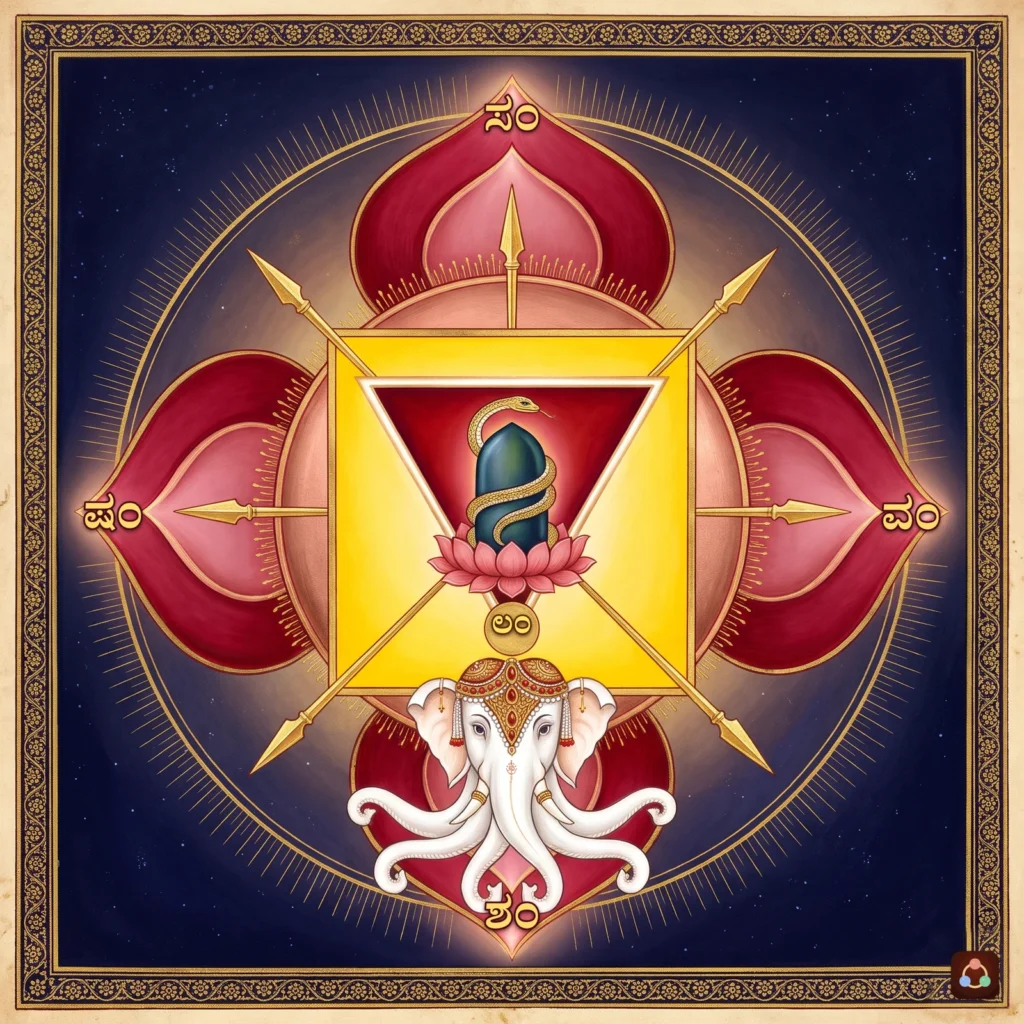
| ದಳಗಳು | ನಾಲ್ಕು, ಕೆಂದಾವರೆಯಂತೆ ಕೆಂಪು |
| ದಳಗಳ ಮೇಲಿನ ಅಕ್ಷರಗಳು | ವಂ ಶಂ ಷಂ ಸಂ, ಚಿನ್ನದ ಬಣ್ಣದಲ್ಲಿ, ಬಲದಿಂದ ಸುತ್ತಿ ಓದಬೇಕು |
| ತತ್ತ್ವ | ಪೃಥ್ವಿ. ಷಟ್ಚಕ್ರ ನಿರೂಪಣ ಮತ್ತು ಸೌಂದರ್ಯ ಲಹರೀ ಎರಡೂ ಒಪ್ಪುತ್ತವೆ. |
| ಅದರ ಗುಣ | ಗಂಧ (ವಾಸನೆ) |
| ಆಕಾರ | ಎಂಟು ಹೊಳೆಯುವ ಶೂಲಗಳಿರುವ ಹಳದಿ ಚೌಕ |
| ಬೀಜ | ಲಂ, ಹಳದಿ, ನಾಲ್ಕು ಕೈಗಳು, ಕೈಯಲ್ಲಿ ವಜ್ರಾಯುಧ, ಐರಾವತದ ಮೇಲೆ ಕುಳಿತಿದೆ |
| ದೇವತೆ | ಬಾಲ ಬ್ರಹ್ಮ: ಕೆಂಪು ಬಣ್ಣ, ನಾಲ್ಕು ಮುಖಗಳು, ನಾಲ್ಕು ಕೈಗಳು |
| ಅಧಿದೇವತೆ | ಡಾಕಿನೀ (ಷಟ್ಚಕ್ರ ನಿರೂಪಣ); ಸಾಕಿನೀ (ಲಲಿತಾ ಸಹಸ್ರನಾಮ) |
| ಮಧ್ಯದಲ್ಲಿ | ಕಂದರ್ಪ ವಾಯು ಇರುವ ತ್ರೈಪುರ ತ್ರಿಕೋನ; ಸ್ವಯಂಭೂ ಲಿಂಗ; ಮೂರೂವರೆ ಸುತ್ತು ಸುತ್ತಿಕೊಂಡಿರುವ ಕುಂಡಲಿನಿ |
| ಗ್ರಂಥಿ | ಬ್ರಹ್ಮ ಗ್ರಂಥಿ |
| ಕಿರಣಗಳು | ಐವತ್ತಾರು (ಸೌಂದರ್ಯ ಲಹರೀ 14) |
| ಸೌಂದರ್ಯ ಲಹರೀ | ಶ್ಲೋಕ 9, 10, 14 ಮತ್ತು 41 |
ಷಟ್ಚಕ್ರ ನಿರೂಪಣ ಏನು ಹೇಳುತ್ತದೆ?
ಪೂರ್ಣಾನಂದರ ಷಟ್ಚಕ್ರ ನಿರೂಪಣ, ಅಂದರೆ ‘ಆರು ಕೇಂದ್ರಗಳ ವಿವರಣೆ’ ಗ್ರಂಥವು ಮೂಲಾಧಾರಕ್ಕೆ 4ರಿಂದ 13ರವರೆಗಿನ ಹತ್ತು ಶ್ಲೋಕಗಳನ್ನು ಮೀಸಲಿಟ್ಟಿದೆ. ಚಕ್ರಗಳ ಸಾಂಪ್ರದಾಯಿಕ ಚಿತ್ರಗಳೆಲ್ಲವೂ ಹೆಚ್ಚಾಗಿ ಮೂಡಿಬಂದಿರುವುದು ಇದರಿಂದಲೇ. ಅದು ತೋರಿಸುವುದನ್ನು ಹೊರಗಿನಿಂದ ಒಳಕ್ಕೆ ನೋಡೋಣ.
ದಳಗಳು. ಕೆಂದಾವರೆಯಂತಹ ಗಾಢ ಕೆಂಪು ಬಣ್ಣದ ನಾಲ್ಕು ದಳಗಳು. ಅವುಗಳ ಮೇಲೆ ಹೊಳೆಯುವ ಚಿನ್ನದ ಬಣ್ಣದಲ್ಲಿ ವ, ಶ, ಷ ಮತ್ತು ಸ ಎಂಬ ನಾಲ್ಕು ಅಕ್ಷರಗಳಿವೆ. ಶ ಮತ್ತು ಷ ಬೇರೆ ಬೇರೆ ಅಕ್ಷರಗಳು: ಶ ತಾಲವ್ಯ (ನಾಲಿಗೆ ಅಂಗುಳಕ್ಕೆ ತಾಗುತ್ತದೆ), ಷ ಮೂರ್ಧನ್ಯ (ನಾಲಿಗೆಯ ತುದಿ ಹಿಂದಕ್ಕೆ ಮಡಚುತ್ತದೆ). ಈ ಅಕ್ಷರಗಳನ್ನು ಬಲದಿಂದ ಶುರುಮಾಡಿ ಸುತ್ತಿ ಓದಬೇಕು.
ಭೂಮಿಯ ಚೌಕ. ಕಮಲದ ನಡುವೆ ಒಂದು ಚೌಕವಿದೆ. ಅದು ಪೃಥ್ವಿ ತತ್ವಕ್ಕೆ, ಅಂದರೆ ಭೂಮಿಯ ಅಂಶಕ್ಕೆ ಸೇರಿದ ಜಾಗ. ಅದು ‘ಮಿಂಚಿನಂತೆ ಸುಂದರವಾದ’ ಹಳದಿ ಬಣ್ಣದಲ್ಲಿದೆ; ಅದರ ಎಂಟು ಕಡೆಗಳಿಂದ ಹೊಳೆಯುವ ಎಂಟು ಶೂಲಗಳು ಹೊರಚಾಚಿಕೊಂಡಿವೆ (ಶ್ಲೋಕ 5).
ಬೀಜಾಕ್ಷರ ಮತ್ತು ಬ್ರಹ್ಮ. ಚೌಕದ ಒಳಗೆ ಭೂಮಿಯ ಬೀಜಾಕ್ಷರವಾದ ‘ಲಂ’ ಇದೆ. ಅದೂ ಕೂಡ ಹಳದಿ ಬಣ್ಣವೇ. ಗ್ರಂಥವು ಇದನ್ನು ಒಂದು ರೂಪವಾಗಿ ಚಿತ್ರಿಸುತ್ತದೆ: ನಾಲ್ಕು ಕೈಗಳು, ಕೈಯಲ್ಲಿ ವಜ್ರಾಯುಧ, ಆನೆಗಳ ರಾಜನಾದ ಐರಾವತದ ಮೇಲೆ ಕುಳಿತಿದೆ (ಶ್ಲೋಕ 5 ಮತ್ತು 6). ಅದರ ಮಡಿಲಲ್ಲಿ ‘ಉದಯಿಸುವ ಸೂರ್ಯನಂತೆ ಬೆಳಗುವ’ ಬಾಲ ಬ್ರಹ್ಮ ಕುಳಿತಿದ್ದಾನೆ. ಅವನಿಗೆ ನಾಲ್ಕು ಮುಖಗಳು, ನಾಲ್ಕು ಕೈಗಳು. ಕೈಗಳಲ್ಲಿ ದಂಡ, ಕಮಂಡಲು, ಜಪಮಾಲೆ; ನಾಲ್ಕನೆಯ ಕೈ ‘ಹೆದರಬೇಡ’ ಎನ್ನುವ ಅಭಯ ಮುದ್ರೆಯಲ್ಲಿದೆ ಎನ್ನುತ್ತದೆ ವ್ಯಾಖ್ಯಾನ.
ಡಾಕಿನೀ. ಈ ಕಮಲದಲ್ಲಿ ಈ ಕೇಂದ್ರದ ಅಧಿದೇವತೆಯಾದ ಡಾಕಿನೀ ನೆಲೆಸಿದ್ದಾಳೆ. ಆಕೆಯ ಮೈಬಣ್ಣ ಕೆಂಪು, ಕಣ್ಣುಗಳೂ ಕೆಂಪು, ನಾಲ್ಕು ತೋಳುಗಳುಳ್ಳವಳು. ‘ಏಕಕಾಲದಲ್ಲಿ ಉದಯಿಸುವ ಅನೇಕ ಸೂರ್ಯರ ಪ್ರಭೆಯಂತೆ’ ಆಕೆ ಬೆಳಗುತ್ತಾಳೆ (ಶ್ಲೋಕ 7). ಆಕೆಯು ‘ನಿತ್ಯ ಶುದ್ಧವಾದ ಪ್ರಜ್ಞೆಯ ಜ್ಞಾನವನ್ನು’ ನೀಡುತ್ತಾಳೆ ಎನ್ನುತ್ತದೆ ಗ್ರಂಥ; ಅಂದರೆ ಆಕೆಯ ಧ್ಯಾನದಿಂದ ತತ್ತ್ವಜ್ಞಾನ, ಅಂದರೆ ವಸ್ತುಗಳ ನಿಜವಾದ ಸ್ವರೂಪದ ಅರಿವು ಸಿಗುತ್ತದೆ.
ತ್ರಿಕೋನ. ಚೌಕದೊಳಗೆ ತುದಿಯು ಕೆಳಮುಖವಾಗಿರುವ ಮಿಂಚಿನಂತಹ ಮೃದುವಾದ ತ್ರಿಕೋನವಿದೆ. ತ್ರಿಪುರಾ ದೇವಿ ಅಲ್ಲಿ ನೆಲೆಸಿರುವುದರಿಂದ ಅದಕ್ಕೆ ತ್ರೈಪುರ ಎಂದು ಹೆಸರು. ಅದರೊಳಗೆ ಬಂಧುಜೀವ ಹೂವಿಗಿಂತಲೂ ಗಾಢ ಕೆಂಪಾದ ಕಂದರ್ಪ ಎಂಬ ವಾಯು ಚಲಿಸುತ್ತದೆ. ಇದು ಕೆಳಮುಖವಾಗಿ ಚಲಿಸುವ ಅಪಾನ ವಾಯುವಿನ ಒಂದು ಭಾಗ ಎಂದು ವ್ಯಾಖ್ಯಾನವು ವಿವರಿಸುತ್ತದೆ. ಜೊತೆಗೆ ಇದು ಏಕೆ ಮುಖ್ಯ ಎಂಬುದಕ್ಕೆ ಒಂದು ಸುಂದರ ಚಿತ್ರಣವನ್ನೂ ನೀಡುತ್ತದೆ. ದಾರಕ್ಕೆ ಕಟ್ಟಿದ ಗಿಡುಗ ಹಾರಲು ಯತ್ನಿಸಿದಂತೆ, ಪ್ರಾಣ ಮತ್ತು ಅಪಾನ ವಾಯುಗಳು ಒಂದನ್ನೊಂದು ಎಳೆದಾಡುತ್ತಿರುತ್ತವೆ. ಹೀಗೆ ಒಂದನ್ನೊಂದು ದೇಹದಿಂದ ಹೊರಹೋಗದಂತೆ ಹಿಡಿದಿಟ್ಟುಕೊಳ್ಳುತ್ತವೆ (ಶ್ಲೋಕ 8).
ಲಿಂಗ. ತ್ರಿಕೋನದೊಳಗೆ ‘ಸ್ವಯಂಭೂ’ ಅಂದರೆ ತಾನಾಗಿಯೇ ಮೂಡಿದ ಲಿಂಗರೂಪಿ ಶಿವನಿದ್ದಾನೆ. ವ್ಯಾಖ್ಯಾನದ ಪ್ರಕಾರ ಅದು ಇನ್ನೂ ಬಿಚ್ಚಿಕೊಳ್ಳದ ಚಿಗುರಿನಂತಿದೆ: ಕೆಳಗೆ ಅಗಲ, ಮೇಲೆ ಮೊನಚು. ಬಣ್ಣ ಕಡು ನೀಲಿ ಹಸಿರು. ಅದರ ಬೆಳಕು ಹುಣ್ಣಿಮೆಯ ಚಂದ್ರನ ಬೆಳಕಿನಂತೆ ತಂಪಾಗಿದೆ. ಕಾಶಿಯಲ್ಲಿ ನೆಲೆಸಿದಷ್ಟೇ ಸಂತೋಷದಿಂದ ಶಿವನು ಇಲ್ಲಿ ವಾಸಿಸುತ್ತಾನೆ ಎನ್ನುತ್ತದೆ ಗ್ರಂಥ (ಶ್ಲೋಕ 9).
ಕುಂಡಲಿನಿ. ಈ ಪುಟದ ಆರಂಭದಲ್ಲಿ ಹೇಳಿದಂತೆ, ಆ ಲಿಂಗದ ಮೇಲೆ ಕುಂಡಲಿನಿ ಮಲಗಿದ್ದಾಳೆ (ಶ್ಲೋಕ 10 ಮತ್ತು 11). ಗದ್ಯವಿರಲಿ ಪದ್ಯವಿರಲಿ, ಸಂಸ್ಕೃತದಲ್ಲಿರಲಿ ಬೇರೆ ಯಾವ ಭಾಷೆಯಲ್ಲೇ ಇರಲಿ, ಎಲ್ಲ ಮಾತಿನ ಮೂಲ ಆಕೆಯೇ ಎನ್ನುತ್ತದೆ ಗ್ರಂಥ. ಉಸಿರಾಟದ ಒಳ-ಹೊರಗಿನ ಚಲನೆಯ ಮೂಲಕ ಆಕೆ ಸಕಲ ಜೀವಿಗಳನ್ನೂ ಬದುಕಿಸಿಡುತ್ತಾಳೆ.
ಪರಾ. ಆಕೆಯ ಮೇಲ್ಭಾಗದಲ್ಲಿ, ಸೂಕ್ಷ್ಮಕ್ಕಿಂತಲೂ ಸೂಕ್ಷ್ಮವಾದ ಪರಮ ಶಕ್ತಿ ನೆಲೆಸಿದ್ದಾಳೆ ಎನ್ನುತ್ತದೆ 12ನೇ ಶ್ಲೋಕ. ಶಾಶ್ವತ ಆನಂದದಿಂದ ಹರಿದುಬರುವ ಅಮೃತದ ಧಾರೆಯನ್ನು ಆಕೆ ಹಿಡಿದಿಟ್ಟುಕೊಂಡಿದ್ದಾಳೆ.
ಫಲಶ್ರುತಿ. ಇಲ್ಲಿ ಆಕೆಯನ್ನು ಧ್ಯಾನಿಸುವುದರಿಂದ ಏನು ಫಲ ಸಿಗುತ್ತದೆ ಎಂಬುದನ್ನು 13ನೇ ಶ್ಲೋಕ ಹೇಳುತ್ತದೆ: ವಾಕ್ ಸಿದ್ಧಿ, ವಿದ್ವತ್ತು, ಮನಸ್ಸಿನ ಸಂತೋಷ ಮತ್ತು ರೋಗಮುಕ್ತಿ. ಇವು ಧ್ಯಾನದ ಬಗ್ಗೆ ಪರಂಪರೆ ಕೊಡುವ ಭರವಸೆಗಳು. ವೈದ್ಯಕೀಯ ಭರವಸೆಗಳಲ್ಲ.
ಸೌಂದರ್ಯ ಲಹರೀ ಏನು ಹೇಳುತ್ತದೆ?
ನಾಲ್ಕು ಶ್ಲೋಕಗಳಲ್ಲಿ ಮೂಲಾಧಾರದ ಪ್ರಸ್ತಾಪ ಬರುತ್ತದೆ.
9ನೇ ಶ್ಲೋಕವು ಏರುವಿಕೆಯ ಆರಂಭದಲ್ಲಿ ಭೂಮಿಯ ತತ್ವವನ್ನು ಇಲ್ಲಿ ಇರಿಸುತ್ತದೆ. 1937 ರ ಅಡ್ಯಾರ್ ವ್ಯಾಖ್ಯಾನವು ನೆನಪಿಡಬೇಕಾದ ಒಂದು ಮಾತು ಸೇರಿಸುತ್ತದೆ: ಮೂಲಾಧಾರ ಮತ್ತು ಅದರ ಪೃಥ್ವಿ ತತ್ವವಿಲ್ಲದಿದ್ದರೆ, ದೇಹವು ತನ್ನ ಸಮತೋಲನ ಮತ್ತು ಸ್ಥಿರತೆಯನ್ನು ಕಳೆದುಕೊಳ್ಳುತ್ತಿತ್ತು. ಶ್ಲೋಕ 9 ಓದಿ
10ನೇ ಶ್ಲೋಕವು ಕುಂಡಲಿನಿಯನ್ನು ಮರಳಿ ಮನೆಗೆ ತರುತ್ತದೆ. ಮೇಲೆ ತನ್ನ ಪತಿಯನ್ನು ಸೇರಿದ ನಂತರ, ಆಕೆ ಮತ್ತೆ ಕೆಳಗೆ ಇಳಿದುಬಂದು, ಮೂರೂವರೆ ಸುತ್ತು ಸುತ್ತಿಕೊಂಡು ಮೂಲಾಧಾರದ ಕುಳಿಯಲ್ಲಿ ಮಲಗುತ್ತಾಳೆ. ಶ್ಲೋಕ 10 ಓದಿ
14ನೇ ಶ್ಲೋಕವು ಪ್ರತಿ ಕೇಂದ್ರದಲ್ಲಿರುವ ಬೆಳಕಿನ ಕಿರಣಗಳನ್ನು ಎಣಿಸುತ್ತದೆ. ಭೂಮಿಯ ಕೇಂದ್ರವಾದ ಮೂಲಾಧಾರದಲ್ಲಿ ಐವತ್ತಾರು ಕಿರಣಗಳಿವೆ. ನಮ್ಮ ಚಿತ್ರದಲ್ಲಿ ಕಮಲದ ಸುತ್ತಲೂ ಇರುವ ಸೂಕ್ಷ್ಮ ಕಿರಣಗಳ ವೃತ್ತವೇ ಇದನ್ನು ಸೂಚಿಸುತ್ತದೆ. ಶ್ಲೋಕ 14 ಓದಿ
ಆಜ್ಞಾ ಚಕ್ರದಿಂದ ಮೂಲಾಧಾರದವರೆಗೆ ಒಂದೊಂದೇ ಕೇಂದ್ರಗಳನ್ನು ವಿವರಿಸುತ್ತಾ ಕೆಳಗಿಳಿಯುವ ಆರು ಶ್ಲೋಕಗಳಲ್ಲಿ 41ನೇ ಶ್ಲೋಕವೇ ಕೊನೆಯದ್ದು.
ತವಾಧಾರೇ ಮೂಲೇ ಸಹ ಸಮಯಯಾ ಲಾಸ್ಯಪರಯಾನವಾತ್ಮಾನಂ ಮನ್ಯೇ ನವರಸಮಹಾತಾಂಡವನಟಮ್ ।ಉಭಾಭ್ಯಾಮೇತಾಭ್ಯಾಮ್ ಉದಯವಿಧಿಮುದ್ದಿಶ್ಯ ದಯಯಾಸನಾಥಾಭ್ಯಾಂ ಜಜ್ಞೇ ಜನಕಜನನೀಮಜ್ಜಗದಿದಮ್
ಅರ್ಥಭೂಮಿತತ್ವವಿರುವ ನಿನ್ನ ಮೂಲಾಧಾರ ಚಕ್ರದಲ್ಲಿ, ಒಂಬತ್ತೂ ರಸಗಳಿಂದ ತುಂಬಿ ಮಹಾ ತಾಂಡವ ನೃತ್ಯ ಮಾಡುವ ನವಾತ್ಮನನ್ನು (ಶಿವನನ್ನು), ಮತ್ತು ಮೃದುವಾದ ಲಾಸ್ಯ ನೃತ್ಯದಲ್ಲಿ ತಲ್ಲೀನಳಾದ ಸಮಯಳನ್ನು ನಾನು ಧ್ಯಾನಿಸುತ್ತೇನೆ. ಜಗತ್ತನ್ನು ಹೊಸದಾಗಿ ಸೃಷ್ಟಿಸಬೇಕೆಂಬ ಕರುಣೆಯಿಂದ ಇವರಿಬ್ಬರೂ ಒಂದಾಗಿರುವುದರಿಂದಲೇ, ಈ ಜಗತ್ತಿಗೊಬ್ಬ ತಂದೆ ಮತ್ತು ತಾಯಿಯಿದ್ದಾರೆ. ಶ್ಲೋಕ 41 ಓದಿ
ಇಲ್ಲಿ ಶಿವನು ನವರಸಗಳಿಂದ ತುಂಬಿದ, ಬಿರುಸಿನ ಮಹಾ ತಾಂಡವವನ್ನು ಆಡುವ ನವಾತ್ಮ. ಆತನ ಪಕ್ಕದಲ್ಲಿ ಜಗನ್ಮಾತೆಯು ಸಮಯಾ ರೂಪದಲ್ಲಿ ಮೃದುವಾದ ಲಾಸ್ಯ ನೃತ್ಯವನ್ನು ಮಾಡುತ್ತಿದ್ದಾಳೆ. ಇವರಿಬ್ಬರೂ ಒಂದಾದುದರಿಂದಲೇ ಜಗತ್ತಿಗೆ ತಂದೆ-ತಾಯಿಗಳು ಸಿಕ್ಕಿದ್ದಾರೆ ಎನ್ನುತ್ತಾರೆ ಕವಿ.
1937 ರ ಪುಸ್ತಕದಲ್ಲಿರುವ ವ್ಯಾಖ್ಯಾನವು ಲಕ್ಷ್ಮೀಧರರ ಮಾರ್ಗವನ್ನು ಅನುಸರಿಸುತ್ತದೆ. ಅದು ಇಲ್ಲಿ ಧ್ಯಾನಿಸಬೇಕಾದ ಜೋಡಿಯನ್ನು ಆದಿನಟ ಮತ್ತು ಲಾಸ್ಯೇಶ್ವರಿ ಎಂದು ಹೆಸರಿಸುತ್ತದೆ; ಅವರ ಸುತ್ತಲೂ ಭೂಮಿಯ ಐವತ್ತಾರು ಕಿರಣಗಳಿವೆ. ಜೊತೆಗೆ ‘ಸಮಯಾ’ ಎಂಬ ಪದದ ಅರ್ಥವನ್ನೂ ಅದು ಬಿಡಿಸಿ ಹೇಳುತ್ತದೆ. ಈ ವ್ಯಾಖ್ಯಾನವು ಸಮಯ ಮಾರ್ಗದ ಉಪಾಸನೆಯನ್ನು ಅನುಸರಿಸುತ್ತದೆ. ಇದರಲ್ಲಿ ದೇವಿಯನ್ನು ಕೆಳಗಿನ ಕೇಂದ್ರಗಳಲ್ಲಿ ಹೊರಗಿನ ಆಚರಣೆಗಳಿಂದ ಪೂಜಿಸುವುದಿಲ್ಲ; ಬದಲಿಗೆ ಒಳಗೇ, ಸಹಸ್ರಾರ ಕಮಲದಲ್ಲಿ ಆರಾಧಿಸುತ್ತಾರೆ. ಶ್ಲೋಕ 41 ಓದಿ
ಲಲಿತಾ ಸಹಸ್ರನಾಮ ಏನು ಹೇಳುತ್ತದೆ?
ಲಲಿತಾ ಸಹಸ್ರನಾಮದಲ್ಲಿ ಮೂಲಾಧಾರದ ಉಲ್ಲೇಖ ಎರಡು ಕಡೆ ಬರುತ್ತದೆ.
ಕುಂಡಲಿನಿಯ ಏರುವಿಕೆ (ನಾಮ 99ರಿಂದ 111):
| ಸಂಖ್ಯೆ | ನಾಮ | ಅರ್ಥ |
|---|---|---|
| 99 | ಮೂಲಾಧಾರೈಕನಿಲಯಾ | ಮೂಲಾಧಾರವೇ ಮುಖ್ಯ ನೆಲೆಯಾಗಿರುವವಳು |
| 100 | ಬ್ರಹ್ಮಗ್ರಂಥಿವಿಭೇದಿನೀ | ಬ್ರಹ್ಮ ಗ್ರಂಥಿಯನ್ನು ಭೇದಿಸುವವಳು |
| 101 | ಮಣಿಪೂರಾಂತರುದಿತಾ | ಮಣಿಪೂರದೊಳಗೆ ಉದಯಿಸುವವಳು |
| 102 | ವಿಷ್ಣುಗ್ರಂಥಿವಿಭೇದಿನೀ | ವಿಷ್ಣು ಗ್ರಂಥಿಯನ್ನು ಭೇದಿಸುವವಳು |
| 103 | ಆಜ್ಞಾಚಕ್ರಾಂತರಾಲಸ್ಥಾ | ಆಜ್ಞಾ ಚಕ್ರದೊಳಗೆ ನೆಲೆಸಿರುವವಳು |
| 104 | ರುದ್ರಗ್ರಂಥಿವಿಭೇದಿನೀ | ರುದ್ರ ಗ್ರಂಥಿಯನ್ನು ಭೇದಿಸುವವಳು |
| 105 | ಸಹಸ್ರಾರಾಂಬುಜಾರೂಢಾ | ಸಾವಿರ ದಳಗಳ ಕಮಲವನ್ನು ಏರುವವಳು |
| 106 | ಸುಧಾಸಾರಾಭಿವರ್ಷಿಣೀ | ಅಮೃತದ ಧಾರೆಯನ್ನು ಸುರಿಸುವವಳು |
| 110 | ಕುಂಡಲಿನೀ | ಸುರುಳಿ ಸುತ್ತಿಕೊಂಡಿರುವವಳು |
| 111 | ಬಿಸತಂತುತನೀಯಸೀ | ತಾವರೆಯ ದಂಟಿನೊಳಗಿನ ನೂಲಿನಷ್ಟು ಸೂಕ್ಷ್ಮಳು |
ಮೂಲಾಧಾರದ ಯೋಗಿನಿ (ನಾಮ 514ರಿಂದ 520). ಈ ಭಾಗದಲ್ಲಿ, ಪ್ರತಿಯೊಂದು ಕೇಂದ್ರಕ್ಕೂ ತನ್ನದೇ ಮುಖಗಳು, ಆಯುಧಗಳು, ಶಾರೀರಿಕ ಧಾತು ಮತ್ತು ಇಷ್ಟವಾದ ನೈವೇದ್ಯವನ್ನು ಹೊಂದಿರುವ ಒಬ್ಬೊಬ್ಬ ಯೋಗಿನಿ ದೇವತೆಯಿರುತ್ತಾಳೆ. ಮೂಲಾಧಾರಕ್ಕೆ ಸಾಕಿನೀ ಅಧಿದೇವತೆ.
| ಸಂಖ್ಯೆ | ನಾಮ | ಅರ್ಥ |
|---|---|---|
| 514 | ಮೂಲಾಧಾರಾಂಬುಜಾರೂಢಾ | ಮೂಲಾಧಾರ ಕಮಲದಲ್ಲಿ ಕುಳಿತಿರುವವಳು |
| 515 | ಪಂಚವಕ್ತ್ರಾ | ಐದು ಮುಖಗಳುಳ್ಳವಳು |
| 516 | ಅಸ್ಥಿಸಂಸ್ಥಿತಾ | ಮೂಳೆಗಳಲ್ಲಿ ನೆಲೆಸಿರುವವಳು |
| 517 | ಅಂಕುಶಾದಿಪ್ರಹರಣಾ | ಅಂಕುಶ ಮೊದಲಾದ ಆಯುಧಗಳನ್ನು ಹಿಡಿದವಳು |
| 518 | ವರದಾದಿನಿಷೇವಿತಾ | ವರದಾ ಮೊದಲಾದ ಶಕ್ತಿಗಳ ಸೇವೆ ಪಡೆಯುವವಳು |
| 519 | ಮುದ್ಗೌದನಾಸಕ್ತಚಿತ್ತಾ | ಹೆಸರುಬೇಳೆ ಹಾಕಿ ಮಾಡಿದ ಅನ್ನದಲ್ಲಿ ಪ್ರೀತಿಯುಳ್ಳವಳು |
| 520 | ಸಾಕಿನ್ಯಂಬಾಸ್ವರೂಪಿಣೀ | ಸಾಕಿನೀ ಮಾತೆಯ ರೂಪದಲ್ಲಿರುವವಳು |
ಎರಡು ಗ್ರಂಥಗಳು, ಒಂದೇ ಕಮಲ
ತತ್ತ್ವದ ವಿಷಯದಲ್ಲಿ ಗ್ರಂಥಗಳು ಒಪ್ಪುತ್ತವೆ: ಷಟ್ಚಕ್ರ ನಿರೂಪಣ ಮತ್ತು ಸೌಂದರ್ಯ ಲಹರೀ ಎರಡೂ ಇದನ್ನು ಪೃಥ್ವಿ ತತ್ತ್ವದ ಕೇಂದ್ರ ಎನ್ನುತ್ತವೆ. ಸೌಂದರ್ಯ ಲಹರಿಯಲ್ಲಿ ಪಂಚಭೂತಗಳ ತತ್ವಗಳು ಬದಲಾಗುವುದು ಸ್ವಾಧಿಷ್ಠಾನ ಮತ್ತು ಮಣಿಪೂರ ಚಕ್ರಗಳಲ್ಲಿ ಮಾತ್ರ, ಈ ಕೇಂದ್ರದಲ್ಲಲ್ಲ. ಆದರೆ ಇದನ್ನು ಆಳುವ ದೇವತೆಗಳ ವಿಷಯದಲ್ಲಿ ಗ್ರಂಥಗಳ ನಡುವೆ ಭಿನ್ನಾಭಿಪ್ರಾಯವಿದೆ.
| ಷಟ್ಚಕ್ರ ನಿರೂಪಣ | ಲಲಿತಾ ಸಹಸ್ರನಾಮ | ಸೌಂದರ್ಯ ಲಹರೀ | |
|---|---|---|---|
| ತತ್ತ್ವ | ಪೃಥ್ವಿ | ಪೃಥ್ವಿ (ಶ್ಲೋಕ 9) | |
| ಅಧಿದೇವತೆ | ಡಾಕಿನೀ | ಸಾಕಿನೀ | ನವಾತ್ಮನಾದ ಶಿವ, ಸಮಯಾ ರೂಪದ ತಾಯಿಯೊಂದಿಗೆ (ಶ್ಲೋಕ 41) |
| ರೂಪ | ಕೆಂಪು ಬಣ್ಣ, ಕೆಂಪು ಕಣ್ಣುಗಳು, ನಾಲ್ಕು ಕೈಗಳು | ಐದು ಮುಖಗಳು | |
| ಕೈಗಳಲ್ಲಿ | ಶೂಲ, ಖಟ್ವಾಂಗ, ಖಡ್ಗ ಮತ್ತು ಪಾತ್ರೆ | ಅಂಕುಶ ಮೊದಲಾದ ಆಯುಧಗಳು | |
| ದೇಹದ ಧಾತು | ಚರ್ಮ (ವುಡ್ರಫ್ ಉಲ್ಲೇಖಿಸುವ ಗ್ರಂಥದಂತೆ) | ಮೂಳೆ | |
| ಪ್ರಿಯವಾದ ಆಹಾರ | ಹಾಲಿನಲ್ಲಿ ಬೇಯಿಸಿದ ಅನ್ನ (ಪಾಯಸಾನ್ನ) | ಹೆಸರುಬೇಳೆ ಹಾಕಿದ ಅನ್ನ |
ಅಂತರಂಗದ ಬದುಕಿಗೆ ಇದರ ಅರ್ಥವೇನು?
ಗ್ರಂಥಗಳು ಮೂಲಾಧಾರವನ್ನು ಕೆಲವು ಸರಳ ರೀತಿಗಳಲ್ಲಿ ಅರ್ಥಮಾಡಿಸುತ್ತವೆ.
ಇದು ಎಲ್ಲದಕ್ಕೂ ಆಸರೆಯಾದ ನೆಲೆ. ಇದು ಪೃಥ್ವಿ ತತ್ತ್ವದ ಕೇಂದ್ರ; ಇದರ ಸೂಕ್ಷ್ಮ ಗುಣ ಗಂಧ. 9ನೇ ಶ್ಲೋಕದ ವ್ಯಾಖ್ಯಾನವು ಈ ಪೃಥ್ವಿ ತತ್ವವನ್ನು ದೇಹದ ಸಮತೋಲನ ಮತ್ತು ಸ್ಥಿರತೆಗೆ ಜೋಡಿಸುತ್ತದೆ.
ಇದು ಶಕ್ತಿಯು ಕಾಯುವ ನೆಲೆ. ಸಾಮಾನ್ಯ ಮನುಷ್ಯನ ಬದುಕಿನಲ್ಲಿ ಕುಂಡಲಿನಿ ಇಲ್ಲ ಎಂದೇನಲ್ಲ. ಆಕೆ ನಿದ್ರಿಸುತ್ತಿದ್ದಾಳೆ, ಅಷ್ಟೇ. ಆಕೆಯನ್ನು ಎಚ್ಚರಗೊಳಿಸಿ, ಮೇಲಕ್ಕೇರಿಸುವುದೇ ಈ ಯೋಗದ ಇಡೀ ಸಾಧನೆ; ಮತ್ತು ಹತ್ತನೇ ಶ್ಲೋಕ ಹೇಳುವಂತೆ ಆಕೆ ವಿಶ್ರಾಂತಿ ಪಡೆಯಲು ಮರಳಿ ಬರುವುದು ಕೂಡ ಇಲ್ಲಿಗೇ.
ಇದು ಮಾತು ಹುಟ್ಟುವ ನೆಲೆ. ನಾವು ಆಡುವ ಪ್ರತಿಯೊಂದು ಮಾತೂ ಈ ಕೇಂದ್ರದಿಂದ ಹೊರಡುವ ನಿಶ್ಯಬ್ದ ಧ್ವನಿಯಾದ ‘ಪರಾ’ ವಾಣಿಯಿಂದಲೇ ಶುರುವಾಗುತ್ತದೆ ಎನ್ನುತ್ತವೆ ಗ್ರಂಥಗಳು. ಮೇಲಿನ ಕೇಂದ್ರಗಳ ಮೂಲಕ ಹಾದುಬರುತ್ತಾ ಅದು ಸ್ಪಷ್ಟಗೊಳ್ಳುತ್ತದೆ; ಕೊನೆಗೆ ತುಟಿಗಳ ಮೂಲಕ ನಾವು ಕೇಳುವ ಮಾತಾಗಿ ಹೊರಹೊಮ್ಮುತ್ತದೆ.
ಇದರ ಸಿದ್ಧಿಗಳೇ ಅಂತಿಮ ಗುರಿಯಲ್ಲ. ಈ ಕೇಂದ್ರದ ಮೇಲೆ ಹತೋಟಿ ಸಾಧಿಸಿದರೆ ಅಸಾಮಾನ್ಯ ಸಿದ್ಧಿಗಳು ಒಲಿಯುತ್ತವೆ ಎಂದು ಪರಂಪರೆ ಹೇಳುತ್ತದೆ. ಆದರೆ ಅಂತಹ ಶಕ್ತಿಗಳು ‘ತಪ್ಪಿಸಿಕೊಳ್ಳಬೇಕಾದ ಹೊಂಡಗಳು’ ಎಂದು 1937 ರ ವ್ಯಾಖ್ಯಾನವು ಎಚ್ಚರಿಸುತ್ತದೆ. ಏಕೆಂದರೆ ಅವು ಸಾಧಕನನ್ನು ನೆತ್ತಿಯ ಮೇಲಿರುವ ಸಹಸ್ರಾರವೆಂಬ ಅಂತಿಮ ಗುರಿಯಿಂದ ದಾರಿ ತಪ್ಪಿಸಿಬಿಡುತ್ತವೆ.
ದೇಹದ ಈ ಜಾಗದಲ್ಲಿ ಏನಿದೆ?
ವೈದ್ಯನಾಗಿ, ದೇಹದ ಈ ಭಾಗದಲ್ಲಿ ನಿಜವಾಗಿ ಏನಿರುತ್ತದೆ ಎಂಬುದನ್ನು ಸರಳವಾಗಿ ಹೇಳುತ್ತೇನೆ.
ಗುದ ಮತ್ತು ಜನನಾಂಗಗಳ ನಡುವಿನ ಭಾಗಕ್ಕೆ ಪೆರಿನಿಯಂ ಎನ್ನುತ್ತೇವೆ. ಇದರ ಕೆಳಗೆ ಸೊಂಟದ ತಳದ ಸ್ನಾಯುಗಳ ಒಂದು ಜೋಲಿ (ಪೆಲ್ವಿಕ್ ಫ್ಲೋರ್) ಇರುತ್ತದೆ. ಇದು ಮೂತ್ರಕೋಶ, ಕರುಳು ಮತ್ತು ಮಹಿಳೆಯರಲ್ಲಿ ಗರ್ಭಾಶಯವನ್ನು ಹಿಡಿದಿಟ್ಟುಕೊಳ್ಳುತ್ತದೆ. ಬೆನ್ನುಹುರಿಯ ತೀರಾ ಕೆಳಭಾಗದಿಂದ ಬರುವ ನರಗಳು ಈ ಜಾಗವನ್ನು ನಿಯಂತ್ರಿಸುತ್ತವೆ. ಬೆನ್ನುಹುರಿಯ ಎರಡೂ ಬದಿಗಳಲ್ಲಿ ನರಗಂಟುಗಳ ಎರಡು ಉದ್ದನೆಯ ಸರಪಳಿಗಳು ಸಾಗುತ್ತವೆ. ಇವು ಬಾಲದ ಮೂಳೆಯ ಮುಂಭಾಗದಲ್ಲಿ ಒಟ್ಟಾಗಿ ಸೇರಿ ಗ್ಯಾಂಗ್ಲಿಯಾನ್ ಇಂಪಾರ್ ಎಂಬ ಪುಟ್ಟ ಗಂಟಾಗುತ್ತವೆ. ಇಡಾ, ಪಿಂಗಳಾ ಮತ್ತು ಸುಷುಮ್ನಾ ನಾಡಿಗಳು ಸಂಧಿಸುವ ಜಾಗವೇ ಮೂಲಾಧಾರ ಎಂದು ಗ್ರಂಥಗಳು ಕರೆಯುತ್ತವೆ. ಸುಮಾರು ಒಂದು ಶತಮಾನದ ಹಿಂದೆ, ವಿದ್ವಾಂಸ ಬ್ರಜೇಂದ್ರನಾಥ್ ಸೀಲ್ ಅವರು ಈ ಎರಡು ನರಗಳ ಸರಪಳಿಗಳನ್ನೇ ಇಡಾ ಮತ್ತು ಪಿಂಗಳಾ ಇರಬಹುದು ಎಂದು ಭಾವಿಸಿದ್ದರು. ಇದು ಸ್ಥಳದ ದೃಷ್ಟಿಯಿಂದ ಒಂದು ಕುತೂಹಲಕರ ಹೋಲಿಕೆ, ಅಷ್ಟೇ. ಹಾಗೆಂದ ಮಾತ್ರಕ್ಕೆ ಮೂಲಾಧಾರವೇ ಆ ನರಗಂಟು ಎಂದು ಅರ್ಥವಲ್ಲ.
ಹಠಯೋಗದಲ್ಲಿ ಇದೇ ಜಾಗದಲ್ಲಿ ಮಾಡುವ ಒಂದು ಅಭ್ಯಾಸವಿದೆ: ಮೂಲಬಂಧ, ಅಂದರೆ ಗುದ ಮತ್ತು ಜನನಾಂಗಗಳ ನಡುವಿನ ಭಾಗದ (ಪೆರಿನಿಯಂ) ಸ್ನಾಯುಗಳನ್ನು ಬಿಗಿಹಿಡಿದು ಹಾಗೆಯೇ ಇಟ್ಟುಕೊಳ್ಳುವುದು. ಇಲ್ಲಿ ಆಧುನಿಕ ವೈದ್ಯಕೀಯ ವಿಜ್ಞಾನವು ನಮಗೆ ಉಪಯುಕ್ತವಾದ ಸತ್ಯವನ್ನು ಹೇಳುತ್ತದೆ. ಮಹಿಳೆಯರಲ್ಲಿ ತಡೆಯಲಾಗದೆ ಮೂತ್ರ ಸೋರುವ ಸಮಸ್ಯೆಗೆ ಮೊದಲ ಹಂತದ ಚಿಕಿತ್ಸೆಯಾಗಿ ಸೊಂಟದ ತಳದ ಸ್ನಾಯುಗಳಿಗೆ ವ್ಯಾಯಾಮ ನೀಡುವಂತೆ ವೈದ್ಯರು ಶಿಫಾರಸು ಮಾಡುತ್ತಾರೆ. ಪರೋಕ್ಷ ವ್ಯಾಯಾಮಗಳಿಗಿಂತ ಈ ಸ್ನಾಯುಗಳನ್ನು ನೇರವಾಗಿ, ಪದೇಪದೇ ಸಂಕುಚಿತಗೊಳಿಸುವುದು ಹೆಚ್ಚು ಪರಿಣಾಮಕಾರಿಯಾಗಿರಬಹುದು ಎಂದು 2024 ರ ಕೊಕ್ರೇನ್ ವಿಮರ್ಶೆಯೊಂದು ತಿಳಿಸಿದೆ (ಆದರೆ ಇದಕ್ಕೆ ಪುರಾವೆಗಳ ಬಲ ಕಡಿಮೆ). ಇದು ಸ್ನಾಯುಗಳಿಗೆ ಸಂಬಂಧಿಸಿದ ವೈದ್ಯಕೀಯ ಸತ್ಯವೇ ಹೊರತು, ಚಕ್ರಗಳ ಬಗೆಗಿನ ಮಾತಲ್ಲ. ಯೋಗದಲ್ಲಿ ಹೇಳಿಕೊಡುವ ಮೂಲಬಂಧವನ್ನೇ ಇಂಥ ಅಧ್ಯಯನಗಳಲ್ಲಿ ಪರೀಕ್ಷಿಸಿಲ್ಲ. ಹಾಗಾಗಿ ಅದಕ್ಕೂ ಇದೇ ಲಾಭವಿದೆ ಎಂದು ನಾನು ಹೇಳುವುದಿಲ್ಲ.
ಆಕರಗಳು
- ಆರ್ಥರ್ ಅವಲಾನ್ (ಸರ್ ಜಾನ್ ವುಡ್ರಫ್), ದಿ ಸರ್ಪೆಂಟ್ ಪವರ್, ಗಣೇಶ್ ಅಂಡ್ ಕೋ, ಮದ್ರಾಸ್. ಷಟ್ಚಕ್ರ ನಿರೂಪಣ, ಶ್ಲೋಕ 4ರಿಂದ 13, ಕಾಳೀಚರಣರ ವ್ಯಾಖ್ಯಾನದೊಂದಿಗೆ, ಪುಟ 331ರಿಂದ 356; ಐದನೆಯ ಅಧ್ಯಾಯ, ಪುಟ 115 ಮತ್ತು 153ರಿಂದ 154.
- ಜಗದ್ಗುರು ಶ್ರೀ ಆದಿ ಶಂಕರಾಚಾರ್ಯ ಭಗವತ್ಪಾದ ಅವರ ಸೌಂದರ್ಯ ಲಹರೀ; ಎಸ್. ಸುಬ್ರಹ್ಮಣ್ಯ ಶಾಸ್ತ್ರಿ ಮತ್ತು ಟಿ. ಆರ್. ಶ್ರೀನಿವಾಸ ಅಯ್ಯಂಗಾರ್ ಅವರ ಲಿಪ್ಯಂತರ, ಇಂಗ್ಲಿಷ್ ಅನುವಾದ ಮತ್ತು ವ್ಯಾಖ್ಯಾನ (ಲಕ್ಷ್ಮೀಧರರೂ ಸೇರಿದಂತೆ ಹಲವು ವ್ಯಾಖ್ಯಾನಕಾರರನ್ನು ಆಧರಿಸಿದ್ದು). ಥಿಯಾಸಫಿಕಲ್ ಪಬ್ಲಿಷಿಂಗ್ ಹೌಸ್, ಅಡಯಾರ್, 1937. ಶ್ಲೋಕ 9, ಪುಟ 51ರಿಂದ 59; ಶ್ಲೋಕ 41, ಪುಟ 157ರಿಂದ 161.
- 9, 10, 14 ಮತ್ತು 41ನೆಯ ಶ್ಲೋಕಗಳ ಅರ್ಥ, ಜೀವನ ಸೂತ್ರ ತಾಣದಲ್ಲಿ ಮತ್ತು ಸೌಂದರ್ಯ ಲಹರೀ ಆ್ಯಪ್ನಲ್ಲಿ.
- ಲಲಿತಾ ಸಹಸ್ರನಾಮ, ನಾಮ 99ರಿಂದ 111 ಮತ್ತು 514ರಿಂದ 520. ಸಂಖ್ಯೆಗಳು ಸಂಸ್ಕೃತ ಡಾಕ್ಯುಮೆಂಟ್ಸ್, lalita1000 ಪ್ರಕಾರ.
- ಹೇ-ಸ್ಮಿತ್ ಮತ್ತು ಸಹಲೇಖಕರು, ಕೊಕ್ರೇನ್ ಡೇಟಾಬೇಸ್ ಆಫ್ ಸಿಸ್ಟಮ್ಯಾಟಿಕ್ ರಿವ್ಯೂಸ್, 2024: ಮಹಿಳೆಯರಲ್ಲಿ ಮೂತ್ರ ಸೋರಿಕೆಗೆ ಸೊಂಟದ ತಳದ ಸ್ನಾಯುಗಳ ವ್ಯಾಯಾಮ. doi:10.1002/14651858.CD009508.pub2
- ಗುಂಡುಜ್ ಮತ್ತು ಸಹಲೇಖಕರು, ಪೇನ್ ಮೆಡಿಸಿನ್, 2015: ಗ್ಯಾಂಗ್ಲಿಯಾನ್ ಇಂಪಾರ್ ಕುರಿತು. doi:10.1111/pme.12752
All seven chakras · Next: Svadhishthana
She sleeps.
Fine as the thread inside a lotus stalk, she lies coiled three and a half times round a small, self-born linga. Her mouth rests over the opening at its top. She shines like a flash of young lightning, and she murmurs, softly, like a swarm of bees.
This is Kundalini, at home in the Muladhara, the lowest of the lotuses. Every ascent in the Soundarya Lahari begins here, and every return ends here.
On this pageThe name · Where it is · The lotus, as the texts describe it · What the Shat-chakra-nirupana says · What the Soundarya Lahari says · What the Lalita Sahasranama says · Two texts, one lotus · What it means for the inner life · What lies here in the body · Sources
The name
Mula means root. Adhara means support. The Muladhara is the root-support: the root of the six lotuses that rise above it along the sushumna, and the ground on which they stand.
Where it is
The Shat-chakra-nirupana places it at the very bottom of the sushumna, “below the genitals and above the anus” (verse 4). Sitting cross-legged, that is the point of the body that rests nearest the ground.
The lotus is attached to the mouth of the sushumna. The text says its head hangs downward. Another tantra, quoted by the commentator, explains why. In ordinary life the lotuses face down. On the path back to the source, they are seen turned upward. Our painting shows it upward, as it is pictured in meditation.
The lotus, as the texts describe it
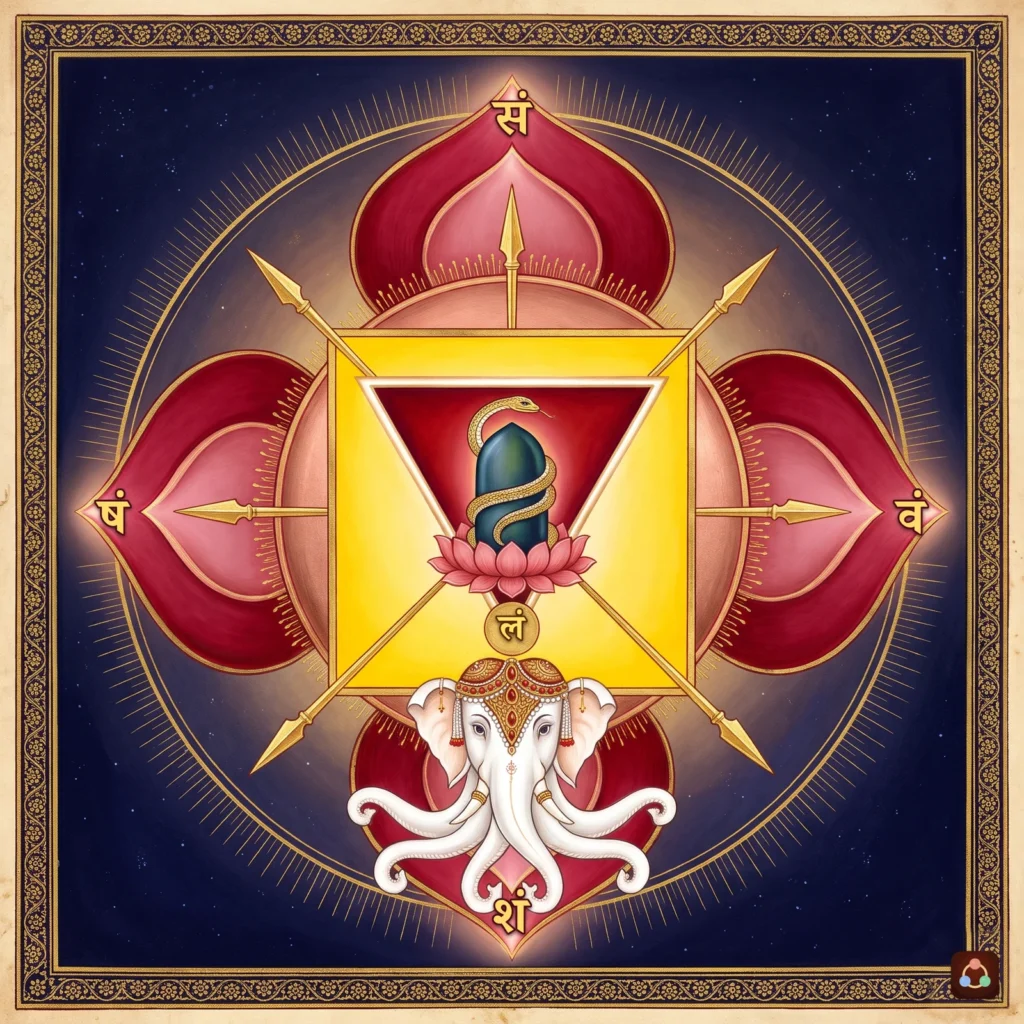
| Petals | Four, crimson like a red lotus |
| Letters on the petals | वं शं षं सं (va, sha, sha, sa), in gold, read round from the right |
| Element | Earth (prithvi). The Shat-chakra-nirupana and the Soundarya Lahari agree. |
| Its quality | Smell (gandha) |
| Its shape | A yellow square, with eight shining spears |
| Bija | लं (lam), yellow, four-armed, holding a thunderbolt, seated on the elephant Airavata |
| Deity | The child Brahma: red, four faces, four arms |
| Ruling goddess | Dakini (Shat-chakra-nirupana); Sakini (Lalita Sahasranama) |
| In the centre | The triangle Traipura with the wind Kandarpa; the Svayambhu linga; Kundalini coiled three and a half times |
| Knot | Brahma granthi |
| Rays | Fifty-six (Soundarya Lahari 14) |
| Soundarya Lahari | Verses 9, 10, 14 and 41 |
What the Shat-chakra-nirupana says
Pūrṇānanda’s Shat-chakra-nirupana, the “Description of the Six Centres”, gives the Muladhara ten verses, 4 to 13. Almost every traditional picture of the chakras is drawn from it. Here is what it shows, from the outside in.
The petals. Four petals, crimson like a red lotus. On them, four letters in shining gold: va, sha, sha and sa. The two sha sounds are different: one is made with the tongue on the palate, the other with the tip of the tongue turned back. The letters are read going round from the right.
The square of earth. In the middle of the lotus is a square. It is the region of Prithvi, the earth. It is yellow, “beautiful like lightning”, and eight shining spears stand out from its eight sides (verse 5).
The bija and Brahma. Inside the square is the seed-syllable of earth, lam. It is yellow too. The text pictures it as a being with four arms, holding a thunderbolt and seated on Airavata, the king of elephants (verses 5 and 6). In its lap sits the child Brahma, the creator, “resplendent like the young Sun”. He has four faces and four arms. The commentary gives him a staff, a water pot, a rosary, and the open hand that says “do not fear”.
Dakini. In this lotus lives the goddess Dakini, the ruler of this centre. She is red, with red eyes and four arms. She shines “like the lustre of many Suns rising at one and the same time” (verse 7). The text says she carries “the revelation of the ever-pure Intelligence”: meditating on her brings knowledge of the true nature of things.
The triangle. Within the square is a soft, lightning-like triangle, its point downward. It is called Traipura, because the goddess Tripura dwells in it. Inside it moves a wind called Kandarpa, deeper red than the bandhujiva flower. The commentary explains it as a part of apana, the downward breath, and gives a lovely picture of why it matters. The upward and downward breaths pull at each other like a falcon tied to a string. Each stops the other from leaving the body (verse 8).
The linga. Inside the triangle is Shiva as the Svayambhu linga, “the self-born”. The commentary says it tapers like an unopened leaf-bud: broad below, pointed above, and dark blue-green in colour. Its light is cool, like the light of the full moon. Shiva lives here, the text says, as happily as he lives in Kashi (verse 9).
Kundalini. Over the linga lies Kundalini, as at the start of this page (verses 10 and 11). The text calls her the source of all speech: prose and verse, in Sanskrit and in every other tongue. She keeps every creature alive by the breath going in and out.
Para. Above her, says verse 12, rises the supreme Shakti, subtler than the subtlest. She holds the stream of nectar that flows from eternal bliss.
The fruit. Verse 13 tells what meditation on her here brings: mastery of speech, learning, gladness of heart, and freedom from disease. These are a tradition’s promises about meditation. They are not medical claims.
What the Soundarya Lahari says
The Muladhara appears in four verses.
Verse 9 places earth here, at the start of the ascent. The 1937 Adyar commentary adds a thought worth keeping: without the Muladhara and its earth, the body would lose its balance and its steadiness. Read verse 9
Verse 10 brings Kundalini home. After meeting her Lord above, she comes back down, coils herself three and a half times, and sleeps in the hollow of the Muladhara. Read verse 10
Verse 14 counts the rays of light in each centre. In the Muladhara, the centre of earth, there are fifty-six. Our painting recalls them with the ring of fine rays round the lotus. Read verse 14
Verse 41 is the last of the six verses that walk down the centres, from the Ajna to the Muladhara.
ತವಾಧಾರೇ ಮೂಲೇ ಸಹ ಸಮಯಯಾ ಲಾಸ್ಯಪರಯಾನವಾತ್ಮಾನಂ ಮನ್ಯೇ ನವರಸಮಹಾತಾಂಡವನಟಮ್ ।ಉಭಾಭ್ಯಾಮೇತಾಭ್ಯಾಮ್ ಉದಯವಿಧಿಮುದ್ದಿಶ್ಯ ದಯಯಾಸನಾಥಾಭ್ಯಾಂ ಜಜ್ಞೇ ಜನಕಜನನೀಮಜ್ಜಗದಿದಮ್
MeaningIn your Muladhara, the root centre (the centre of earth), I contemplate Navatman (Shiva), the dancer of the great tandava, charged with all nine rasas, the emotions of art, dancing with Samaya, who is absorbed in the gentle lasya dance. Because these two have come together in compassion, so that the world may be created anew, this world has a father and a mother. Tradition notes that the Kaulas worship the Devi here in the Muladhara, while the Samaya school worships her inwardly in the higher centres. Read verse 41
Here Shiva is Navatman, the dancer of the great tandava, the vigorous dance, full of all nine moods of art. Beside him the Mother, as Samaya, dances the gentle lasya. Because these two come together, the poet says, the world has a father and a mother.
The commentary in the 1937 book follows Lakshmidhara. It names the pair to be meditated on here as Adi-nata and Lasyeshvari, ringed by the fifty-six rays of earth. It also explains the word Samaya. This commentary follows the Samaya way of worship. In it, the Mother is worshipped within, in the thousand-petalled lotus, and not in outer rites at the lower centres. Read verse 41
What the Lalita Sahasranama says
The Lalita Sahasranama speaks of the Muladhara in two places.
Kundalini’s rising (names 99 to 111):
| No. | Name | Meaning |
|---|---|---|
| 99 | mūlādhāraika-nilayā | Whose chief home is the Muladhara |
| 100 | brahma-granthi-vibhedinī | Who breaks the knot of Brahma |
| 101 | maṇipūrāntar-uditā | Who rises up within the Manipura |
| 102 | viṣṇu-granthi-vibhedinī | Who breaks the knot of Vishnu |
| 103 | ājñā-cakrāntarāla-sthā | Who stays within the Ajna |
| 104 | rudra-granthi-vibhedinī | Who breaks the knot of Rudra |
| 105 | sahasrārāmbujārūḍhā | Who rises to the thousand-petalled lotus |
| 106 | sudhā-sārābhivarṣiṇī | Who pours down streams of nectar |
| 110 | kuṇḍalinī | The coiled one |
| 111 | bisa-tantu-tanīyasī | Fine as the thread inside a lotus stalk |
The yogini of the Muladhara (names 514 to 520). In this section, each centre has a goddess, a yogini, with her own faces, weapons, bodily tissue and favourite food. For the Muladhara she is Sakini.
| No. | Name | Meaning |
|---|---|---|
| 514 | mūlādhārāmbujārūḍhā | Seated on the lotus of the Muladhara |
| 515 | pañca-vaktrā | Who has five faces |
| 516 | asthi-saṃsthitā | Who dwells in the bones |
| 517 | aṅkuśādi-praharaṇā | Who holds the goad and other weapons |
| 518 | varadādi-niṣevitā | Attended by Varada and the other Shaktis |
| 519 | mudgaudanāsakta-cittā | Fond of rice cooked with green gram |
| 520 | sākinyambā-svarūpiṇī | Who is the Mother Sakini |
Two texts, one lotus
On the element, the texts agree: the Shat-chakra-nirupana and the Soundarya Lahari both make this the centre of earth. The Soundarya Lahari’s change of elements touches only the Svadhishthana and the Manipura, not this centre. They differ on who rules it.
| Shat-chakra-nirupana | Lalita Sahasranama | Soundarya Lahari | |
|---|---|---|---|
| Element | Earth | Earth (verse 9) | |
| Who rules it | Dakini | Sakini | Shiva as Navatman, with the Mother as Samaya (verse 41) |
| Her form | Red, with red eyes and four arms | Five faces | |
| What she holds | Spear, skull-staff, sword and a cup | The goad and other weapons | |
| Bodily tissue | Skin (a text quoted by Woodroffe) | Bone | |
| Favourite food | Rice cooked in milk | Rice cooked with green gram |
What it means for the inner life
The texts read the Muladhara in a few simple ways.
It is the ground. This is the centre of earth, and its subtle quality is smell. The commentary on verse 9 links earth to the body’s balance and steadiness.
It is where the power waits. Kundalini is not absent in an ordinary life. She is asleep. The whole work of this yoga is her waking and her rising, and the tenth verse tells us she comes back here to rest.
It is where speech begins. The texts trace every word we speak back to a silent sound, para, rising from this centre. It becomes clearer as it passes through the higher centres, until it reaches the lips as the speech we hear.
Its powers are not the goal. Tradition says that mastering this centre brings unusual powers. The 1937 commentary warns that such powers are “pitfalls to be avoided”. They turn the seeker away from the goal, which lies at the top, in the Sahasrara.
What lies here in the body
I am a physician, so let me say plainly what sits at this spot.
Between the anus and the genitals lies the perineum. Under it is the floor of the pelvis, a sling of muscle that holds up the bladder, the bowel and, in women, the womb. The nerves that serve it come from the lowest part of the spine. Two long chains of nerve knots run down either side of the spine. Just in front of the tailbone, they end by joining into one small knot, the ganglion impar. The texts call the Muladhara the place where ida, pingala and sushumna meet. A century ago, the scholar Brajendranath Seal took ida and pingala to be these two chains. It is a striking coincidence. It is only a coincidence of place. It does not show that the Muladhara is that knot.
Hatha yoga has a practice at this very spot: mula bandha, the root lock, a held contraction at the perineum. Here modern medicine has something real to say. Exercises that train the pelvic floor muscles are the first recommended treatment for urinary leakage in women. A 2024 Cochrane review found, with low certainty, that direct, repeated contractions of these muscles may help more than indirect exercises. That is a fact about muscles, not about chakras. Mula bandha itself, as yoga teaches it, has not been tested in such trials, so I would not claim the same benefit for it.
Sources
- Arthur Avalon (Sir John Woodroffe), The Serpent Power, Ganesh and Co, Madras. Shat-chakra-nirupana, verses 4 to 13, with the commentary of Kalicharana, pp. 331 to 356; chapter V, p. 115 and pp. 153 to 154.
- Adi Shankaracharya, Saundarya-Lahari, with transliteration, English translation and commentary by S. Subrahmanya Sastri and T. R. Srinivasa Ayyangar, drawing on Lakshmidhara and other commentators. Theosophical Publishing House, Adyar, 1937. Verse 9, pp. 51 to 59; verse 41, pp. 157 to 161.
- The meanings of verses 9, 10, 14 and 41 on Jeevana Sutra, and in the Soundarya Lahari app.
- Lalita Sahasranama, names 99 to 111 and 514 to 520. Numbers as in Sanskrit Documents, lalita1000.
- Hay-Smith EJC and others. Comparisons of approaches to pelvic floor muscle training for urinary incontinence in women. Cochrane Database of Systematic Reviews 2024, CD009508. doi:10.1002/14651858.CD009508.pub2
- Gunduz OH and others. Pain relief due to transsacrococcygeal ganglion impar block in chronic coccygodynia. Pain Medicine 2015; 16: 1278 to 1281. doi:10.1111/pme.12752