

Power.
And wealth.
Do these two change a person?
In everyday talk we often hear: ‘Look, the moment a few coins came into his hands, how much he has changed!’ Or: ‘The moment he sat in the chair of power, his head started spinning.’ On the surface this seems true.
But look closely and the reality seems different.
Neither money nor power changes a person suddenly. Instead, they strip off the mask he had put on until then out of fear of society, or out of need. They lay bare the real person within. Wealth and strength do not give a person a new face. They work like a magnifying glass that makes whatever is inside him a hundred times bigger and shows it to the world.
Look carefully at the world around us.
The way he gets out of the car. The sound of the door slamming. When he walks with his mobile in hand, it is the walk of one who expects the whole world to make way for him. At a hotel, while eating, he never looks the waiter in the eye. To him the waiter is not even a human being, only a machine that provides service. If there is a small mistake, if things are a minute late, he shouts so that the whole hotel turns to look. While parking, he barks at the security guard in a raised voice.
Why?
He may argue that it is righteous anger at not getting proper service for the money he paid. But look deeper and the real reason is different. It is the hunger to display his ‘existence’ and his ‘power’ on the weak person in front of him.
There is a wonderful Sanskrit subhashita. Centuries ago it captured human psychology in a way that is still relevant today:
विद्या विवादाय धनं मदाय शक्तिः परेषां परिपीडनाय ।
vidyā vivādāya dhanaṃ madāya śaktiḥ pareṣāṃ paripīḍanāya |
It tells us what happens when learning, wealth and strength fall into the hands of wicked people, that is, people without refinement.
They use whatever little learning they have only for ‘controversy’. Their aim is to defeat the person in front, ridicule him, and prove that they alone are brilliant. Take a look at today’s social media. See the quarrels and hatreds there. Learning is not flowing there as knowledge. It has become a weapon of controversy and ego.
When money comes into their hands, it breeds ‘mada’, that is, arrogance. And when authority or strength comes, it is used to torment others (para-peeda).
Why does this happen?
Insecurity.
To hide the hollowness within, a person needs armour. For people without refinement, money and power become that armour. To imagine that they stand tall by trampling those in front of them, they need that ‘tormenting of others’. Behind their arrogance there is, in truth, a vast sense of inferiority.
But.
The next line of the same verse opens another height of what a human being can be, a beautiful picture.
खलस्य साधोर्विपरीतमेतत् ज्ञानाय दानाय च रक्षणाय ॥
khalasya sādhorviparītametat jñānāya dānāya ca rakṣaṇāya ||
What happens if these same three weapons come into the hands of good people? The story is turned completely upside down.
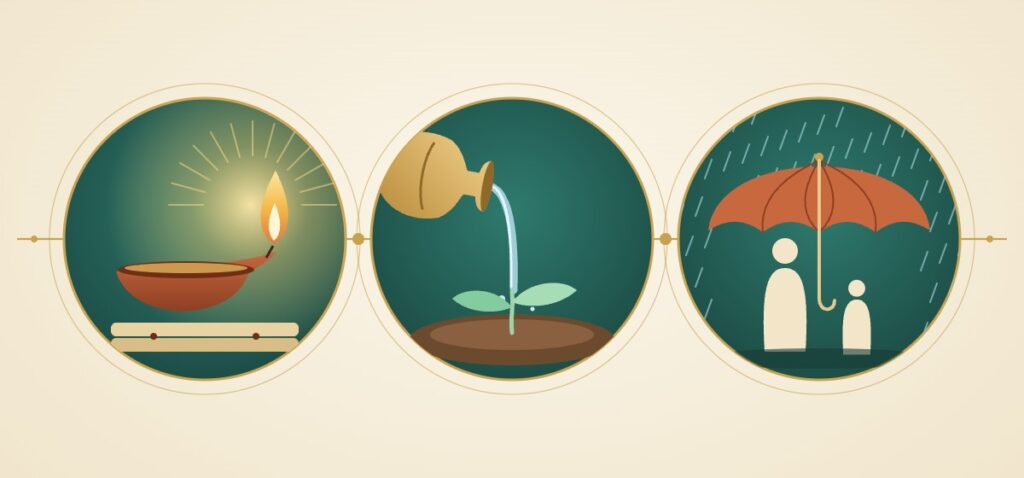
In the hands of good people, learning grows into ‘knowledge’. They long to share what they have learned with the world and to become a light in another person’s life. Going to them, we do not feel small about our ignorance. Instead we feel eager to learn something new. They do not argue. They converse.
And if wealth comes into their hands?
It flows as ‘giving’. Instead of the arrogance of ‘I earned this myself’, they have the gratitude of returning to society what they received from society. Giving does not mean only giving money. It may be the gift of time, or an attentive ear. From their pocket money goes quietly to someone else’s medical treatment, or to a child’s education. Even while giving, those hands stay curled in, taking care that the self-respect of the person in front is not hurt. They feel no hurry to hang up a board saying ‘I am a donor’.
Now strength.
If authority or strength comes into the hands of good people, it becomes an umbrella of protection. In the shade of their authority, the weak breathe easily. A trust rises: “He is there for us.” Strength does not become a tool for frightening others. It becomes a hand raised in reassurance that takes away their fear.
This is not merely some mythological tale. It is the truth of the everyday life of all of us. In our office, in the apartment where we live, on the road we travel, we keep meeting both kinds of people.
Near some people we feel as if our very existence has shrunk, as if we are nothing. Their ego chokes us.
Then there are others. After sitting with them and talking a little, when we get up to leave we feel some respect for ourselves. The goodness within us wakes up. Their knowledge and their humility cool us down. The difference is not in wealth or position. It is in the mind that takes that wealth in.
Choice.
In the end, that alone remains.
The learning we have earned, the money we have gathered, or the post we have gained does not measure us. How we use that wealth and strength decides our true character. Strength is easy to come by. But the restraint to use it without trampling the person beside us is hard. Wealth coming is common. But to turn it into affection rather than arrogance, and let it flow, is greatness.
As the evening of life draws near, when the strength of hands and feet fades, when the chair of power is empty, when the wish to enjoy the bank balance withers… whatever remains, it is only the ‘protection’ we gave to another and the ‘knowledge’ we shared.
Controversies are forgotten.
Ego turns to dust.
Only memories remain. Whether we remain in those memories as a face that frightened or a voice that gave hope depends only on the choice we make today.


Leave a comment