
ಏಳೂ ಚಕ್ರಗಳು · ಹಿಂದಿನದು: ಸ್ವಾಧಿಷ್ಠಾನ
ಮಳೆ ಮೋಡದ ಬಣ್ಣದ ಕಮಲವೊಂದರ ಒಳಗೆ ಕೆಂಪು ತ್ರಿಕೋನವೊಂದು ಬೆಳಗುತ್ತಿದೆ.
ಆ ತ್ರಿಕೋನದೊಳಗೆ ಅಗ್ನಿಯ ಬೀಜಾಕ್ಷರವಿದೆ; ಕೆಂಪಗಿರುವ ಅದು ಟಗರಿನ ಮೇಲೆ ಕುಳಿತಿದೆ. ತ್ರಿಕೋನದ ಹೊರಗೆ, ಅದರ ಮೂರು ಬದಿಗಳಲ್ಲಿ ಮಂಗಳಕರವಾದ ಮೂರು ಸ್ವಸ್ತಿಕ ಚಿಹ್ನೆಗಳಿವೆ. ಇವೆಲ್ಲದರ ಸುತ್ತ ಹತ್ತು ಕಡುಬಣ್ಣದ ದಳಗಳು ಅರಳಿವೆ. ಪ್ರತಿ ದಳದ ಮೇಲೂ ನೀಲಕಮಲದ ಬಣ್ಣದ ಒಂದೊಂದು ಅಕ್ಷರವಿದೆ.
ಇದು ಹೊಕ್ಕುಳಿನ ಮಟ್ಟದಲ್ಲಿರುವ ಮೂರನೆಯ ಕಮಲ, ಮಣಿಪೂರ. ಷಟ್ಚಕ್ರ ನಿರೂಪಣ ಗ್ರಂಥವು ಇಲ್ಲಿ ಅಗ್ನಿಯನ್ನು ಕಾಣುತ್ತದೆ. ಸೌಂದರ್ಯ ಲಹರಿ ಇಲ್ಲಿ ಜಲವನ್ನು ಕಾಣುತ್ತದೆ: ಕಪ್ಪನೆಯ ಮಳೆಮೋಡ, ಅದರೊಳಗೆ ತಾಯಿಯ ಶಕ್ತಿ ಮಿಂಚಾಗಿ ಹೊಳೆಯುತ್ತದೆ.
ಈ ಪುಟದಲ್ಲಿಹೆಸರು · ಇದು ಎಲ್ಲಿದೆ? · ಗ್ರಂಥಗಳು ವರ್ಣಿಸುವ ಕಮಲದ ರೂಪ · ಷಟ್ಚಕ್ರ ನಿರೂಪಣ ಏನು ಹೇಳುತ್ತದೆ? · ಸೌಂದರ್ಯ ಲಹರೀ ಏನು ಹೇಳುತ್ತದೆ? · ಲಲಿತಾ ಸಹಸ್ರನಾಮ ಏನು ಹೇಳುತ್ತದೆ? · ಮೂರು ಗ್ರಂಥಗಳು, ಒಂದೇ ಕಮಲ · ಅಂತರಂಗದ ಬದುಕಿಗೆ ಇದರ ಅರ್ಥವೇನು? · ದೇಹದ ಈ ಜಾಗದಲ್ಲಿ ಏನಿದೆ? · ಆಕರಗಳು
ಹೆಸರು
ಮಣಿ ಎಂದರೆ ರತ್ನ. ಪುರ ಎಂದರೆ ನಗರ, ಅಥವಾ ತುಂಬಿಕೊಂಡಿರುವುದು. ಹಾಗಾಗಿ ಈ ಹೆಸರಿಗೆ ‘ರತ್ನಗಳ ನಗರ’ ಎಂದೂ, ‘ರತ್ನಗಳಿಂದ ತುಂಬಿದ್ದು’ ಎಂದೂ ಅರ್ಥ ಮಾಡಬಹುದು.
ಈ ಹೆಸರು ಏಕೆ ಎಂಬುದಕ್ಕೆ ಗ್ರಂಥಗಳು ಎರಡು ಕಾರಣ ಕೊಡುತ್ತವೆ. ಷಟ್ಚಕ್ರ ನಿರೂಪಣದ ವ್ಯಾಖ್ಯಾನದಲ್ಲಿ ಗೌತಮೀಯ ತಂತ್ರದ ಮಾತೊಂದು ಬರುತ್ತದೆ: ‘ಈ ಪದ್ಮವು ರತ್ನದಂತೆ ಹೊಳೆಯುವುದರಿಂದ ಇದಕ್ಕೆ ಮಣಿಪೂರ ಎಂದು ಹೆಸರು ಬಂದಿದೆ.’ 1937ರ ಸೌಂದರ್ಯ ಲಹರಿಯ ವ್ಯಾಖ್ಯಾನವು ಇನ್ನೊಂದು ವಿವರಣೆ ನೀಡುತ್ತದೆ. ತಾಯಿ ಈ ಕಮಲವನ್ನು ಮಣಿಗಳಿಂದ ತುಂಬಿಸುತ್ತಾಳೆ ಎಂಬ ಮಾತಿದೆ; ಆದ್ದರಿಂದ ಸಮಯ ಮಾರ್ಗದಲ್ಲಿ ಅವಳನ್ನು ಆರಾಧಿಸುವವರು ಇಲ್ಲಿ ಅವಳನ್ನು ಧ್ಯಾನಿಸುವಾಗ ರತ್ನಗಳನ್ನು ಸಮರ್ಪಿಸುತ್ತಾರೆ ಎನ್ನುತ್ತದೆ ಅದು.
ಇದು ಎಲ್ಲಿದೆ?
ಷಟ್ಚಕ್ರ ನಿರೂಪಣವು ಇದನ್ನು ಸ್ವಾಧಿಷ್ಠಾನದ ‘ಮೇಲೆ’ ಮತ್ತು ‘ಹೊಕ್ಕುಳಿನ ಮೂಲದಲ್ಲಿ’ ಇರಿಸುತ್ತದೆ (ಶ್ಲೋಕ 19). ಈ ಗ್ರಂಥವು ಇದನ್ನು ನಾಭಿಪದ್ಮ ಎಂದೇ ಕರೆಯುತ್ತದೆ. ಸರ್ ಜಾನ್ ವುಡ್ರಫ್ ಅವರ ಪಟ್ಟಿಯು ಇದನ್ನು ಹೊಕ್ಕುಳಿನ ಭಾಗದ ಬೆನ್ನುಹುರಿಯ ಕೇಂದ್ರದಲ್ಲಿ ಗುರುತಿಸುತ್ತದೆ.
ಈ ಗ್ರಂಥದಲ್ಲಿ ಬರುವ ಪ್ರತಿಯೊಂದು ಕಮಲದಂತೆಯೇ, ಇದು ಕೂಡ ದೇಹದ ಈ ಭಾಗದ ನೇರದಲ್ಲಿ ಬೆನ್ನುಹುರಿಯೊಳಗೆ ಇರುವ ಕೇಂದ್ರವೇ ಹೊರತು, ಚರ್ಮದ ಮೇಲಿನ ಯಾವುದೇ ಬಿಂದುವಲ್ಲ.
ಗ್ರಂಥಗಳು ವರ್ಣಿಸುವ ಕಮಲದ ರೂಪ
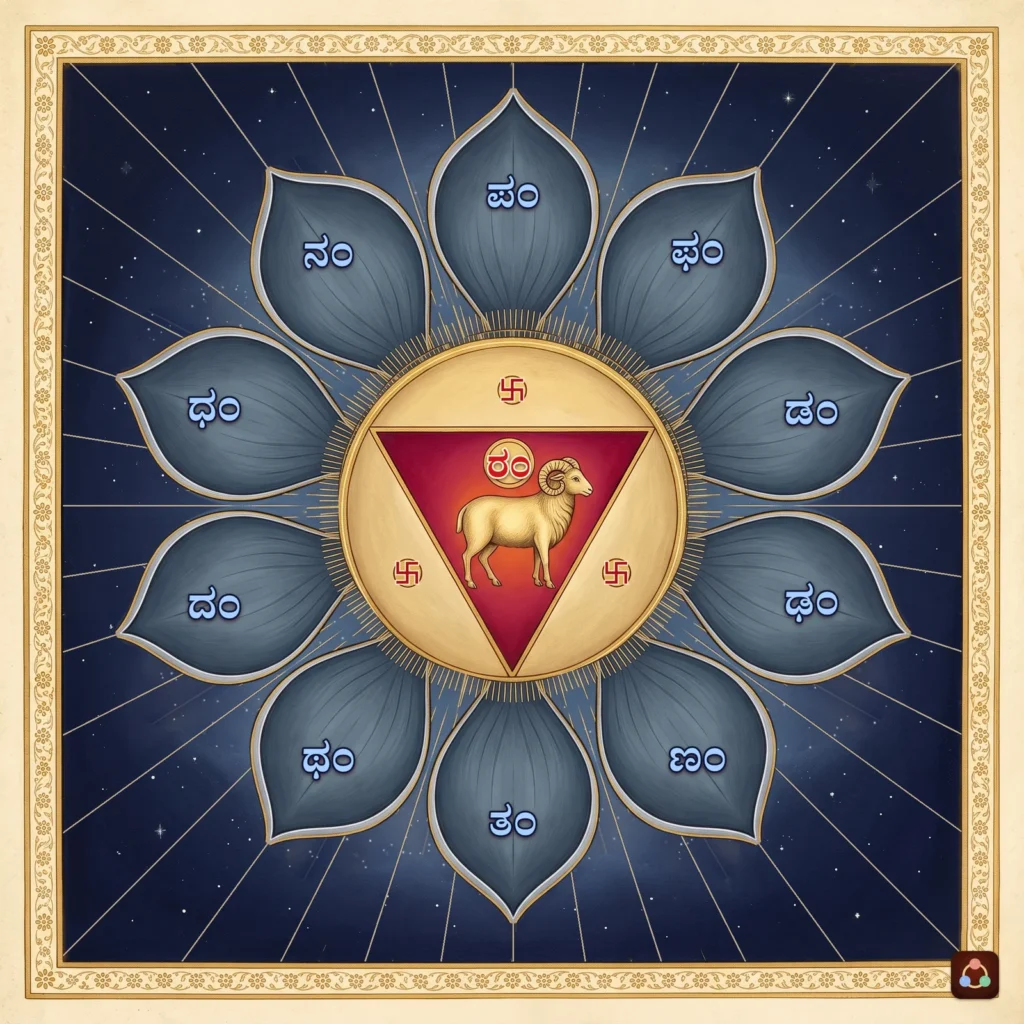
| ದಳಗಳು | ಹತ್ತು, ನೀರು ತುಂಬಿದ ಮಳೆಮೋಡಗಳ ಬಣ್ಣ |
| ದಳಗಳ ಮೇಲಿನ ಅಕ್ಷರಗಳು | ಡಂ ಢಂ ಣಂ ತಂ ಥಂ ದಂ ಧಂ ನಂ ಪಂ ಫಂ, ಪ್ರತಿಯೊಂದರ ಮೇಲೆ ಬಿಂದು, ನೀಲಿ ಕಮಲದ ಬಣ್ಣ, ಬಲದಿಂದ ಸುತ್ತಿ ಓದಬೇಕು |
| ತತ್ತ್ವ | ಷಟ್ಚಕ್ರ ನಿರೂಪಣದಲ್ಲಿ ಅಗ್ನಿ (ತೇಜಸ್ಸು); ಸೌಂದರ್ಯ ಲಹರಿಯಲ್ಲಿ ಜಲ |
| ಸಂಬಂಧ | ರೂಪ ತತ್ತ್ವ (ರೂಪ ಮತ್ತು ಬಣ್ಣ), ಕಣ್ಣು (ನೋಡುವ ಇಂದ್ರಿಯ), ಮತ್ತು ಕರ್ಮೇಂದ್ರಿಯವಾದ ಗುದ; ಇವು ಇಲ್ಲಿ ಲೀನವಾಗುತ್ತವೆ (ವುಡ್ರಫ್ ಅವರ ಪಟ್ಟಿಯಂತೆ) |
| ಆಕಾರ | ಉದಯಸೂರ್ಯನಂತೆ ಹೊಳೆಯುವ ಕೆಂಪು ತ್ರಿಕೋನ; ಅದರ ಹೊರಗೆ, ಮೂರು ಬದಿಗಳಲ್ಲಿ, ಮೂರು ಸ್ವಸ್ತಿಕಗಳು |
| ಬೀಜ | ರಂ, ಕೆಂಪು ಬಣ್ಣ, ಟಗರಿನ ಮೇಲೆ ಕುಳಿತಿದೆ, ನಾಲ್ಕು ಕೈಗಳು. 1937ರ ಸೌಂದರ್ಯ ಲಹರೀ ವ್ಯಾಖ್ಯಾನದಲ್ಲಿ, ಜಲದೊಂದಿಗೆ, ವಂ |
| ದೇವತೆ | ರುದ್ರ: ಕೆಂಪು ಬಣ್ಣ, ಆದರೆ ಭಸ್ಮದಿಂದ ಬಿಳುಪಾಗಿ ಕಾಣುತ್ತಾನೆ; ವೃದ್ಧರೂಪ, ಮೂರು ಕಣ್ಣುಗಳು; ಎತ್ತಿನ ಮೇಲೆ ಕುಳಿತವನು |
| ಅಧಿದೇವತೆ | ಲಾಕಿನೀ, ಷಟ್ಚಕ್ರ ನಿರೂಪಣದಲ್ಲೂ ಲಲಿತಾ ಸಹಸ್ರನಾಮದಲ್ಲೂ |
| ಕಿರಣಗಳು | ಐವತ್ತೆರಡು (ಸೌಂದರ್ಯ ಲಹರೀ 14) |
| ಸೌಂದರ್ಯ ಲಹರೀ | ಶ್ಲೋಕ 9, 14, 40, 41 ಮತ್ತು 99 (1937ರ ಪುಸ್ತಕದಲ್ಲಿ 101) |
ಷಟ್ಚಕ್ರ ನಿರೂಪಣ ಏನು ಹೇಳುತ್ತದೆ?
ಷಟ್ಚಕ್ರ ನಿರೂಪಣವು ಮಣಿಪೂರಕ್ಕೆ 19 ರಿಂದ 21 ರವರೆಗಿನ ಮೂರು ಶ್ಲೋಕಗಳನ್ನು ಮೀಸಲಿಟ್ಟಿದೆ. ಅವು ತೋರಿಸುವುದನ್ನು ಹೊರಗಿನಿಂದ ಒಳಕ್ಕೆ ನೋಡೋಣ.
ದಳಗಳು. ‘ನೀರು ತುಂಬಿದ ಮಳೆ ಮೋಡಗಳ ಬಣ್ಣದ’ ಹತ್ತು ದಳಗಳು (ಶ್ಲೋಕ 19). ವ್ಯಾಖ್ಯಾನವು ಇದನ್ನು ಕಡು ಬಣ್ಣ ಎಂದು ವಿವರಿಸುತ್ತದೆ. ಆ ದಳಗಳ ಮೇಲೆ ಡದಿಂದ ಫದವರೆಗಿನ ಹತ್ತು ಅಕ್ಷರಗಳಿವೆ: ಡ, ಢ, ಣ, ತ, ಥ, ದ, ಧ, ನ, ಪ ಮತ್ತು ಫ. ಪ್ರತಿ ದಳದ ಮೇಲೆ ಒಂದೊಂದು ಅಕ್ಷರವಿದೆ. ಅಕ್ಷರಗಳು ‘ನೀಲಕಮಲದ ಬಣ್ಣ’ದವು; ಪ್ರತಿ ಅಕ್ಷರದ ಮೇಲೂ ನಾದ ಮತ್ತು ಬಿಂದು ಇವೆ.
ಅಗ್ನಿಯ ಮಂಡಲ. ಕಮಲದ ಒಳಗೆ, ‘ತ್ರಿಕೋನಾಕಾರವಾಗಿದ್ದು ಉದಯಿಸುವ ಸೂರ್ಯನಂತೆ ಹೊಳೆಯುವ ವಹ್ನಿಮಂಡಲವನ್ನು ಧ್ಯಾನಿಸಿ’ ಎನ್ನುತ್ತದೆ ಶ್ಲೋಕ. ವುಡ್ರಫ್ ಅವರ ಆವೃತ್ತಿಯಲ್ಲಿರುವ ಈ ಶ್ಲೋಕಗಳ ಸಾರಾಂಶ ಇದು ಕೆಂಪು ಎನ್ನುತ್ತದೆ. ತ್ರಿಕೋನದ ಹೊರಗೆ ಮೂರು ಸ್ವಸ್ತಿಕಗಳಿದ್ದು, ವ್ಯಾಖ್ಯಾನವು ಅವುಗಳನ್ನು ‘ತ್ರಿಕೋನದ ಮೂರು ಬದಿಗಳಲ್ಲಿ’ ಇರಿಸುತ್ತದೆ. ವ್ಯಾಖ್ಯಾನ ಎತ್ತಿಕೊಡುವ ರಾಘವಭಟ್ಟರ ಮಾತು ಈ ಗುರುತನ್ನು ವಿವರಿಸುತ್ತದೆ: ಒಂದನ್ನೊಂದು ದಾಟಿ ನಾಲ್ಕು ದಿಕ್ಕಿಗೆ ಚಾಚುವ ಎರಡು ನೇರ ಗೆರೆಗಳು. ತ್ರಿಕೋನದ ತುದಿ ಮೇಲೋ ಕೆಳಗೋ ಎಂದು ಗ್ರಂಥ ಹೇಳುವುದಿಲ್ಲ. ನಮ್ಮ ಚಿತ್ರದಲ್ಲಿ ತುದಿ ಕೆಳಕ್ಕಿದೆ.
ಬೀಜ ಮತ್ತು ಟಗರು. ತ್ರಿಕೋನದೊಳಗೆ ಅಗ್ನಿಯ ಬೀಜಾಕ್ಷರವಾದ ‘ರಂ’ ಇದೆ. ಅದನ್ನು ಮೂರ್ತಿಯ ರೂಪದಲ್ಲಿ ಕಲ್ಪಿಸಿದರೆ ಅದು ಸಾಕ್ಷಾತ್ ಅಗ್ನಿಯೇ: ‘ಟಗರಿನ ಮೇಲೆ ಕುಳಿತಿರುವ, ನಾಲ್ಕು ತೋಳುಗಳುಳ್ಳ, ಉದಯಿಸುವ ಸೂರ್ಯನಂತೆ ಬೆಳಗುವ’ ರೂಪ (ಶ್ಲೋಕ 20). ಸಾರಾಂಶ ಇನ್ನಷ್ಟು ಹೇಳುತ್ತದೆ: ಈತ ಕೆಂಪು ಬಣ್ಣದವನು; ಕೈಗಳಲ್ಲಿ ವಜ್ರ ಮತ್ತು ‘ಶಕ್ತಿ’ ಎಂಬ ಆಯುಧ (ವುಡ್ರಫ್ ಅವರ ಟಿಪ್ಪಣಿಯಂತೆ ಅದು ಅಗ್ನಿಯದೇ ಆಯುಧ); ಉಳಿದೆರಡು ಕೈಗಳಲ್ಲಿ ವರ ಮತ್ತು ಅಭಯ ಮುದ್ರೆಗಳು. ವ್ಯಾಖ್ಯಾನಕಾರರು ಕೊಡುವ ಒಂದು ಧ್ಯಾನಶ್ಲೋಕದಲ್ಲಿ ವಜ್ರಾಯುಧದ ಬದಲು ಆತನ ಕೈಯಲ್ಲಿ ರುದ್ರಾಕ್ಷಿ ಮಾಲೆಯಿದೆ.
ರುದ್ರ. ‘ಆತನ ಮಡಿಲಿನಲ್ಲಿ ಶುದ್ಧ ಸಿಂಧೂರ ವರ್ಣದ ರುದ್ರನು ಸದಾ ನೆಲೆಸಿದ್ದಾನೆ’ (ಶ್ಲೋಕ 20). ಆತ ಭಸ್ಮವನ್ನು ಬಳಿದುಕೊಂಡಿರುವುದರಿಂದ ಬಿಳಿಯಾಗಿ ಕಾಣುತ್ತಾನೆ. ನೋಡಲು ವೃದ್ಧ; ಮೂರು ಕಣ್ಣುಗಳು. ಆತನ ಕೈಗಳು ವರ ಕೊಡುತ್ತವೆ, ಭಯ ಹೋಗಲಾಡಿಸುತ್ತವೆ. ಶ್ಲೋಕವು ಆತನನ್ನು ‘ಸೃಷ್ಟಿಯ ಸಂಹಾರಕ’ ಎಂದು ಕರೆಯುತ್ತದೆ. ಆತನನ್ನು ವೃಷಭದ ಮೇಲೆ ಕುಳಿತವನಾಗಿ ಧ್ಯಾನಿಸಬೇಕು ಎಂದು ವ್ಯಾಖ್ಯಾನಕಾರರು ಸೇರಿಸುತ್ತಾರೆ.
ಲಾಕಿನೀ. ‘ಇಲ್ಲಿ ಎಲ್ಲರಿಗೂ ಒಳಿತನ್ನು ಮಾಡುವ ಲಾಕಿನೀ ನೆಲೆಸಿದ್ದಾಳೆ’ (ಶ್ಲೋಕ 21). ಆಕೆಗೆ ನಾಲ್ಕು ತೋಳುಗಳಿದ್ದು, ದೇಹ ತೇಜಸ್ಸಿನಿಂದ ಕೂಡಿದೆ. ಕಪ್ಪು ಮೈಬಣ್ಣದವಳಾದ ಆಕೆ ಹಳದಿ ವಸ್ತ್ರ ಧರಿಸಿದ್ದಾಳೆ ಮತ್ತು ಅನೇಕ ಆಭರಣಗಳನ್ನು ತೊಟ್ಟಿದ್ದಾಳೆ. ಅಮೃತಪಾನದಿಂದ ಆಕೆಯ ಮನಸ್ಸು ಉಲ್ಲಾಸಗೊಂಡಿದೆ ಎಂದು ಶ್ಲೋಕ ಹೇಳುತ್ತದೆ. ವ್ಯಾಖ್ಯಾನಕಾರರು ಕೊಡುವ ಇನ್ನೊಂದು ಧ್ಯಾನಶ್ಲೋಕವು ಇನ್ನೂ ಹೆಚ್ಚಿನ ವಿವರ ನೀಡುತ್ತದೆ. ಅದರಲ್ಲಿ ಆಕೆ ನೀಲಿ ಬಣ್ಣದವಳು, ಮೂರು ಮುಖಗಳಿದ್ದು ಪ್ರತಿ ಮುಖದಲ್ಲೂ ಮೂರು ಕಣ್ಣುಗಳಿವೆ. ಆಕೆಯ ರೂಪ ಉಗ್ರ; ಹಲ್ಲುಗಳು ಹೊರಚಾಚಿವೆ. ಬಲಗೈಗಳಲ್ಲಿ ವಜ್ರ ಮತ್ತು ಶಕ್ತಿ ಆಯುಧಗಳನ್ನು ಹಿಡಿದು, ಎಡಗೈಗಳಲ್ಲಿ ವರ ಮತ್ತು ಅಭಯ ಮುದ್ರೆಗಳನ್ನು ತೋರುತ್ತಿದ್ದಾಳೆ. ಅದೇ ಶ್ಲೋಕ ಆಕೆ ಮಾಂಸಪ್ರಿಯೆ ಎನ್ನುತ್ತದೆ; ಆಕೆಯ ಬಾಯಲ್ಲಿ ರಕ್ತವನ್ನೂ ಚಿತ್ರಿಸುತ್ತದೆ. ಇದು ಏಕೆ ಎಂಬುದನ್ನು ವುಡ್ರಫ್ ತಮ್ಮ ಅಧ್ಯಾಯದಲ್ಲಿ ವಿವರಿಸುತ್ತಾರೆ. ಅವರ ಪ್ರಕಾರ ಲಾಕಿನೀ ಯೋಗಿಯ ದೇಹದ್ದೇ ಆದ ಶಕ್ತಿ, ಈ ಕೇಂದ್ರದ ದೇಹಧಾತುವಿನ ಶಕ್ತಿ; ಈ ಕೇಂದ್ರದ ಮೇಲಿನ ಏಕಾಗ್ರತೆ ‘ಈ ದೇವತೆಯ ಹಸಿವನ್ನು ತಣಿಸುವುದನ್ನೂ ಒಳಗೊಳ್ಳಬಹುದು’. ‘ಮೇಲಿನ ಕೇಂದ್ರಗಳ ಶಕ್ತಿಗಳು ಮಾಂಸ ತಿನ್ನುವವರಲ್ಲ’ ಎಂದೂ ಅವರು ಸೇರಿಸುತ್ತಾರೆ. ನಮ್ಮ ಚಿತ್ರದಲ್ಲಿ ಆಕೆಯನ್ನಾಗಲಿ, ರುದ್ರನನ್ನಾಗಲಿ ತೋರಿಸಿಲ್ಲ.
ಫಲಶ್ರುತಿ. ಈ ನಾಭಿಪದ್ಮವನ್ನು ಧ್ಯಾನಿಸುವವನು ‘ಲೋಕವನ್ನು ಲಯಗೊಳಿಸುವ ಮತ್ತು ಸೃಷ್ಟಿಸುವ ಸಾಮರ್ಥ್ಯವನ್ನು’ ಪಡೆಯುತ್ತಾನೆ ಎಂದು 21ನೆಯ ಶ್ಲೋಕ ಭರವಸೆ ನೀಡುತ್ತದೆ. ವಿದ್ಯೆಯ ಸಕಲ ಸಂಪತ್ತಿನೊಡನೆ ವಾಗ್ದೇವಿಯಾದ ವಾಣಿಯು ‘ಆತನ ಮುಖಕಮಲದಲ್ಲಿ ಸದಾ ನೆಲೆಸಿರುತ್ತಾಳೆ’ ಎಂದೂ ಅದು ಸೇರಿಸುತ್ತದೆ. ಇವು ಧ್ಯಾನದ ಬಗ್ಗೆ ಪರಂಪರೆ ಕೊಡುವ ಭರವಸೆಗಳು. ವೈದ್ಯಕೀಯ ಹೇಳಿಕೆಗಳಲ್ಲ.
ಸೌಂದರ್ಯ ಲಹರೀ ಏನು ಹೇಳುತ್ತದೆ?
ಸೌಂದರ್ಯ ಲಹರಿಯು ಈ ಕೇಂದ್ರಕ್ಕೆ ಬೇರೆಯದೇ ತತ್ವವನ್ನು ನೀಡುತ್ತದೆ. ಇದರದೇ ಆದ ಶ್ಲೋಕ 40ನೆಯದು. ಇನ್ನೂ ಹಲವು ಶ್ಲೋಕಗಳ ವ್ಯಾಖ್ಯಾನದಲ್ಲಿ ಮಣಿಪೂರದ ಮಾತು ಬರುತ್ತದೆ.
9ನೆಯ ಶ್ಲೋಕವು ಇಲ್ಲಿ ಜಲತತ್ವವನ್ನು ಇರಿಸುತ್ತದೆ, ಮತ್ತು ಕೆಳಗಿನ ಸ್ವಾಧಿಷ್ಠಾನದಲ್ಲಿ ಅಗ್ನಿಯನ್ನು ಇರಿಸುತ್ತದೆ. ಕಮಲ ಅದೇ ಕಮಲ. ಬದಲಾಗುವುದು ಅದರೊಳಗೆ ಧ್ಯಾನಿಸುವ ತತ್ವ ಮಾತ್ರ; ಆ ತತ್ವದ ಜೊತೆಗೆ, 1937ರ ಅಡ್ಯಾರ್ ವ್ಯಾಖ್ಯಾನದ ಕ್ರಮದಂತೆ, ಅದರ ಬೀಜಾಕ್ಷರವೂ ಬದಲಾಗುತ್ತದೆ: ಇಲ್ಲಿ ‘ರಂ’ ಬದಲು ‘ವಂ’. ಅದೇ ಪುಸ್ತಕದಲ್ಲಿ 35ನೆಯ ಶ್ಲೋಕದ ವ್ಯಾಖ್ಯಾನದ ಒಂದು ಪಟ್ಟಿ ಈ ಕೇಂದ್ರಕ್ಕೆ ಬೇರೆ ದೇವತೆಯನ್ನೂ ಕೊಡುತ್ತದೆ: ರುದ್ರನ ಬದಲು ವಿಷ್ಣು. ಈ ಕಮಲವು ರಸ ಅಥವಾ ರುಚಿಯೆಂಬ ಸೂಕ್ಷ್ಮ ರೂಪದ ಜಲತತ್ವವನ್ನು ಸೂಚಿಸುತ್ತದೆ ಎಂದು ವ್ಯಾಖ್ಯಾನ ಹೇಳುತ್ತದೆ. ಇದು ದೇಹದಲ್ಲಿ ಮೂರನೆಯ ಕಮಲವಾದರೂ, ಪಂಚಭೂತಗಳ ಕ್ರಮವನ್ನು ಉಳಿಸಿಕೊಳ್ಳಲು ಕವಿ ಇದನ್ನು ಎರಡನೆಯದಾಗಿ ಹೆಸರಿಸಿದ್ದಾರೆ. ಇದನ್ನು ಗೆದ್ದವನಿಗೆ ನೀರಿನ ಮೇಲೆ ತೇಲುವ, ನಡೆಯುವ ಶಕ್ತಿ ಸಿಗುತ್ತದೆ ಎಂಬ ಮಾತಿದೆ ಎನ್ನುತ್ತದೆ ವ್ಯಾಖ್ಯಾನ. ಈ ಕೇಂದ್ರವನ್ನು ಅದು ಶ್ರೀಚಕ್ರದ ಒಳಗಿನ ದಶಕೋನಕ್ಕೂ (ಹತ್ತು ಮೂಲೆಗಳ ಆಕೃತಿಗೂ) ಜೋಡಿಸುತ್ತದೆ. ಶ್ಲೋಕ 9 ಓದಿ
14ನೆಯ ಶ್ಲೋಕವು ಪ್ರತಿ ಕೇಂದ್ರದಲ್ಲಿರುವ ಬೆಳಕಿನ ಕಿರಣಗಳನ್ನು ಎಣಿಸುತ್ತದೆ. ಜಲತತ್ವದ ಕೇಂದ್ರವಾದ ಮಣಿಪೂರದಲ್ಲಿ ಐವತ್ತೆರಡು ಕಿರಣಗಳಿವೆ. ಶ್ಲೋಕ 14 ಓದಿ
40ನೆಯ ಶ್ಲೋಕ ಈ ಕೇಂದ್ರದ್ದೇ.
ತಟಿತ್ತ್ವಂತಂ ಶಕ್ತ್ಯಾ ತಿಮಿರಪರಿಪಂಥಿಸ್ಫುರಣಯಾಸ್ಫುರನ್ನಾನಾರತ್ನಾ-ಭರಣಪರಿಣದ್ಧೇಂದ್ರಧನುಷಮ್ ।ತವ ಶ್ಯಾಮಂ ಮೇಘಂ ಕಮಪಿ ಮಣಿಪೂರೈಕಶರಣಂನಿಷೇವೇ ವರ್ಷಂತಂ ಹರಮಿಹಿರತಪ್ತಂ ತ್ರಿಭುವನಮ್
ಅರ್ಥಮಣಿಪೂರ ಚಕ್ರವನ್ನೇ (ಜಲತತ್ವ) ತನ್ನ ಮನೆಯನ್ನಾಗಿಸಿಕೊಂಡಿರುವ ನಿನ್ನ ಆ ಅದ್ಭುತವಾದ ಕೃಷ್ಣಮೇಘವನ್ನು ನಾನು ಸೇವಿಸುತ್ತೇನೆ. ಅದು ಕತ್ತಲೆಯ ಶತ್ರುವಾದ ಮಿಂಚನ್ನು ಹೊತ್ತಿದೆ, ಮತ್ತು ನಿನ್ನ ರತ್ನಾಭರಣಗಳ ಹೊಳಪು ಕಾಮನಬಿಲ್ಲಿನಂತೆ ಅದನ್ನು ಸುತ್ತುವರಿದಿದೆ. ಹರನೆಂಬ ಸೂರ್ಯನ (ರುದ್ರನ ಪ್ರಳಯಾಗ್ನಿ) ತಾಪದಿಂದ ಸುಟ್ಟುಹೋಗಿರುವ ಮೂರೂ ಲೋಕಗಳ ಮೇಲೆ ಅದು ಮಳೆಯನ್ನು ಸುರಿಸಿ, ಅವುಗಳಿಗೆ ಮರುಜೀವ ನೀಡುತ್ತದೆ. ಶ್ಲೋಕ 40 ಓದಿ
ಇಲ್ಲಿ ಧ್ಯಾನಿಸಬೇಕಾದ ಜೋಡಿ ದೇವತೆಗಳನ್ನು 1937ರ ವ್ಯಾಖ್ಯಾನ ಹೆಸರಿಸುತ್ತದೆ: ಮೋಡದ ಒಡೆಯನಾದ ಮೇಘೇಶ್ವರ, ಮತ್ತು ಮಿಂಚಾದ ಸೌದಾಮಿನೀ. ಅದು ಇವರನ್ನು ಅಮೃತೇಶ್ವರ ಮತ್ತು ಅಮೃತೇಶ್ವರೀ ಎಂದೂ ಕರೆಯುತ್ತದೆ, ಹಾಗೂ ಐವತ್ತೆರಡು ಜಲ ಕಿರಣಗಳ ನಡುವೆ ಇವರನ್ನು ಇರಿಸುತ್ತದೆ. ಕಪ್ಪನೆಯ ಮೋಡ ಆತನ ರೂಪ; ಮಿಂಚು ಆತನ ಶಕ್ತಿ. ಆ ಮಿಂಚು ಓಡಿಸುವ ಕತ್ತಲೆಯನ್ನು ವ್ಯಾಖ್ಯಾನ ಹೀಗೆ ವಿವರಿಸುತ್ತದೆ: ಕುಂಡಲಿನಿಯ ಬೆಳಕು ಮಣಿಪೂರದ ಕತ್ತಲೆಯನ್ನು ಬೆಳಕು ಮತ್ತು ಕತ್ತಲೆ ಬೆರೆತ ಜಾಗವನ್ನಾಗಿ ಬದಲಾಯಿಸುತ್ತದೆ.
ನಂತರ ಅದು ಈ ಶ್ಲೋಕದ ಬಗೆಗಿನ ಪರಂಪರೆಯ ಒಂದು ಮಾತನ್ನು ಮುಂದಿಡುತ್ತದೆ. ಹೃದಯದಲ್ಲಿರುವ ಸೂರ್ಯನ ಕಿರಣಗಳು ಮತ್ತು ಸ್ವಾಧಿಷ್ಠಾನದಲ್ಲಿರುವ ಅಗ್ನಿಯ ಕಾವು ಮಣಿಪೂರದ ನೀರನ್ನು ಮೋಡಗಳನ್ನಾಗಿ ಮಾಡುತ್ತವೆ. ಮಹಾಪ್ರಳಯದ ಕಾಲದಲ್ಲಿ ಆ ಮೋಡಗಳು ಮಳೆಯಾಗಿ ಸುರಿದು ಜಗತ್ತನ್ನೇ ಸುಡುವ ಬೆಂಕಿಯನ್ನು ನಂದಿಸುತ್ತವೆ. ಲಕ್ಷ್ಮೀಧರರ ದೀರ್ಘ ವ್ಯಾಖ್ಯಾನದಿಂದ 1937ರ ಪುಸ್ತಕ ಇನ್ನೊಂದು ಮಾತನ್ನೂ ಎತ್ತಿಕೊಡುತ್ತದೆ. ಇಂದು ಉಳಿದಿದೆ ಎಂದು ತಿಳಿಯದ ಒಂದು ಹಳೆಯ ಗ್ರಂಥದಲ್ಲಿ ಸದಾಶಿವ ಮಣಿಪೂರದಲ್ಲಿ ಚಳಿಗಾಲದ ಮೋಡವಾಗಿ ಬೆಳಗುತ್ತಾನೆ; ಆತನ ಮಡದಿ ಮಿಂಚಾಗಿ ಹೊಳೆಯುತ್ತಾಳೆ. ಶ್ಲೋಕ 40 ಓದಿ
41ನೆಯ ಶ್ಲೋಕದ ವ್ಯಾಖ್ಯಾನದಲ್ಲಿ ಅತ್ಯಂತ ಮುಖ್ಯವಾದ ಮಾತೊಂದು ಬರುತ್ತದೆ. ಅದರ ಪ್ರಕಾರ, ಕೆಳಗಿನ ಎರಡು ಕೇಂದ್ರಗಳು ‘ಕತ್ತಲೆಯ ಪ್ರದೇಶ’ದಲ್ಲಿವೆ. ಆಮೇಲೆ ಪುಸ್ತಕ ಒಂದು ವಿವರಣೆ ಕೊಡುತ್ತದೆ; ಅದು ಲಕ್ಷ್ಮೀಧರರ ನಿಲುವು ಎಂದು ಮುಂದೆ ಹೇಳುತ್ತದೆ. ಆರು ಬಗೆಯ ಐಕ್ಯತೆಯ ಧ್ಯಾನದಿಂದ, ಗುರುಕೃಪೆಯಿಂದ, ತಾಯಿ ಕೆಳಗಿನ ಎರಡು ಕೇಂದ್ರಗಳನ್ನು ಭೇದಿಸಿ ಮಣಿಪೂರದಲ್ಲಿ ನೇರವಾಗಿ ಪ್ರತ್ಯಕ್ಷಳಾಗುತ್ತಾಳೆ. ರತ್ನಖಚಿತ ಆಭರಣಗಳವರೆಗಿನ ಎಲ್ಲ ಉಪಚಾರಗಳೊಂದಿಗೆ ಸಮಯ ಮಾರ್ಗದ ಪೂರ್ಣ ಅಂತರಂಗ ಪೂಜೆ ನಡೆಯುವುದು ಇಲ್ಲಿ; ನಂತರ ಅವಳನ್ನು ಹೃದಯಕ್ಕೆ ಮತ್ತು ಅದರಾಚೆಗೆ ಕರೆದೊಯ್ಯುತ್ತಾರೆ. ಶಂಕರಾಚಾರ್ಯರ ನಿಲುವು ಬೇರೆ ಎನ್ನುತ್ತದೆ ಪುಸ್ತಕ: 7ನೆಯ ಶ್ಲೋಕದಲ್ಲಿ ಅವರು ತಾಯಿಯನ್ನು ಚಿತ್ರಿಸಿರುವ ರೀತಿಯಿಂದ ಅರ್ಥಮಾಡಿಕೊಂಡರೆ, ಸಾಧಕ ನಾಲ್ಕು ಬಗೆಯ ಐಕ್ಯತೆಯನ್ನು ಅರಿತಾಗ ತಾಯಿ ಮಣಿಪೂರದಲ್ಲಿ ಪ್ರತ್ಯಕ್ಷಳಾಗುತ್ತಾಳೆ. ಶ್ಲೋಕ 41 ಓದಿ
ಕಾವ್ಯದ ಕೊನೆಯ ಭಾಗದಲ್ಲಿ, 1937ರ ಪುಸ್ತಕದ ಲೆಕ್ಕದ 101ನೆಯ ಶ್ಲೋಕದಲ್ಲಿ (ಈ ತಾಣದಲ್ಲಿ ಅದು 99ನೆಯ ಶ್ಲೋಕ), ವ್ಯಾಖ್ಯಾನವು ಮತ್ತೆ ಈ ಕೇಂದ್ರದತ್ತ ಮರಳುತ್ತದೆ. ಪುಸ್ತಕ ತಿಳಿಸುವಂತೆ, ಮಣಿಪೂರದಲ್ಲಿ ತಾಯಿಯನ್ನು ಆರಾಧಿಸುವವರು ‘ಸಾರ್ಷ್ಟಿ’ ಎಂಬ ಮುಕ್ತಿಯನ್ನು ಪಡೆಯುತ್ತಾರೆ ಎನ್ನುತ್ತಾರೆ ಲಕ್ಷ್ಮೀಧರರು: ಅಂದರೆ ಅವರು ಅವಳ ನಗರದ ಪಕ್ಕದಲ್ಲೇ ಒಂದು ನಗರವನ್ನು ಕಟ್ಟಿಕೊಂಡು, ಸದಾ ಅವಳ ಸೇವೆಯಲ್ಲೇ ಜೀವಿಸುತ್ತಾರೆ. ಹತ್ತು ದಳಗಳು ಏಕೆ ಎಂಬುದನ್ನೂ ಅವರು ವಿವರಿಸುತ್ತಾರೆ. ಮಣಿಪೂರ ‘ಮೂಲಾಧಾರ ಮತ್ತು ಸ್ವಾಧಿಷ್ಠಾನಗಳ ಲಕ್ಷಣಗಳಿಂದ ಆದದ್ದು’, ಒಂದರ ನಾಲ್ಕು ದಳ ಮತ್ತು ಇನ್ನೊಂದರ ಆರು; ಹಾಗಾಗಿ ಹತ್ತು ದಳಗಳು ಎನ್ನುತ್ತಾರೆ. ಶ್ಲೋಕ 99 ಓದಿ
ಲಲಿತಾ ಸಹಸ್ರನಾಮ ಏನು ಹೇಳುತ್ತದೆ?
ಕುಂಡಲಿನಿಯ ಏರುವಿಕೆ (ನಾಮ 100ರಿಂದ 102). ಕುಂಡಲಿನಿಯ ಏರುವಿಕೆಯನ್ನು ಗುರುತಿಸುವ ನಾಮಗಳಲ್ಲಿ ಜಗನ್ಮಾತೆ ಮೊದಲು ‘ಬ್ರಹ್ಮಗ್ರಂಥಿಯನ್ನು ಭೇದಿಸುವವಳು’ (100), ಆಮೇಲೆ ‘ಮಣಿಪೂರದಲ್ಲಿ ಪ್ರಕಟವಾಗುವವಳು’ (101), ಆಮೇಲೆ ‘ವಿಷ್ಣುಗ್ರಂಥಿಯನ್ನು ಭೇದಿಸುವವಳು’ (102). ಕುಂಡಲಿನಿಯ ಏರುವಿಕೆಯ ವುಡ್ರಫ್ ಅವರ ವಿವರಣೆಯೂ ಇದಕ್ಕೆ ಹೊಂದುತ್ತದೆ: ಅದರಲ್ಲಿ ಮಣಿಪೂರವೇ ಬ್ರಹ್ಮಗ್ರಂಥಿ, ವಿಷ್ಣುಗ್ರಂಥಿ ಹೃದಯದಲ್ಲಿ. 1937ರ ಸೌಂದರ್ಯ ಲಹರೀ ವ್ಯಾಖ್ಯಾನ ಬೇರೆ ಹೇಳುತ್ತದೆ. ಅದು ತತ್ತ್ವಗಳ ಕ್ರಮದಲ್ಲಿ ಎರಡೆರಡು ಕೇಂದ್ರಗಳ ಜೋಡಿಯ ಕೊನೆಯಲ್ಲಿ ಗ್ರಂಥಿಗಳನ್ನು ಇಡುತ್ತದೆ; ಹಾಗಾಗಿ ಅಲ್ಲಿ ರುದ್ರಗ್ರಂಥಿ ಸ್ವಾಧಿಷ್ಠಾನದಲ್ಲಿ, ಬ್ರಹ್ಮಗ್ರಂಥಿ ಆಜ್ಞೆಯಲ್ಲಿ.
ಮಣಿಪೂರದ ಯೋಗಿನಿ (ನಾಮ 495ರಿಂದ 503). ಈ ಕೇಂದ್ರಕ್ಕೆ ಲಲಿತಾ ಸಹಸ್ರನಾಮವು ಲಾಕಿನೀ ದೇವಿಯನ್ನು ಹೆಸರಿಸುತ್ತದೆ.
| ಸಂಖ್ಯೆ | ನಾಮ | ಅರ್ಥ |
|---|---|---|
| 495 | ಮಣಿಪೂರಾಬ್ಜನಿಲಯಾ | ಮಣಿಪೂರದ ಹತ್ತು ದಳಗಳ ಕಮಲದಲ್ಲಿ ನೆಲೆಸಿರುವವಳು |
| 496 | ವದನತ್ರಯಸಂಯುತಾ | ಮೂರು ಮುಖಗಳುಳ್ಳವಳು |
| 497 | ವಜ್ರಾದಿಕಾಯುಧೋಪೇತಾ | ವಜ್ರ ಮೊದಲಾದ ಆಯುಧಗಳನ್ನು ಹಿಡಿದವಳು |
| 498 | ಡಾಮರ್ಯಾದಿಭಿರಾವೃತಾ | ಡಾಮರೀ ಮೊದಲಾದ ಪರಿವಾರ ಶಕ್ತಿಗಳಿಂದ ಸುತ್ತುವರಿದವಳು |
| 499 | ರಕ್ತವರ್ಣಾ | ಕೆಂಪು ಬಣ್ಣದವಳು |
| 500 | ಮಾಂಸನಿಷ್ಠಾ | ಜೀವಿಗಳ ಮಾಂಸಧಾತುವಿನ ಅಧಿದೇವತೆ |
| 501 | ಗುಡಾನ್ನಪ್ರೀತಮಾನಸಾ | ಬೆಲ್ಲದ ಅನ್ನದಲ್ಲಿ ಪ್ರೀತಿಯುಳ್ಳವಳು |
| 502 | ಸಮಸ್ತಭಕ್ತಸುಖದಾ | ಎಲ್ಲ ಭಕ್ತರಿಗೂ ಸುಖ ಕೊಡುವವಳು |
| 503 | ಲಾಕಿನ್ಯಂಬಾಸ್ವರೂಪಿಣೀ | ಲಾಕಿನೀ ಮಾತೆಯ ರೂಪದಲ್ಲಿರುವವಳು |
ಈ ಬಾರಿ ಹೆಸರಿನಲ್ಲಿ ಎರಡೂ ಪಟ್ಟಿಗಳು ಒಪ್ಪುತ್ತವೆ: ಎರಡರಲ್ಲೂ ಮಣಿಪೂರವನ್ನು ಆಳುವವಳು ಲಾಕಿನೀ. ಆಕೆಗೆ ಮೂರು ಮುಖಗಳಿವೆ ಮತ್ತು ಆಕೆ ವಜ್ರಾಯುಧ ಹಿಡಿದಿದ್ದಾಳೆ ಎಂಬುದರಲ್ಲೂ ಅವು ಒಪ್ಪುತ್ತವೆ. ಎರಡೂ ಆಕೆಯನ್ನು ಮಾಂಸ ಧಾತುವಿನೊಂದಿಗೆ ಜೋಡಿಸುತ್ತವೆ. ಜೀವಿಗಳ ಮಾಂಸ ಧಾತುವಿಗೆ ಆಕೆ ಅಧಿದೇವತೆ ಎಂದು ಲಲಿತಾ ಸಹಸ್ರನಾಮ ಹೇಳುತ್ತದೆ. ಷಟ್ಚಕ್ರ ನಿರೂಪಣದ ಜೊತೆ ಬರುವ ಧ್ಯಾನಶ್ಲೋಕವು ಆಕೆಗೆ ಮಾಂಸವೆಂದರೆ ಪ್ರೀತಿ ಎನ್ನುತ್ತದೆ, ಮತ್ತು ಕೆಲವರು ಇದನ್ನು ‘ಮಾಂಸದಲ್ಲಿ ನೆಲೆಸಿದವಳು’ ಎಂದೂ ಅರ್ಥೈಸುತ್ತಾರೆ. ವುಡ್ರಫ್ ಅವರು ಬೇರೊಂದು ಗ್ರಂಥದಿಂದ ನೀಡುವ ಪಟ್ಟಿ ಮತ್ತು 1937ರ ಸೌಂದರ್ಯ ಲಹರಿ ವ್ಯಾಖ್ಯಾನ ಎರಡೂ ಈ ಕೇಂದ್ರದಲ್ಲಿ ಮಾಂಸ ಧಾತುವನ್ನೇ ಇರಿಸುತ್ತವೆ. ಆಕೆಯ ಬಣ್ಣದಲ್ಲಿ (ಇಲ್ಲಿ ಕೆಂಪು; ಷಟ್ಚಕ್ರ ನಿರೂಪಣದಲ್ಲಿ ಕಪ್ಪು ಅಥವಾ ನೀಲಿ) ಮತ್ತು ಆಹಾರದಲ್ಲಿ ಅವು ಬೇರೆಯಾಗುತ್ತವೆ.
ಮೂರು ಗ್ರಂಥಗಳು, ಒಂದೇ ಕಮಲ
ಹತ್ತು ದಳಗಳ ಬಗ್ಗೆ ಗ್ರಂಥಗಳು ಒಪ್ಪುತ್ತವೆ. ಆದರೆ ತತ್ತ್ವ, ಇಲ್ಲಿ ನೆಲೆಸಿರುವ ದೇವತೆ ಮತ್ತು ಗ್ರಂಥಿಗಳ ವಿಚಾರದಲ್ಲಿ ಅವು ಬೇರೆ ಬೇರೆಯಾಗುತ್ತವೆ.
| ಷಟ್ಚಕ್ರ ನಿರೂಪಣ | ಲಲಿತಾ ಸಹಸ್ರನಾಮ | ಸೌಂದರ್ಯ ಲಹರೀ | |
|---|---|---|---|
| ತತ್ತ್ವ | ಅಗ್ನಿ (ಶ್ಲೋಕ 19) | ಜಲ (ಶ್ಲೋಕ 9 ಮತ್ತು 14; 40ನೆಯ ಶ್ಲೋಕದ ವ್ಯಾಖ್ಯಾನ) | |
| ಬೀಜ | ರಂ, ಟಗರಿನ ಮೇಲೆ | ವಂ, 1937ರ ವ್ಯಾಖ್ಯಾನದ ಕ್ರಮದಂತೆ | |
| ಇಲ್ಲಿ ನೆಲೆಸಿರುವವರು | ಬೀಜದ ಮಡಿಲಲ್ಲಿ ರುದ್ರ | ಮೋಡ ಮತ್ತು ಮಿಂಚು, ಮೇಘೇಶ್ವರ ಮತ್ತು ಸೌದಾಮಿನೀ (40ನೆಯ ಶ್ಲೋಕದ ವ್ಯಾಖ್ಯಾನ); 35ನೆಯ ಶ್ಲೋಕದ 1937ರ ವ್ಯಾಖ್ಯಾನದ ಪಟ್ಟಿಯಲ್ಲಿ ವಿಷ್ಣು | |
| ಅಧಿದೇವತೆ | ಲಾಕಿನೀ | ಲಾಕಿನೀ | |
| ರೂಪ | ಶ್ಯಾಮವರ್ಣ (ಶ್ಲೋಕ 21); ನೀಲಿ, ಮೂರು ಮುಖಗಳು, ಪ್ರತಿ ಮುಖಕ್ಕೆ ಮೂರು ಕಣ್ಣುಗಳು (ವ್ಯಾಖ್ಯಾನಕಾರರು ಉಲ್ಲೇಖಿಸುವ ಧ್ಯಾನ ಶ್ಲೋಕದಂತೆ) | ಕೆಂಪು, ಮೂರು ಮುಖಗಳು | |
| ಕೈಗಳಲ್ಲಿ | ನಾಲ್ಕು ಕೈಗಳು (ಶ್ಲೋಕ 21); ವಜ್ರ ಮತ್ತು ಶಕ್ತಿ ಆಯುಧ, ಉಳಿದ ಕೈಗಳಲ್ಲಿ ಅಭಯ ಮತ್ತು ವರ (ಧ್ಯಾನ ಶ್ಲೋಕ ಮತ್ತು ಸಾರಾಂಶ) | ವಜ್ರ ಮೊದಲಾದ ಆಯುಧಗಳು | |
| ದೇಹದ ಧಾತು | ಮಾಂಸ: ಧ್ಯಾನ ಶ್ಲೋಕದಲ್ಲಿ “ಮಾಂಸಪ್ರಿಯೆ”; ವುಡ್ರಫ್ ಅವರ ಟಿಪ್ಪಣಿಯ ಒಂದು ಪಾಠದಲ್ಲಿ “ಮಾಂಸದಲ್ಲಿ ನೆಲೆಸಿದವಳು” | ಮಾಂಸ (ವುಡ್ರಫ್ ಕೊಡುವ ಒಂದು ಪಟ್ಟಿಯಲ್ಲೂ ಹೀಗೆಯೇ) | 14ನೆಯ ಶ್ಲೋಕದ 1937ರ ವ್ಯಾಖ್ಯಾನದಲ್ಲಿ ಮಾಂಸ |
| ಪ್ರಿಯವಾದ ಆಹಾರ | ಮಾಂಸ ಮತ್ತು ರಕ್ತ ಬೆರೆಸಿ ಬೇಯಿಸಿದ ಅನ್ನ ಮತ್ತು ಬೇಳೆ (ಸಾರಾಂಶದಂತೆ) | ಬೆಲ್ಲದ ಅನ್ನ | |
| ಗ್ರಂಥಿಗಳು | 19ರಿಂದ 21ರ ಶ್ಲೋಕಗಳಲ್ಲಿ ಹೆಸರಿಲ್ಲ; ಕುಂಡಲಿನಿಯ ಏರುವಿಕೆಯ ವುಡ್ರಫ್ ಅವರ ವಿವರಣೆಯಲ್ಲಿ ಮಣಿಪೂರ ಬ್ರಹ್ಮಗ್ರಂಥಿ, ಹೃದಯ ವಿಷ್ಣುಗ್ರಂಥಿ | ಬ್ರಹ್ಮಗ್ರಂಥಿಯ ಭೇದನ ಸ್ವಲ್ಪ ಮೊದಲು (ನಾಮ 100), ವಿಷ್ಣುಗ್ರಂಥಿಯದು ಸ್ವಲ್ಪ ನಂತರ (ನಾಮ 102) | ರುದ್ರಗ್ರಂಥಿ ಸ್ವಾಧಿಷ್ಠಾನದಲ್ಲಿ, ಬ್ರಹ್ಮಗ್ರಂಥಿ ಆಜ್ಞೆಯಲ್ಲಿ: ತತ್ತ್ವಗಳ ಕ್ರಮದಲ್ಲಿ ಜೋಡಿ ಕೇಂದ್ರಗಳ ಕೊನೆಯಲ್ಲಿ ಗ್ರಂಥಿಗಳು (1937ರ ವ್ಯಾಖ್ಯಾನ) |
| ಕಿರಣಗಳು | ಐವತ್ತೆರಡು (ಶ್ಲೋಕ 14) |
ಅಂತರಂಗದ ಬದುಕಿಗೆ ಇದರ ಅರ್ಥವೇನು?
ಗ್ರಂಥಗಳು ಮಣಿಪೂರವನ್ನು ಕೆಲವು ಸರಳ ರೀತಿಗಳಲ್ಲಿ ಅರ್ಥಮಾಡಿಸುತ್ತವೆ.
ಇದು ಒಳಗಿನ ಅಗ್ನಿಯ ಕೇಂದ್ರ. ವುಡ್ರಫ್ ಇದನ್ನು ‘ಜೀರ್ಣಕ್ರಿಯೆಯ ಕೇಂದ್ರ’ ಎಂದು ಕರೆಯುತ್ತಾರೆ. ಈ ಕೇಂದ್ರದ ಸೂಕ್ಷ್ಮ ಅಗ್ನಿ ಹೊಟ್ಟೆಯಲ್ಲಿರುವ ವೈಶ್ವಾನರ ಎಂಬ ಸ್ಥೂಲ ಅಗ್ನಿಯನ್ನು ನಡೆಸುತ್ತದೆ ಎಂದು ಅವರು ಬರೆಯುತ್ತಾರೆ. ದೇಹದ ಅಗ್ನಿಯನ್ನು ಹೊತ್ತಿಸಿ ಜೀರ್ಣಕ್ರಿಯೆಯನ್ನು ನಿಯಂತ್ರಿಸುವ ಸಮಾನ ವಾಯು ಹೊಕ್ಕುಳಿನಲ್ಲಿ ನೆಲೆಸಿದೆ ಎನ್ನುತ್ತಾರೆ. ಅವರ ಪಟ್ಟಿಯಲ್ಲಿ ಈ ಕೇಂದ್ರಕ್ಕೆ ರೂಪ, ಬಣ್ಣ ಮತ್ತು ದೃಷ್ಟಿಯ ಜೊತೆ ನಂಟಿದೆ.
ಅಗ್ನಿ ಮತ್ತು ಜಲ ಜೊತೆಜೊತೆಗೇ ಇರುತ್ತವೆ. ಷಟ್ಚಕ್ರ ನಿರೂಪಣವು ಇಲ್ಲಿ ಬೆಂಕಿಯನ್ನು ಕಂಡರೆ, ಸೌಂದರ್ಯ ಲಹರಿಯು ನೀರನ್ನು ಕಂಡು ಅದನ್ನು ಮಳೆಯಾಗಿ ಬದಲಾಯಿಸುತ್ತದೆ. ಕಾವಿನಿಂದ ಹುಟ್ಟಿದ ಮೋಡಗಳು ಮಳೆಯಾಗಿ ಸುರಿದು ಜಗತ್ತನ್ನೇ ಸುಡುವ ಬೆಂಕಿಯನ್ನು ನಂದಿಸುತ್ತವೆ. ಸ್ವಾಧಿಷ್ಠಾನದಲ್ಲಿದ್ದಂತೆಯೇ, ಇಲ್ಲೂ ಶಕ್ತಿಯು ಒಂಟಿಯಾಗಿ ಉಳಿಯುವುದಿಲ್ಲ; ಅದರ ಜೊತೆಗೆ ಕರುಣೆಯೂ ಬರುತ್ತದೆ.
ಅಂತರಂಗ ಪೂಜೆ ಶುರುವಾಗುವುದೇ ಇಲ್ಲಿ. 1937ರ ಸೌಂದರ್ಯ ಲಹರಿ ವ್ಯಾಖ್ಯಾನದ ಪ್ರಕಾರ, ಕೆಳಗಿನೆರಡು ಕಮಲಗಳು ಕತ್ತಲೆಯಲ್ಲಿವೆ. ಸಮಯ ಮಾರ್ಗದವರು ಮಣಿಪೂರವನ್ನು ತಲುಪಿದ ತಾಯಿಯನ್ನೂ, ಮೊದಲ ಎರಡರ ಮೇಲಿನ ನಾಲ್ಕು ಕೇಂದ್ರಗಳನ್ನೂ ಪೂಜಿಸುತ್ತಾರೆ. ಅವರ ಪೂಜೆ ಇಲ್ಲಿಂದ ಸಹಸ್ರಾರ ಕಮಲದವರೆಗೆ ಏರುತ್ತದೆ.
ಇಲ್ಲಿ ಸಿಗುವ ಸಿದ್ಧಿಗಳೇ ಅಂತಿಮ ಗುರಿಯಲ್ಲ. ಈ ಕೇಂದ್ರವನ್ನು ಗೆದ್ದವನಿಗೆ ನೀರಿನ ಮೇಲೆ ಹತೋಟಿ ಸಿಗುತ್ತದೆ ಎಂಬ ಮಾತಿದೆ ಎಂದು 9ನೆಯ ಶ್ಲೋಕದ ವ್ಯಾಖ್ಯಾನ ಹೇಳುತ್ತದೆ. ಆದರೆ ಅದೇ ವ್ಯಾಖ್ಯಾನ ಇಂತಹ ಸಿದ್ಧಿಗಳನ್ನು ‘ಅಪಾಯದ ಹಳ್ಳಗಳು’ ಎಂದು ಎಚ್ಚರಿಸುತ್ತದೆ. ಸಾಧಕನ ಗುರಿ ಇರುವುದು ಮೇಲಿನ ಹಂತಗಳಲ್ಲಿ.
ದೇಹದ ಈ ಜಾಗದಲ್ಲಿ ಏನಿದೆ?
ನಾನು ವೈದ್ಯ. ಹಾಗಾಗಿ ದೇಹದ ಈ ಮಟ್ಟದಲ್ಲಿ ಏನಿದೆ ಎಂದು ನೇರವಾಗಿ ಹೇಳುತ್ತೇನೆ.
ಹೊಕ್ಕುಳು ಹೆಚ್ಚಾಗಿ ನಾಲ್ಕನೆಯ ಸೊಂಟದ ಕಶೇರುವಿನ ಮಟ್ಟದಲ್ಲಿರುತ್ತದೆ; 834 ಜನರ ಸ್ಕ್ಯಾನ್ ಪರೀಕ್ಷೆಗಳನ್ನು ನೋಡಿದ ಅಧ್ಯಯನವೊಂದರಲ್ಲಿ, ಅದು ಹೆಚ್ಚಾಗಿ ಇಲ್ಲೇ ಇರುವುದು ಕಂಡುಬಂದಿದೆ. ಇದರ ಸುತ್ತಲೂ ಮೇಲ್ಭಾಗದಲ್ಲೂ ಆಹಾರವನ್ನು ಅರಗಿಸುವ ಅಂಗಗಳಿವೆ: ಜಠರ, ಲಿವರ್, ಮೇದೋಜೀರಕ ಗ್ರಂಥಿ ಮತ್ತು ಸಣ್ಣ ಕರುಳು. ಇವುಗಳ ಹಿಂದಿನಿಂದ ಹೊಟ್ಟೆಯ ದೊಡ್ಡ ರಕ್ತನಾಳ ಸಾಗುತ್ತದೆ. ಸ್ವಲ್ಪ ಮೇಲ್ಭಾಗದಲ್ಲಿ, ಜಠರದ ಹಿಂಭಾಗದಲ್ಲಿ, ನರಗಳ ಜಾಲ ಮತ್ತು ಸಣ್ಣ ಗಂಟುಗಳು ಆ ರಕ್ತನಾಳದ ಕವಲೊಂದನ್ನು ಸುತ್ತುವರಿದಿವೆ. ವೈದ್ಯರು ಇದನ್ನು ಸೀಲಿಯಾಕ್ ಪ್ಲೆಕ್ಸಸ್ ಎನ್ನುತ್ತಾರೆ; ಇದರ ಹಳೆಯ ಹೆಸರು ಸೋಲಾರ್ ಪ್ಲೆಕ್ಸಸ್. ಎದೆಯ ಕಡೆಯಿಂದ ಬರುವ ನರಗಳು ವಪೆಯ ಮೂಲಕ ಬಂದು ಇದನ್ನು ಸೇರುತ್ತವೆ, ಜೊತೆಗೆ ವೇಗಸ್ ನರದ ಕವಲುಗಳೂ ಬರುತ್ತವೆ. ನಮ್ಮ ಗಮನಕ್ಕೆ ಬಾರದೆಯೇ ಜೀರ್ಣಾಂಗಗಳನ್ನು ನಡೆಸುವ ನರಗಳು ಮತ್ತು ಅಲ್ಲಿಂದ ನೋವಿನ ಸಂದೇಶವನ್ನು ಕೊಂಡೊಯ್ಯುವ ನರಗಳು ಇದರ ಮೂಲಕವೇ ಸಾಗುತ್ತವೆ. ಮೇದೋಜೀರಕ ಗ್ರಂಥಿಯ ಕ್ಯಾನ್ಸರ್ನಿಂದ ಬರುವ ನೋವನ್ನು ತಗ್ಗಿಸಲು ವೈದ್ಯರು ಕೆಲವೊಮ್ಮೆ ಈ ನರಜಾಲವನ್ನು ಬ್ಲಾಕ್ ಮಾಡುವುದು ಇದೇ ಕಾರಣಕ್ಕೆ.
ಒಂದು ಶತಮಾನದ ಹಿಂದೆ, ಕೆಲವು ಲೇಖಕರು ಚಕ್ರಗಳನ್ನು ಇಂತಹ ನರಕೇಂದ್ರಗಳಿಗೆ ಹೊಂದಿಸಲು ನೋಡಿದರು. ವಿದ್ವಾಂಸ ಬ್ರಜೇಂದ್ರನಾಥ ಶೀಲ್ ಅವರು ನಾಭಿ ಕೇಂದ್ರವನ್ನು ಸೋಲಾರ್ ಪ್ಲೆಕ್ಸಸ್ಗೆ ಜೋಡಿಸಿ, ಮಣಿಪೂರವನ್ನು ಲಂಬಾರ್ ಪ್ಲೆಕ್ಸಸ್ ಎಂದು ಕರೆದರು. ಇನ್ನೊಬ್ಬ ಲೇಖಕರ ಪಟ್ಟಿ ಇಲ್ಲಿ ಎಪಿಗ್ಯಾಸ್ಟ್ರಿಕ್ ಪ್ಲೆಕ್ಸಸ್ ಅನ್ನು ಇಡುತ್ತದೆ. ಇವುಗಳಲ್ಲಿ ಯಾವುದು ಸರಿ ಎಂಬುದು ‘ಅವರವರ ಅಭಿಪ್ರಾಯಕ್ಕೆ ಬಿಟ್ಟದ್ದು’ ಎಂದೂ, ‘ಚಕ್ರಗಳು ಇರುವುದು ಸುಷುಮ್ನೆಯಲ್ಲಿ’ ಎಂಬುದನ್ನು ಮೂಲ ಗ್ರಂಥ ಸ್ಪಷ್ಟವಾಗಿ ಹೇಳುತ್ತದೆ ಎಂದೂ ವುಡ್ರಫ್ ಬರೆದರು. ನಂತರದ ದಿನಗಳಲ್ಲಿ ಪಾಶ್ಚಾತ್ಯ ಲೇಖಕರು ಇದನ್ನು ಸೋಲಾರ್ ಪ್ಲೆಕ್ಸಸ್ ಚಕ್ರ ಎಂದೇ ಕರೆಯತೊಡಗಿದರು. ಆದರೆ ಪ್ರಾಚೀನ ಗ್ರಂಥಗಳಲ್ಲಿ ಆ ಹೆಸರಿಲ್ಲ.
ವುಡ್ರಫ್ ಅವರು ಒಂದು ಎಚ್ಚರಿಕೆಯ ಮಾತನ್ನೂ ತಿಳಿಸಿದ್ದಾರೆ. ಬ್ರಹ್ಮಗ್ರಂಥಿಯನ್ನು ಭೇದಿಸುವುದು ನೋವು, ಅಸ್ವಸ್ಥತೆ ಮತ್ತು ಕಾಯಿಲೆಗಳಿಗೂ ದಾರಿ ಮಾಡಿಕೊಡಬಹುದು ಎಂದು ಯೋಗಿಗಳು ಹೇಳುತ್ತಾರೆ ಎಂದು ಬರೆಯುತ್ತಾ, ‘ಹೊಕ್ಕುಳಿನಂತಹ ಕೇಂದ್ರದ ಮೇಲೆ ಏಕಾಗ್ರತೆ ವಹಿಸುವುದರಿಂದ ಹೀಗಾಗುವ ಸಾಧ್ಯತೆ ಇಲ್ಲದಿಲ್ಲ’ ಎಂದೂ ಅವರು ಹೇಳುತ್ತಾರೆ. ಸಾಧಕ ಇದಕ್ಕೆ ಅರ್ಹನಾಗಿರಬೇಕು, ಅದನ್ನು ಅವನ ಗುರು ನಿರ್ಧರಿಸುತ್ತಾನೆ, ಮತ್ತು ಯೋಗದ ವಿಧಾನವನ್ನು ಗುರುವಿನಿಂದ ಮಾತ್ರ ಕಲಿಯಬಹುದು ಎಂದೂ ಅವರು ಸೇರಿಸುತ್ತಾರೆ.
ದೇಹದ ಈ ಭಾಗಕ್ಕೆ ಸಂಬಂಧಿಸಿದಂತೆ ಯೋಗದ ಬಗ್ಗೆ ಯಾವುದೇ ಅಧ್ಯಯನಗಳು ನಡೆದಿವೆಯೇ? 2025ರ ಪರಿಶೀಲನಾ ವರದಿಯೊಂದು ಇರಿಟೆಬಲ್ ಬವೆಲ್ ಸಿಂಡ್ರೋಮ್ ತೊಂದರೆಗೆ ಯೋಗದ ಪರಿಣಾಮವನ್ನು ನೋಡಿದ 11 ಪ್ರಾಯೋಗಿಕ ಅಧ್ಯಯನಗಳನ್ನು ಒಟ್ಟುಗೂಡಿಸಿ ಪರಿಶೀಲಿಸಿತು; ಇದರಲ್ಲಿ ಒಟ್ಟು 535 ರೋಗಿಗಳಿದ್ದರು. ರೋಗಲಕ್ಷಣಗಳು, ಆತಂಕ, ಖಿನ್ನತೆ ಅಥವಾ ಬದುಕಿನ ನೆಮ್ಮದಿಯಲ್ಲಿ ಇತರ ಗುಂಪುಗಳಿಗೆ ಹೋಲಿಸಿದರೆ ಯಾವುದೇ ಸ್ಪಷ್ಟ ವ್ಯತ್ಯಾಸ ಅದಕ್ಕೆ ಕಾಣಲಿಲ್ಲ, ಮತ್ತು ಇದರ ಸಾಕ್ಷ್ಯಗಳು ಅಷ್ಟಾಗಿ ಖಚಿತವಾಗಿಲ್ಲ ಎಂದು ಅದು ಹೇಳಿತು. ಆಮ್ಲ ಹಿಮ್ಮುಖ ಹರಿವಿನ ಸಮಸ್ಯೆ ಇದ್ದ 19 ರೋಗಿಗಳಲ್ಲಿ ನಡೆಸಿದ ಒಂದು ಸಣ್ಣ ಅಧ್ಯಯನದಲ್ಲಿ, ಹೊಟ್ಟೆಯ ಮೂಲಕ ಉಸಿರಾಡುವ ಒಂದು ತಿಂಗಳ ಅಭ್ಯಾಸವು ಅನ್ನನಾಳದಲ್ಲಿ ಆಮ್ಲ ಉಳಿಯುವ ಸಮಯವನ್ನು ಕಡಿಮೆ ಮಾಡಿತು ಎಂದು ಕಂಡುಬಂತು. ಇದನ್ನು ಇನ್ನೂ ದೊಡ್ಡ ಗುಂಪುಗಳಲ್ಲಿ ಪರೀಕ್ಷಿಸಿ ನೋಡಬೇಕಿದೆ. ಮಣಿಪೂರದ ಹೆಸರನ್ನು ನಿರ್ದಿಷ್ಟವಾಗಿ ಹೇಳಿದ ಅಧ್ಯಯನವೊಂದನ್ನು ನಾನು ಕಂಡೆ; ಅದು 15 ಜನರಲ್ಲಿ ಬೆರಳ ತುದಿಯ ಸುತ್ತಲಿನ ಬೆಳಕನ್ನು ಸೆರೆಹಿಡಿಯುವ ಕ್ಯಾಮೆರಾದ ಮೂಲಕ ಚಕ್ರದ ‘ಶಕ್ತಿ’ಯನ್ನು ಅಳೆದಿತ್ತು. ಆ ಸಾಧನವು ದೇಹದ ಯಾವುದೇ ಕ್ರಿಯೆಯನ್ನು ಅಳೆಯಲು ವೈದ್ಯಕೀಯವಾಗಿ ಒಪ್ಪಿತವಾದದ್ದಲ್ಲ. ಆಧುನಿಕ ವೈದ್ಯಲೋಕವು ಒಪ್ಪುವ ರೀತಿಯಲ್ಲಿ ಮಣಿಪೂರ ಚಕ್ರವನ್ನೇ ಪರೀಕ್ಷಿಸಿದ ಯಾವುದೇ ಅಧ್ಯಯನ ನನಗೆ ಸಿಗಲಿಲ್ಲ.
ಆಕರಗಳು
- ಆರ್ಥರ್ ಅವಲಾನ್ (ಸರ್ ಜಾನ್ ವುಡ್ರಫ್), ದಿ ಸರ್ಪೆಂಟ್ ಪವರ್, ಗಣೇಶ್ ಅಂಡ್ ಕೋ, ಮದ್ರಾಸ್. ಷಟ್ಚಕ್ರ ನಿರೂಪಣ, ಶ್ಲೋಕ 19ರಿಂದ 21, ಕಾಳೀಚರಣರ ವ್ಯಾಖ್ಯಾನದೊಂದಿಗೆ, ಪುಟ 366ರಿಂದ 370; 4ನೆಯ ಶ್ಲೋಕದ ವ್ಯಾಖ್ಯಾನ, ಪುಟ 332; ಪೀಠಿಕೆ, ಪುಟ 11ರಿಂದ 12; ಪುಟ 77ರಿಂದ 78, 93 ಮತ್ತು 237; ಐದನೆಯ ಅಧ್ಯಾಯ, ಪುಟ 117ರಿಂದ 120, 141ರಿಂದ 142, 153ರಿಂದ 155 ಮತ್ತು 158ರಿಂದ 159.
- ಜಗದ್ಗುರು ಶ್ರೀ ಆದಿ ಶಂಕರಾಚಾರ್ಯ ಭಗವತ್ಪಾದ ಅವರ ಸೌಂದರ್ಯ ಲಹರೀ; ಎಸ್. ಸುಬ್ರಹ್ಮಣ್ಯ ಶಾಸ್ತ್ರಿ ಮತ್ತು ಟಿ. ಆರ್. ಶ್ರೀನಿವಾಸ ಅಯ್ಯಂಗಾರ್ ಅವರ ಲಿಪ್ಯಂತರ, ಇಂಗ್ಲಿಷ್ ಅನುವಾದ ಮತ್ತು ವ್ಯಾಖ್ಯಾನ (ಲಕ್ಷ್ಮೀಧರರೂ ಸೇರಿದಂತೆ ಹಲವು ವ್ಯಾಖ್ಯಾನಕಾರರನ್ನು ಆಧರಿಸಿದ್ದು). ಥಿಯಾಸಫಿಕಲ್ ಪಬ್ಲಿಷಿಂಗ್ ಹೌಸ್, ಅಡಯಾರ್, 1937. ಶ್ಲೋಕ 9, ಪುಟ 54ರಿಂದ 59; ಶ್ಲೋಕ 14, ಪುಟ 75ರಿಂದ 78; ಶ್ಲೋಕ 35, ಪುಟ 143; ಶ್ಲೋಕ 40, ಪುಟ 154ರಿಂದ 156; ಶ್ಲೋಕ 41, ಪುಟ 158 ಮತ್ತು 161ರಿಂದ 164; ಶ್ಲೋಕ 101, ಪುಟ 252 ಮತ್ತು 255ರಿಂದ 257.
- 9, 14, 40, 41 ಮತ್ತು 99ನೆಯ ಶ್ಲೋಕಗಳ ಅರ್ಥ, ಜೀವನ ಸೂತ್ರ ತಾಣದಲ್ಲಿ ಮತ್ತು ಸೌಂದರ್ಯ ಲಹರೀ ಆ್ಯಪ್ನಲ್ಲಿ.
- ಲಲಿತಾ ಸಹಸ್ರನಾಮ, ನಾಮ 100ರಿಂದ 102 ಮತ್ತು 495ರಿಂದ 503. ಸಂಖ್ಯೆಗಳು ಮತ್ತು ಅರ್ಥಗಳು ಸಂಸ್ಕೃತ ಡಾಕ್ಯುಮೆಂಟ್ಸ್, lalita1000 ಪ್ರಕಾರ.
- ಶಿನ್ ಮತ್ತು ಸಹಲೇಖಕರು, ಇಂಟರ್ನ್ಯಾಷನಲ್ ಜರ್ನಲ್ ಆಫ್ ಸ್ಪೈನ್ ಸರ್ಜರಿ, 2024: ಹೊಕ್ಕುಳು ಬೆನ್ನುಮೂಳೆಯ ಯಾವ ಮಟ್ಟದಲ್ಲಿದೆ ಎಂಬ ಸಿಟಿ ಸ್ಕ್ಯಾನ್ ಅಧ್ಯಯನ. doi:10.14444/8651
- ಮಿರಿಲಾಸ್ ಮತ್ತು ಸ್ಕಾಂಡಲಾಕಿಸ್, ದಿ ಅಮೆರಿಕನ್ ಸರ್ಜನ್, 2010: ಹೊಟ್ಟೆಯ ಹಿಂಭಾಗದ ನರಗಳ ರಚನೆ. PubMed 20349652
- ಲೂಕಾಸ್ ಮತ್ತು ಸಹಲೇಖಕರು, ಕ್ಲಿನಿಕಲ್ ಅನಾಟಮಿ, 2007: ಸೀಲಿಯಾಕ್ ಧಮನಿ ಮತ್ತು ಅದರ ಸುತ್ತಲಿನ ನರಗ್ರಂಥಿಗಳು. doi:10.1002/ca.20473
- ಒಕಿಟಾ ಮತ್ತು ಸಹಲೇಖಕರು, ಜರ್ನಲ್ ಆಫ್ ಕ್ಲಿನಿಕಲ್ ಗ್ಯಾಸ್ಟ್ರೋಎಂಟರಾಲಜಿ, 2023: ಮೇದೋಜೀರಕ ಗ್ರಂಥಿಯ ಕ್ಯಾನ್ಸರ್ ನೋವಿಗೆ ಸೀಲಿಯಾಕ್ ನರಜಾಲದ ತಡೆ. doi:10.1097/MCG.0000000000001773
- ಸಾಬ್ ಮತ್ತು ಸಹಲೇಖಕರು, ಅಮೆರಿಕನ್ ಜರ್ನಲ್ ಆಫ್ ಗ್ಯಾಸ್ಟ್ರೋಎಂಟರಾಲಜಿ, 2025: ಇರಿಟೆಬಲ್ ಬವೆಲ್ ಸಿಂಡ್ರೋಮ್ಗೆ ಯೋಗ, ಹನ್ನೊಂದು ಅಧ್ಯಯನಗಳ ವಿಮರ್ಶೆ. doi:10.14309/ajg.0000000000003524
- ಎಹೆರರ್ ಮತ್ತು ಸಹಲೇಖಕರು, ಅಮೆರಿಕನ್ ಜರ್ನಲ್ ಆಫ್ ಗ್ಯಾಸ್ಟ್ರೋಎಂಟರಾಲಜಿ, 2012: ಆಮ್ಲ ಹಿಮ್ಮುಖ ಹರಿವಿಗೆ ಹೊಟ್ಟೆಯ ಉಸಿರಾಟದ ವ್ಯಾಯಾಮ. doi:10.1038/ajg.2011.420
- ವೀರಬ್ರಹ್ಮಾಚಾರ್ ಮತ್ತು ಸಹಲೇಖಕರು, ಅಡ್ವಾನ್ಸಸ್ ಇನ್ ಮೈಂಡ್ ಬಾಡಿ ಮೆಡಿಸಿನ್, 2023: ನಾದಯೋಗ ಧ್ಯಾನ ಮತ್ತು ಚಕ್ರಗಳ ಎಲೆಕ್ಟ್ರೋ ಫೋಟೋನಿಕ್ ಚಿತ್ರಣ. PubMed 37119541
All seven chakras · Before: Svadhishthana
A red triangle glows inside a lotus the colour of rain-clouds.
In the triangle is the seed-syllable of fire, red, seated on a ram. Outside it, one on each of its three sides, are three svastikas, signs of good fortune. Around it all open ten dark petals, and on each petal is a letter the colour of a blue lotus.
This is the Manipura, the third lotus, at the level of the navel. Here the Shat-chakra-nirupana sees fire. The Soundarya Lahari sees water instead: a dark rain-cloud, with the Mother’s power flashing in it as lightning.
On this pageThe name · Where it is · The lotus, as the texts describe it · What the Shat-chakra-nirupana says · What the Soundarya Lahari says · What the Lalita Sahasranama says · Three texts, one lotus · What it means for the inner life · What lies here in the body · Sources
The name
Mani means a gem. Pura can mean a city, or something filled. So the name can be read as “the city of gems”, or “filled with gems”.
The texts give two reasons for it. The commentary on the Shat-chakra-nirupana quotes the Gautamiya Tantra: “This Lotus is called Manipura because it is lustrous like a gem.” The 1937 Soundarya Lahari commentary gives another. The Mother, it says, is said to fill this lotus with gems, and so those who worship her in the Samaya way offer jewels when they meditate on her here.
Where it is
The Shat-chakra-nirupana places it “above it”, that is, above the Svadhishthana, “and at the root of the navel” (verse 19). The text calls it the navel lotus, nabhi-padma. Woodroffe’s table places it in the spinal centre of the region of the navel.
As with every lotus in this text, it is a centre within the spine, at the level of this part of the body, not a spot on the skin.
The lotus, as the texts describe it
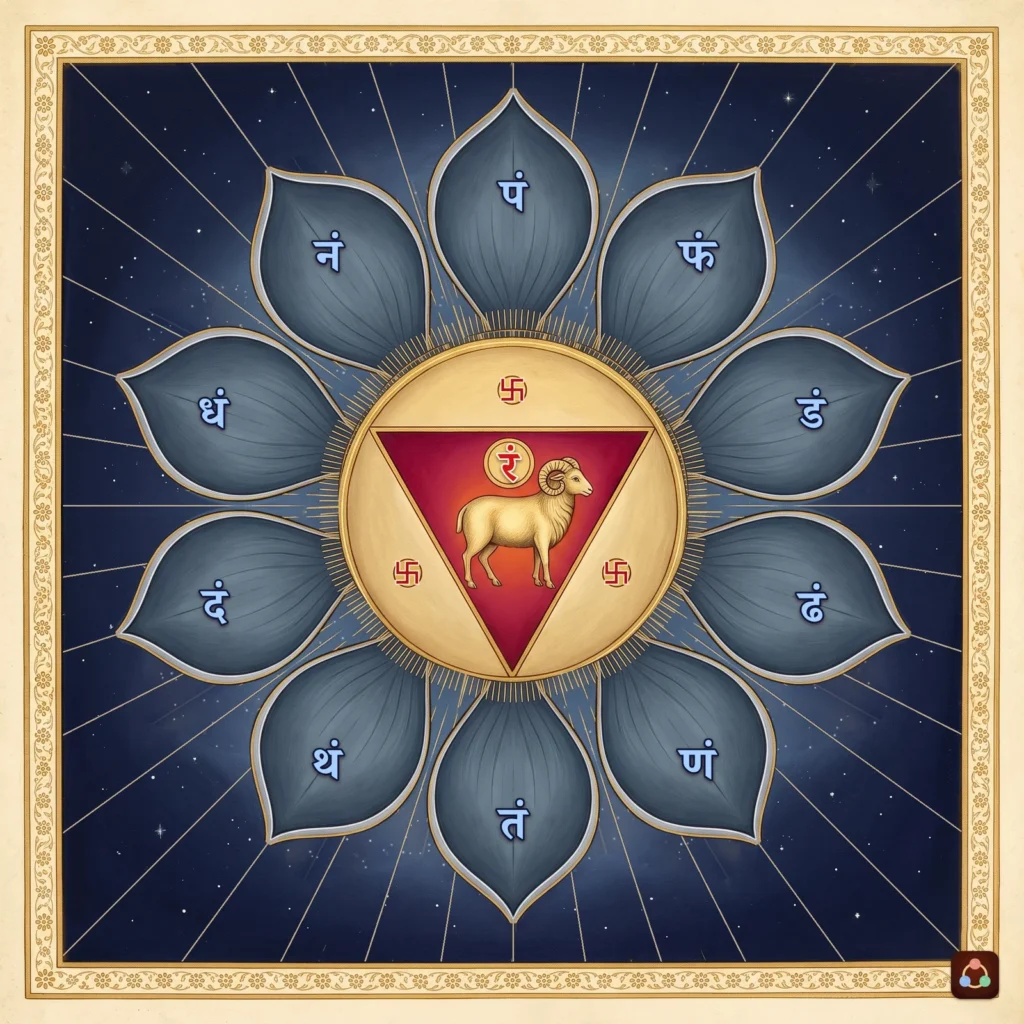
| Petals | Ten, the colour of heavy rain-clouds |
| Letters on the petals | डं ढं णं तं थं दं धं नं पं फं (ḍa, ḍha, ṇa, ta, tha, da, dha, na, pa, pha), each with the bindu, the colour of a blue lotus, read round from the right |
| Element | Fire (tejas) in the Shat-chakra-nirupana; water in the Soundarya Lahari |
| Linked with | Form and colour: the principle (tattva) of form and colour, the sense of sight, and the anus as the organ of action, which are dissolved here (Woodroffe’s table) |
| Its shape | A red triangle, shining like the rising sun, with three svastikas outside it, one on each side |
| Bija | रं (ram), red, seated on a ram, four-armed. In the 1937 Soundarya Lahari commentary, with water, वं (vam) |
| Deity | Rudra: red, but white with ash; old in appearance, three-eyed; pictured on a bull |
| Ruling goddess | Lakini, in both the Shat-chakra-nirupana and the Lalita Sahasranama |
| Rays | Fifty-two (Soundarya Lahari 14) |
| Soundarya Lahari | Verses 9, 14, 40, 41 and 99 (101 in the 1937 book) |
What the Shat-chakra-nirupana says
The Shat-chakra-nirupana gives the Manipura three verses, 19 to 21. Here is what they show, from the outside in.
The petals. Ten petals, “of the colour of heavy-laden rain-clouds” (verse 19). The commentary explains this as a dark colour. On the petals are ten letters, from ḍa to pha: ḍa, ḍha, ṇa, ta, tha, da, dha, na, pa and pha, one on each petal. They are “of the colour of the blue lotus”, and above each letter are the nada and the bindu.
The region of fire. Within the lotus, the verse says, “meditate there on the region of Fire, triangular in form and shining like the rising sun”. The summary of these verses in Woodroffe’s edition calls it red. Outside the triangle are three svastikas, and the commentary places them “on three sides of the triangle”. A writer it quotes, Raghava-bhatta, explains the mark: two straight lines that cross and go out in four directions. The text does not say which way the triangle points. Our painting points it down.
The bija and the ram. Within the triangle is the seed-syllable of fire, ram. Pictured as a being, it is fire itself: “seated on a ram, four-armed, radiant like the rising Sun” (verse 20). The summary adds that he is red, that he holds the thunderbolt (vajra) and the weapon called the shakti, which Woodroffe’s note calls fire’s own weapon, and that his other two hands make the gestures of granting boons and of removing fear. A meditation verse that the commentator quotes gives him a rosary of rudraksha beads in place of the thunderbolt.
Rudra. “In His lap ever dwells Rudra, who is of a pure vermilion hue” (verse 20). He is smeared with ash, so he looks white. He is old in appearance and has three eyes, and his hands grant boons and remove fear. The verse calls him “the destroyer of creation”. The commentator adds that he should be pictured seated on a bull.
Lakini. “Here abides Lakini, the benefactress of all” (verse 21). She has four arms and a radiant body. She is dark, she is dressed in yellow, and she wears many ornaments. Her mind, the verse says, is lifted by drinking nectar. A meditation verse that the commentator quotes adds much more. In it she is blue, with three faces and three eyes on each face. Her look is fierce and her teeth protrude. In her right hands she holds the thunderbolt and the shakti weapon, and with her left hands she grants boons and removes fear. The same verse says she is fond of meat, and pictures her with blood at her mouth. Woodroffe’s own chapter explains why. Lakini, he writes, is a power of the yogi’s own body, the power of the bodily tissue at this centre, and concentration on this centre “may involve the satisfaction of the appetites of this Devata”. He adds that “the Shaktis of the higher centres are not meat-eaters”. Our painting does not show her, or Rudra.
The fruit. Verse 21 promises that whoever meditates on this navel lotus gains “the power to destroy and create (the world)”. It adds that Vani, the goddess of speech, “with all the wealth of knowledge ever abides in the lotus of his face”. These are a tradition’s promises about meditation. They are not medical claims.
What the Soundarya Lahari says
The Soundarya Lahari gives this centre a different element. Its own verse is verse 40, and the commentary brings the Manipura into several more.
Verse 9 places water here, and fire in the Svadhishthana below. The lotus is the same lotus. What changes is the element meditated on inside it, and with the element, in the 1937 Adyar commentary’s scheme, its seed-syllable: vam here, not ram. A table in the same book’s commentary on verse 35 also gives this centre a different god: Vishnu, not Rudra. The commentary says this lotus stands for water in its subtle form, as taste. It is the third lotus in the body, but the poet names it second, to keep to the order of the elements. Mastering it, the commentary says, is said to give power over water, such as floating on it or walking on it. It also links this centre to the inner ten-cornered figure of the Sri Chakra. Read verse 9
Verse 14 counts the rays of light in each centre. In the Manipura, the centre of water, there are fifty-two. Read verse 14
Verse 40 is this centre’s own verse.
ತಟಿತ್ತ್ವಂತಂ ಶಕ್ತ್ಯಾ ತಿಮಿರಪರಿಪಂಥಿಸ್ಫುರಣಯಾಸ್ಫುರನ್ನಾನಾರತ್ನಾ-ಭರಣಪರಿಣದ್ಧೇಂದ್ರಧನುಷಮ್ ।ತವ ಶ್ಯಾಮಂ ಮೇಘಂ ಕಮಪಿ ಮಣಿಪೂರೈಕಶರಣಂನಿಷೇವೇ ವರ್ಷಂತಂ ಹರಮಿಹಿರತಪ್ತಂ ತ್ರಿಭುವನಮ್
MeaningI serve that wondrous dark cloud of yours which has the manipura chakra (the centre of water) as its only home. It carries lightning, the Shakti whose flash is the enemy of darkness, and the glitter of your many jewelled ornaments girds it like a rainbow. Over the three worlds, scorched by the sun that is Hara (Rudra’s burning fire at the dissolution), it pours down rain and brings them back to life. Read verse 40
The 1937 commentary names the pair to be meditated on here: Megheshvara, the lord of the cloud, and Saudamani, the lightning. It also calls them Amriteshvara and Amriteshvari, the lord and lady of nectar, and places them in the middle, ringed by fifty-two watery rays. The dark cloud is his form, and the lightning is his Shakti. The commentary also explains the darkness that the lightning drives away: the light of Kundalini turns the darkness of the Manipura into a place of light mixed with darkness.
Then it gives a traditional view of the verse. The rays of the sun from the heart, and the heat of the fire in the Svadhishthana, turn the water of the Manipura into clouds. At the great dissolution, those clouds pour down and put out the fire that burns the world. From Lakshmidhara’s long commentary, the 1937 book also reports an old text, no longer known to survive, in which Sadashiva shines in the Manipura as a winter cloud, with his consort as the lightning. Read verse 40
Verse 41 brings the most important note. The commentary on it says the two lower centres lie in “the region of darkness”. The book then gives an account that it later names as Lakshmidhara’s view. Through meditation on six kinds of oneness, and by the grace of the guru, the Mother bursts through the two lower centres and shows herself directly in the Manipura. The full inner worship of the Samaya way, with every offering up to jewels set with gems, is done here, and then she is led up to the heart and beyond. Shankaracharya’s own view, the book says, read from his picture of the Mother in verse 7, is that she appears in the Manipura when the worshipper has realised four kinds of oneness. Read verse 41
Near the end of the poem, at verse 101 in the 1937 book’s numbering, which is verse 99 on this site, the commentary returns to this centre. Lakshmidhara, as the book reports him, holds that those who worship the Mother in the Manipura gain the freedom called sarshti: they build a city beside her city and live there, always in her service. He also explains the ten petals. The Manipura has ten, he says, because it is “made up of the characteristics of” the Muladhara and the Svadhishthana, the four petals of the one and the six of the other. Read verse 99
What the Lalita Sahasranama says
The rise of Kundalini (names 100 to 102). In the names that trace her rise, the Mother is first “she who breaks through the knot of Brahma” (100), then “she who emerges in the Manipura” (101), then “she who breaks through the knot of Vishnu” (102). Woodroffe’s account of the rise agrees: it calls the Manipura the knot of Brahma, and places Vishnu’s knot at the heart. The 1937 Soundarya Lahari commentary differs. It places the knots at the ends of pairs of centres taken in the order of the elements, so that Rudra’s knot falls at the Svadhishthana and Brahma’s at the Ajna.
The yogini of the Manipura (names 495 to 503). For this centre the Lalita Sahasranama names Lakini.
| No. | Name | Meaning |
|---|---|---|
| 495 | maṇipūrābja-nilayā | Who dwells in the ten-petalled lotus of the Manipura |
| 496 | vadana-traya-saṃyutā | Who has three faces |
| 497 | vajrādikāyudhopetā | Who holds the thunderbolt (vajra) and other weapons |
| 498 | ḍāmary-ādibhir-āvṛtā | Surrounded by Damari and the other attendant Shaktis |
| 499 | rakta-varṇā | Red in colour |
| 500 | māṃsa-niṣṭhā | Who presides over the flesh of living beings |
| 501 | guḍānna-prīta-mānasā | Fond of rice cooked with jaggery |
| 502 | samasta-bhakta-sukhadā | Who gives happiness to all her devotees |
| 503 | lākiny-ambā-svarūpiṇī | In the form of the mother Lakini |
Here, for once, the two lists agree on the name: Lakini rules the Manipura in both. They agree that she has three faces and that she holds the thunderbolt. Both tie her to flesh. The Lalita Sahasranama says she presides over the flesh of living beings. The meditation verse quoted with the Shat-chakra-nirupana says she is fond of meat, and some read it as “she who abides in flesh”. A list that Woodroffe gives from another text, and the 1937 Soundarya Lahari commentary, also put flesh at this centre. They differ on her colour, red here, and dark or blue in the Shat-chakra-nirupana, and on her food.
Three texts, one lotus
On the ten petals, the texts agree. They differ on the element, on the god who dwells here, and on the knots.
| Shat-chakra-nirupana | Lalita Sahasranama | Soundarya Lahari | |
|---|---|---|---|
| Element | Fire (verse 19) | Water (verses 9 and 14; the commentary on 40) | |
| Bija | रं (ram), on a ram | वं (vam), in the 1937 commentary’s scheme | |
| Who dwells here | Rudra, in the lap of the bija | Megheshvara and Saudamani, the cloud and the lightning (commentary on verse 40); Vishnu, in the table in the 1937 commentary on verse 35 | |
| Ruling goddess | Lakini | Lakini | |
| Her form | Dark (verse 21); blue, with three faces and three eyes on each (in a meditation verse the commentator quotes) | Red, with three faces | |
| What she holds | Four arms (verse 21); the thunderbolt and the shakti weapon, her other hands removing fear and granting boons (the meditation verse and the summary) | The thunderbolt (vajra) and other weapons | |
| Bodily tissue | Flesh: the meditation verse calls her “fond of meat”; one reading, in Woodroffe’s note, is “she who abides in flesh” | Flesh (as also in a list Woodroffe gives) | Flesh, in the 1937 commentary on verse 14 |
| Favourite food | Rice and dal cooked and mixed with meat and blood (the summary) | Rice with jaggery | |
| The knots | Not named in verses 19 to 21; Woodroffe’s account of the rise calls the Manipura the knot of Brahma, and the heart the knot of Vishnu | The knot of Brahma is broken just before (name 100), and Vishnu’s just after (name 102) | Rudra’s knot at the Svadhishthana, Brahma’s at the Ajna: the knots fall at the ends of pairs of centres, in the order of the elements (1937 commentary) |
| Rays | Fifty-two (verse 14) |
What it means for the inner life
The texts read the Manipura in a few simple ways.
It is the centre of inner fire. Woodroffe calls it “this digestive centre”. The subtle fire of this centre, he writes, governs the gross fire, called Vaishvanara, in the belly. The breath called samana, which kindles the body’s fire and governs digestion, is said to dwell at the navel. In his table, this centre is linked with form and colour, and with sight.
Fire and water belong together. The Shat-chakra-nirupana sees fire here. The Soundarya Lahari sees water, and turns it into rain. Clouds born from heat pour down and put out the fire that would burn the world. As at the Svadhishthana, power is never left alone; mercy comes with it.
It is where inner worship begins. For the 1937 Soundarya Lahari commentary, the two lotuses below lie in darkness. Those who follow the Samaya way worship the Mother who has reached the Manipura, and the four centres above the first two. Their worship rises from here to the thousand-petalled lotus.
Its powers are not the goal. The commentary on verse 9 says that one who masters this centre is said to gain power over water. The same commentary calls such powers “pitfalls”. The goal lies above.
What lies here in the body
I am a physician, so let me say plainly what sits at this level.
The navel itself most often lies at the level of the fourth lumbar vertebra; a study of scans in 834 people found it most often there. Around and above it lie the organs of digestion: the stomach, the liver, the pancreas and the small intestine. Behind them runs the great artery of the abdomen. Higher up, behind the stomach, a web of nerves and small nerve knots wraps around a branch of that artery. Doctors call it the coeliac plexus; its old name is the solar plexus. Nerves from the chest come through the diaphragm to join it, and so do branches of the vagus nerve. It carries the nerves that run the organs of digestion without our thinking, and the nerves that carry pain from them. That is why doctors sometimes block it to ease the pain of cancer of the pancreas.
A century ago, some writers tried to match the chakras to such nerve centres. The scholar Brajendranath Seal linked the navel centre to the solar plexus, and called the Manipura itself the lumbar plexus. Another author’s list puts the epigastric plexus here. Woodroffe wrote that it “must be a matter of opinion” which of these fits, and that the text makes it plain “the Chakras are in the Sushumna”. Later writers in the West often call it the solar plexus chakra. The old texts do not use that name.
Woodroffe also passed on a warning. The yogis say, he writes, that piercing the knot of Brahma can bring pain, disorder and even disease, and he added that this is “not unlikely to follow from concentration on such a centre as the navel”. He adds that the student must be fit for it, as his guru judges, and that the method can be learned only from the guru.
Is there any study of yoga for this part of the body? A review in 2025 pooled eleven trials of yoga for irritable bowel syndrome, with 535 patients. It found no clear difference from the comparison groups in symptoms, anxiety, depression or quality of life, and said the evidence was uncertain. One small trial, of 19 patients with acid reflux, found that a month of training in breathing from the belly reduced the time acid spent in the food pipe. It needs repeating in larger groups. The one study I found that named the Manipura measured its “energy” with a camera that reads the glow around the fingertips, in 15 people. That device is not an accepted measure of any function of the body. I found no study that has tested the Manipura itself in a way medicine accepts.
Sources
- Arthur Avalon (Sir John Woodroffe), The Serpent Power, Ganesh and Co, Madras. Shat-chakra-nirupana, verses 19 to 21, with the commentary of Kalicharana, pp. 366 to 370; commentary on verse 4, p. 332; Introduction, pp. 11 to 12; pp. 77 to 78, 93 and 237; chapter V, pp. 117 to 120, 141 to 142, 153 to 155 and 158 to 159.
- Adi Shankaracharya, Saundarya-Lahari, with transliteration, English translation and commentary by S. Subrahmanya Sastri and T. R. Srinivasa Ayyangar, drawing on Lakshmidhara and other commentators. Theosophical Publishing House, Adyar, 1937. Verse 9, pp. 54 to 59; verse 14, pp. 75 to 78; verse 35, p. 143; verse 40, pp. 154 to 156; verse 41, pp. 158 and 161 to 164; verse 101, pp. 252 and 255 to 257.
- The meanings of verses 9, 14, 40, 41 and 99 on Jeevana Sutra, and in the Soundarya Lahari app.
- Lalita Sahasranama, names 100 to 102 and 495 to 503. Numbers and meanings as in Sanskrit Documents, lalita1000.
- Shin D and others. Are the umbilicus and iliac crests truly at the level of L4 to L5? A computed tomography-based study of surface anatomy of the anterior lumbar spine. International Journal of Spine Surgery 2024; 18: 660 to 666. doi:10.14444/8651
- Mirilas P, Skandalakis JE. Surgical anatomy of the retroperitoneal spaces, part IV: retroperitoneal nerves. The American Surgeon 2010; 76: 253 to 262. PubMed 20349652
- Loukas M and others. Clinical anatomy of celiac artery compression syndrome: a review. Clinical Anatomy 2007; 20: 612 to 617. doi:10.1002/ca.20473
- Okita M and others. Efficacy of endoscopic ultrasound-guided celiac plexus neurolysis for abdominal pain in patients with unresectable pancreatic cancer: network meta-analysis of randomized controlled trials. Journal of Clinical Gastroenterology 2023; 57: 1054 to 1062. doi:10.1097/MCG.0000000000001773
- Saab O and others. Yoga for irritable bowel syndrome: a systematic review and meta-analysis of randomized controlled trials. American Journal of Gastroenterology 2025; 120: 2764 to 2775. doi:10.14309/ajg.0000000000003524
- Eherer AJ and others. Positive effect of abdominal breathing exercise on gastroesophageal reflux disease: a randomized, controlled study. American Journal of Gastroenterology 2012; 107: 372 to 378. doi:10.1038/ajg.2011.420
- Veerabrahmachar R and others. Immediate effect of Nada Yoga meditation on energy levels and alignment of seven chakras as assessed by electro-photonic imaging: a randomized controlled crossover pilot study. Advances in Mind-Body Medicine 2023; 37: 11 to 16. PubMed 37119541