
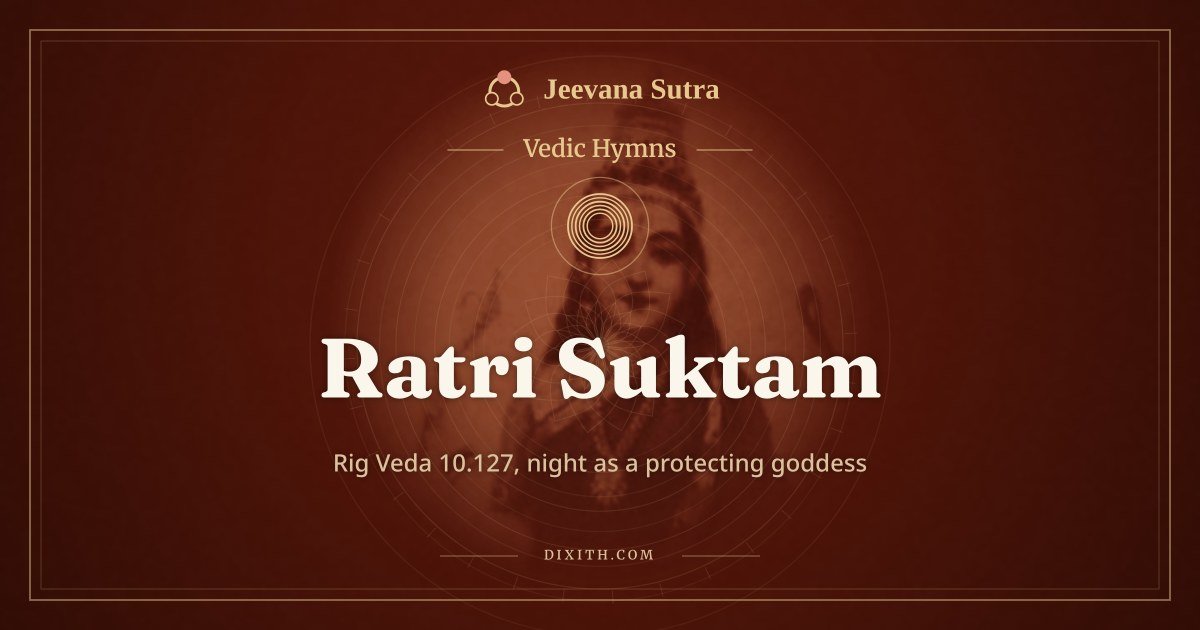
We have learned that darkness means fear. This seer of the Rig Veda sees night as a goddess: one who looks everywhere with the eyes of the stars, who puts villages and birds to sleep, who protects from the wolf and from thieves.
The fourth mantra, which says that like birds returning to their nests we rest when you come, is the heart of this hymn. There is a tradition of reciting it before the recitation of the Durga Saptashati.
Text with svara (Devanagari)
Viniyoga (use of the hymn)
अस्य श्री रात्रीति सूक्तस्य कुशिक ऋषिः गायत्रीच्छंदः, रात्रिर्देवता,
श्रीजगदंबा प्रीत्यर्थे सप्तशतीपाठादौ जपे विनियोगः ।
The hymn
रात्री॒ व्य॑ख्यदाय॒ती पु॑रु॒त्रा दे॒व्य॒॑क्षभिः॑ ।
विश्वा॒ अधि॒ श्रियो᳚ऽधित ॥ 1 ॥
ओर्व॑प्रा॒ अम॑र्त्या नि॒वतो᳚ दे॒व्यु॒॑द्वतः॑ ।
ज्योति॑षा बाधते॒ तमः॑ ॥ 2 ॥
निरु॒ स्वसा᳚रमस्कृतो॒षसं᳚ दे॒व्या᳚य॒ती ।
अपेदु॑ हासते॒ तमः॑ ॥ 3 ॥
सा नो᳚ अ॒द्य यस्या᳚ व॒यं नि ते॒ याम॒न्नवि॑क्ष्महि ।
वृ॒क्षे न व॑स॒तिं-वँयः॑ ॥ 4 ॥
नि ग्रामा᳚सो अविक्षत॒ नि प॒द्वंतो॒ नि प॒क्षिणः॑ ।
नि श्ये॒नास॑श्चिद॒र्थिनः॑ ॥ 5 ॥
या॒वया᳚ वृ॒क्यं॒॑ वृकं॑-यँ॒वय॑ स्ते॒नमू॑र्म्ये ।
अथा॑ नः सु॒तरा᳚ भव ॥ 6 ॥
उप॑ मा॒ पेपि॑श॒त्तमः॑ कृ॒ष्णं-व्यँ॑क्तमस्थित ।
उष॑ ऋ॒णेव॑ यातय ॥ 7 ॥
उप॑ ते॒ गा इ॒वाक॑रं-वृँणी॒ष्व दु॑हितर्दिवः ।
रात्रि॒ स्तोमं॒ न जि॒ग्युषे᳚ ॥ 8 ॥
ॐ शांतिः॒ शांतिः॒ शांतिः॑ ॥
Text in English IAST transliteration
asya śrī rātrīti sūktasya kuśika ṛṣiḥ gāyatrīcchaṃdaḥ, rātrirdevatā,
śrījagadaṃbā prītyarthe saptaśatīpāṭhādau jape viniyogaḥ |
The hymn
rātrī̱ vyákhyadāya̱tī púru̱trā de̱vyá̱kṣabhíḥ |
viśvā̱ adhi̱ śriyő’dhita || 1 ||
orváprā̱ amártyā ni̱vatő de̱vyú̱dvatáḥ |
jyotíṣā bādhate̱ tamáḥ || 2 ||
niru̱ svasā̋ramaskṛto̱ṣasa̋ṃ de̱vyā̋ya̱tī |
apedú hāsate̱ tamáḥ || 3 ||
sā nő a̱dya yasyā̋ va̱yaṃ ni te̱ yāma̱nnavíkṣmahi |
vṛ̱kṣe na vása̱tiṃ-va~yáḥ || 4 ||
ni grāmā̋so avikṣata̱ ni pa̱dvaṃto̱ ni pa̱kṣiṇáḥ |
ni śye̱nāsáścida̱rthináḥ || 5 ||
yā̱vayā̋ vṛ̱kyá̱ṃ vṛkáṃ-ya̱~vayá ste̱namū́rmye |
athā́ naḥ su̱tarā̋ bhava || 6 ||
upá mā̱ pepíśa̱ttamáḥ kṛ̱ṣṇaṃ-vyá~ktamasthita |
uṣá ṛ̱ṇevá yātaya || 7 ||
upá te̱ gā i̱vākáraṃ-vṛ~ṇī̱ṣva dúhitardivaḥ |
rātri̱ stoma̱ṃ na ji̱gyuṣe̋ || 8 ||
oṃ śāṃti̱ḥ śāṃti̱ḥ śāṃtíḥ ||
Accents: macron below for anudātta, acute for svarita, double acute for the kampa; udātta is unmarked.
About this hymn
The Rig Veda has many hymns to Dawn, and this is its only full hymn to Night. Here Night is not darkness. She drives darkness back with starlight, and she is Dawn’s elder sister.
Some indexes name the seer Kushika Saubhara and others Ratri Bharadvaji. The word pepishat in the seventh mantra is very obscure and is read both as adorning and as enveloping. The digit 1 used as a kampa sign in the source text has been left out here.
The accented text follows the 2026 collection of Vedic hymns prepared by Aprameya of Udupi. How to read the marks: a line below a syllable is anudatta, a vertical stroke above is svarita, a double stroke above is the long svarita. Learning from a teacher remains the right way.
Sources: several. Where versions differ, we have noted it here.
For life today
The fifth mantra calls night the time when the whole village, animals, birds and even the hunting hawk all rest. In the age of electric light and screens we have lost that rhythm.
Poor sleep and the fatigue of night shifts are among the commonest health problems today. Today the hymn can be read this way: dim the lights after dark and welcome night as a bird returns to its nest.
Noticed a mistake or a different reading? Tell us.



Leave a comment