All seven chakras · Next: Svadhishthana
She sleeps.
Fine as the thread inside a lotus stalk, she lies coiled three and a half times round a small, self-born linga. Her mouth rests over the opening at its top. She shines like a flash of young lightning, and she murmurs, softly, like a swarm of bees.
This is Kundalini, at home in the Muladhara, the lowest of the lotuses. Every ascent in the Soundarya Lahari begins here, and every return ends here.
On this pageThe name · Where it is · The lotus, as the texts describe it · What the Shat-chakra-nirupana says · What the Soundarya Lahari says · What the Lalita Sahasranama says · Two texts, one lotus · What it means for the inner life · What lies here in the body · Sources
The name
Mula means root. Adhara means support. The Muladhara is the root-support: the root of the six lotuses that rise above it along the sushumna, and the ground on which they stand.
Where it is
The Shat-chakra-nirupana places it at the very bottom of the sushumna, “below the genitals and above the anus” (verse 4). Sitting cross-legged, that is the point of the body that rests nearest the ground.
The lotus is attached to the mouth of the sushumna. The text says its head hangs downward. Another tantra, quoted by the commentator, explains why. In ordinary life the lotuses face down. On the path back to the source, they are seen turned upward. Our painting shows it upward, as it is pictured in meditation.
The lotus, as the texts describe it
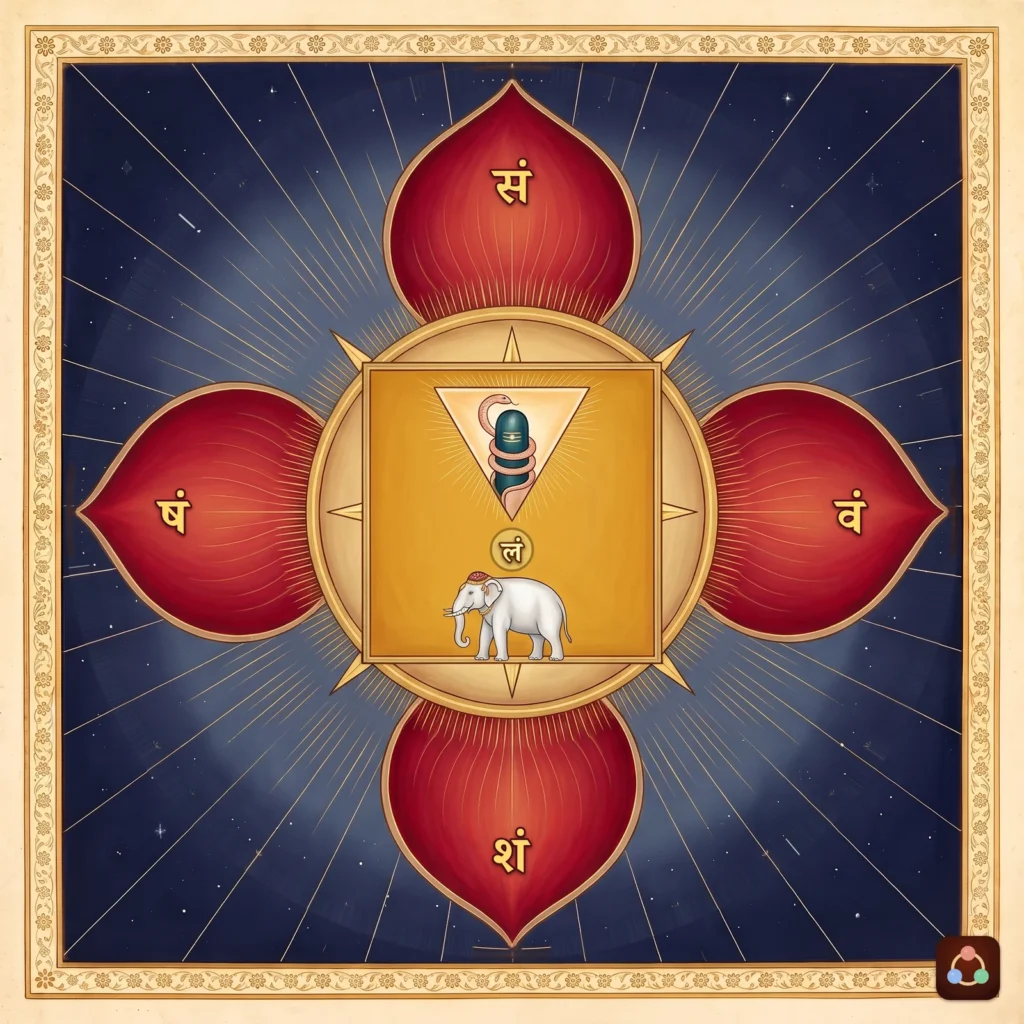
| Petals | Four, crimson like a red lotus |
| Letters on the petals | वं शं षं सं (va, sha, sha, sa), in gold, read round from the right |
| Element | Earth (prithvi). The Shat-chakra-nirupana and the Soundarya Lahari agree. |
| Its quality | Smell (gandha) |
| Its shape | A yellow square, with eight shining spears |
| Bija | लं (lam), yellow, four-armed, holding a thunderbolt, seated on the elephant Airavata |
| Deity | The child Brahma: red, four faces, four arms |
| Ruling goddess | Dakini (Shat-chakra-nirupana); Sakini (Lalita Sahasranama) |
| In the centre | The triangle Traipura with the wind Kandarpa; the Svayambhu linga; Kundalini coiled three and a half times |
| Knot | Brahma granthi |
| Rays | Fifty-six (Soundarya Lahari 14) |
| Soundarya Lahari | Verses 9, 10, 14 and 41 |
What the Shat-chakra-nirupana says
Pūrṇānanda’s Shat-chakra-nirupana, the “Description of the Six Centres”, gives the Muladhara ten verses, 4 to 13. Almost every traditional picture of the chakras is drawn from it. Here is what it shows, from the outside in.
The petals. Four petals, crimson like a red lotus. On them, four letters in shining gold: va, sha, sha and sa. The two sha sounds are different: one is made with the tongue on the palate, the other with the tip of the tongue turned back. The letters are read going round from the right.
The square of earth. In the middle of the lotus is a square. It is the region of Prithvi, the earth. It is yellow, “beautiful like lightning”, and eight shining spears stand out from its eight sides (verse 5).
The bija and Brahma. Inside the square is the seed-syllable of earth, lam. It is yellow too. The text pictures it as a being with four arms, holding a thunderbolt and seated on Airavata, the king of elephants (verses 5 and 6). In its lap sits the child Brahma, the creator, “resplendent like the young Sun”. He has four faces and four arms. The commentary gives him a staff, a water pot, a rosary, and the open hand that says “do not fear”.
Dakini. In this lotus lives the goddess Dakini, the ruler of this centre. She is red, with red eyes and four arms. She shines “like the lustre of many Suns rising at one and the same time” (verse 7). The text says she carries “the revelation of the ever-pure Intelligence”: meditating on her brings knowledge of the true nature of things.
The triangle. Within the square is a soft, lightning-like triangle, its point downward. It is called Traipura, because the goddess Tripura dwells in it. Inside it moves a wind called Kandarpa, deeper red than the bandhujiva flower. The commentary explains it as a part of apana, the downward breath, and gives a lovely picture of why it matters. The upward and downward breaths pull at each other like a falcon tied to a string. Each stops the other from leaving the body (verse 8).
The linga. Inside the triangle is Shiva as the Svayambhu linga, “the self-born”. The commentary says it tapers like an unopened leaf-bud: broad below, pointed above, and dark blue-green in colour. Its light is cool, like the light of the full moon. Shiva lives here, the text says, as happily as he lives in Kashi (verse 9).
Kundalini. Over the linga lies Kundalini, as at the start of this page (verses 10 and 11). The text calls her the source of all speech: prose and verse, in Sanskrit and in every other tongue. She keeps every creature alive by the breath going in and out.
Para. Above her, says verse 12, rises the supreme Shakti, subtler than the subtlest. She holds the stream of nectar that flows from eternal bliss.
The fruit. Verse 13 tells what meditation on her here brings: mastery of speech, learning, gladness of heart, and freedom from disease. These are a tradition’s promises about meditation. They are not medical claims.
What the Soundarya Lahari says
The Muladhara appears in four verses.
Verse 9 places earth here, at the start of the ascent. The 1937 Adyar commentary adds a thought worth keeping: without the Muladhara and its earth, the body would lose its balance and its steadiness. Read verse 9
Verse 10 brings Kundalini home. After meeting her Lord above, she comes back down, coils herself three and a half times, and sleeps in the hollow of the Muladhara. Read verse 10
Verse 14 counts the rays of light in each centre. In the Muladhara, the centre of earth, there are fifty-six. Our painting recalls them with the fine rays that spread across the sky behind the lotus. Read verse 14
Verse 41 is the last of the six verses that walk down the centres, from the Ajna to the Muladhara.
Here Shiva is Navatman, the dancer of the great tandava, the vigorous dance, full of all nine moods of art. Beside him the Mother, as Samaya, dances the gentle lasya. Because these two come together, the poet says, the world has a father and a mother.
The commentary in the 1937 book follows Lakshmidhara. It names the pair to be meditated on here as Adi-nata and Lasyeshvari, ringed by the fifty-six rays of earth. It also explains the word Samaya. This commentary follows the Samaya way of worship. In it, the Mother is worshipped within, in the thousand-petalled lotus, and not in outer rites at the lower centres. Read verse 41
What the Lalita Sahasranama says
The Lalita Sahasranama speaks of the Muladhara in two places.
Kundalini’s rising (names 99 to 111):
| No. | Name | Meaning |
|---|---|---|
| 99 | mūlādhāraika-nilayā | Whose chief home is the Muladhara |
| 100 | brahma-granthi-vibhedinī | Who breaks the knot of Brahma |
| 101 | maṇipūrāntar-uditā | Who rises up within the Manipura |
| 102 | viṣṇu-granthi-vibhedinī | Who breaks the knot of Vishnu |
| 103 | ājñā-cakrāntarāla-sthā | Who stays within the Ajna |
| 104 | rudra-granthi-vibhedinī | Who breaks the knot of Rudra |
| 105 | sahasrārāmbujārūḍhā | Who rises to the thousand-petalled lotus |
| 106 | sudhā-sārābhivarṣiṇī | Who pours down streams of nectar |
| 110 | kuṇḍalinī | The coiled one |
| 111 | bisa-tantu-tanīyasī | Fine as the thread inside a lotus stalk |
The yogini of the Muladhara (names 514 to 520). In this section, each centre has a goddess, a yogini, with her own faces, weapons, bodily tissue and favourite food. For the Muladhara she is Sakini.
| No. | Name | Meaning |
|---|---|---|
| 514 | mūlādhārāmbujārūḍhā | Seated on the lotus of the Muladhara |
| 515 | pañca-vaktrā | Who has five faces |
| 516 | asthi-saṃsthitā | Who dwells in the bones |
| 517 | aṅkuśādi-praharaṇā | Who holds the goad and other weapons |
| 518 | varadādi-niṣevitā | Attended by Varada and the other Shaktis |
| 519 | mudgaudanāsakta-cittā | Fond of rice cooked with green gram |
| 520 | sākinyambā-svarūpiṇī | Who is the Mother Sakini |
Two texts, one lotus
On the element, the texts agree: the Shat-chakra-nirupana and the Soundarya Lahari both make this the centre of earth. The Soundarya Lahari’s change of elements touches only the Svadhishthana and the Manipura, not this centre. They differ on who rules it.
| Shat-chakra-nirupana | Lalita Sahasranama | Soundarya Lahari | |
|---|---|---|---|
| Element | Earth | Earth (verse 9) | |
| Who rules it | Dakini | Sakini | Shiva as Navatman, with the Mother as Samaya (verse 41) |
| Her form | Red, with red eyes and four arms | Five faces | |
| What she holds | Spear, skull-staff, sword and a cup | The goad and other weapons | |
| Bodily tissue | Skin (a text quoted by Woodroffe) | Bone | |
| Favourite food | Rice cooked in milk | Rice cooked with green gram |
What it means for the inner life
The texts read the Muladhara in a few simple ways.
It is the ground. This is the centre of earth, and its subtle quality is smell. The commentary on verse 9 links earth to the body’s balance and steadiness.
It is where the power waits. Kundalini is not absent in an ordinary life. She is asleep. The whole work of this yoga is her waking and her rising, and the tenth verse tells us she comes back here to rest.
It is where speech begins. The texts trace every word we speak back to a silent sound, para, rising from this centre. It becomes clearer as it passes through the higher centres, until it reaches the lips as the speech we hear.
Its powers are not the goal. Tradition says that mastering this centre brings unusual powers. The 1937 commentary warns that such powers are “pitfalls to be avoided”. They turn the seeker away from the goal, which lies at the top, in the Sahasrara.
What lies here in the body
I am a physician, so let me say plainly what sits at this spot.
Between the anus and the genitals lies the perineum. Under it is the floor of the pelvis, a sling of muscle that holds up the bladder, the bowel and, in women, the womb. The nerves that serve it come from the lowest part of the spine. Two long chains of nerve knots run down either side of the spine. Just in front of the tailbone, they end by joining into one small knot, the ganglion impar. The texts call the Muladhara the place where ida, pingala and sushumna meet. A century ago, the scholar Brajendranath Seal took ida and pingala to be these two chains. It is a striking coincidence. It is only a coincidence of place. It does not show that the Muladhara is that knot.
Hatha yoga has a practice at this very spot: mula bandha, the root lock, a held contraction at the perineum. Here modern medicine has something real to say. Exercises that train the pelvic floor muscles are the first recommended treatment for urinary leakage in women. A 2024 Cochrane review found, with low certainty, that direct, repeated contractions of these muscles may help more than indirect exercises. That is a fact about muscles, not about chakras. Mula bandha itself, as yoga teaches it, has not been tested in such trials, so I would not claim the same benefit for it.
Sources
- Arthur Avalon (Sir John Woodroffe), The Serpent Power, Ganesh and Co, Madras. Shat-chakra-nirupana, verses 4 to 13, with the commentary of Kalicharana, pp. 331 to 356; chapter V, p. 115 and pp. 153 to 154.
- Adi Shankaracharya, Saundarya-Lahari, with transliteration, English translation and commentary by S. Subrahmanya Sastri and T. R. Srinivasa Ayyangar, drawing on Lakshmidhara and other commentators. Theosophical Publishing House, Adyar, 1937. Verse 9, pp. 51 to 59; verse 41, pp. 157 to 161.
- The meanings of verses 9, 10, 14 and 41 on Jeevana Sutra, and in the Soundarya Lahari app.
- Lalita Sahasranama, names 99 to 111 and 514 to 520. Numbers as in Sanskrit Documents, lalita1000.
- Hay-Smith EJC and others. Comparisons of approaches to pelvic floor muscle training for urinary incontinence in women. Cochrane Database of Systematic Reviews 2024, CD009508. doi:10.1002/14651858.CD009508.pub2
- Gunduz OH and others. Pain relief due to transsacrococcygeal ganglion impar block in chronic coccygodynia. Pain Medicine 2015; 16: 1278 to 1281. doi:10.1111/pme.12752