
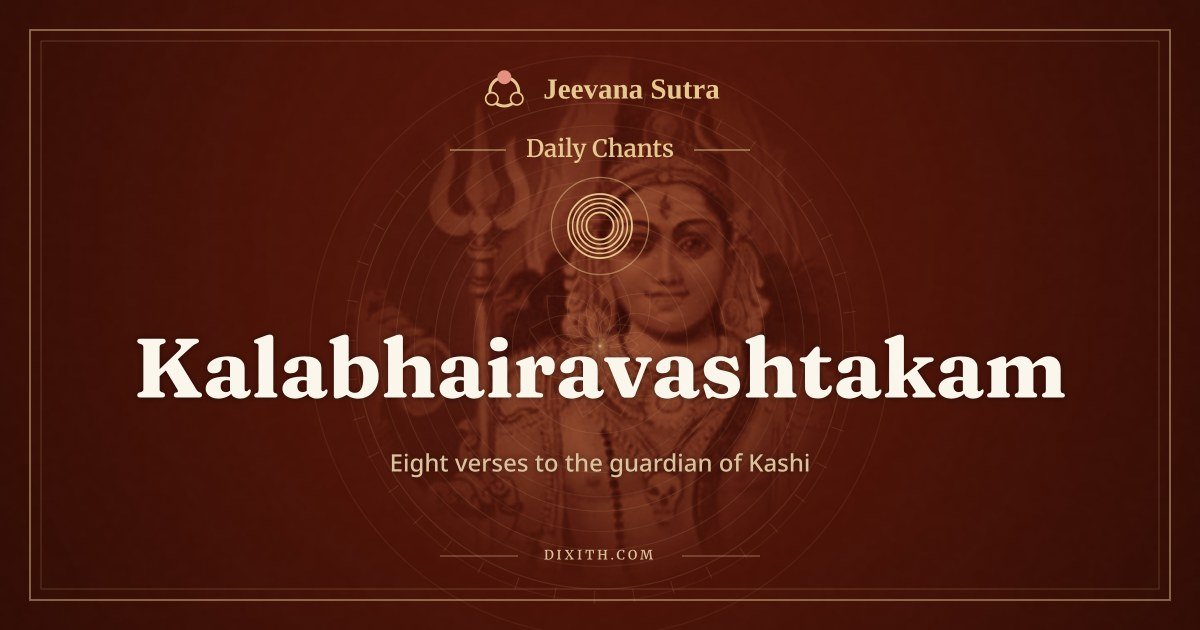
Kala means time, and kala means death. There is no one who does not fear both. This hymn says that Kalabhairava is the one who strikes fear even into Kala.
In Kashi, Kalabhairava is worshipped as the kshetrapala, that is, the guardian of the city. Every verse returns to the same single line, Kashikapuradhinatha Kalabhairavam bhaje. That repetition gives the recitation its rhythm.
Meaning
- 1
I worship Kalabhairava, lord of Kashi, whose holy lotus feet are served by Indra, king of the gods, who wears a serpent as his sacred thread and the moon on his head, who is a mine of compassion, who is saluted by Narada and the yogis, and who is clothed only in the directions. - 2
I worship Kalabhairava, lord of Kashi, radiant as a crore of suns, the supreme one who carries us across the ocean of worldly life, blue-throated, giver of what is desired, three-eyed, death even to Death, lotus-eyed, holding the rosary and the trident, imperishable. - 3
I worship Kalabhairava, lord of Kashi, who holds the trident, axe, noose and staff, the first cause of all, dark-bodied, the primal god, imperishable and free of affliction, the lord of terrible valour who delights in the wondrous tandava dance. - 4
I worship Kalabhairava, lord of Kashi, giver of both enjoyment and liberation, of glorious and beautiful form, loving towards devotees, steadfast, whose body is all the worlds, whose waist shines with sweetly tinkling golden bells. - 5
I worship Kalabhairava, lord of Kashi, guardian of the bridge of dharma and destroyer of the path of adharma, who frees us from the noose of karma and gives true well-being, the all-pervading one, pure of body and adorned with golden locks. - 6
I worship Kalabhairava, lord of Kashi, whose feet are lovely with the light of jewelled sandals, eternal, without a second, the chosen deity, stainless, who breaks the pride of Death, whose fearsome fangs are his ornament. - 7
I worship Kalabhairava, lord of Kashi, whose thunderous laugh splits the layers of the cosmic egg born of Brahma, whose glance destroys the net of sins, stern in his rule, giver of the eight siddhis, wearer of a garland of skulls. - 8
I worship Kalabhairava, lord of Kashi, leader of the hosts of spirits, giver of wide renown, the lord who weighs and purifies the merits and sins of those who live in Kashi, expert in the path of right conduct, ancient, master of the world.
Those who read this lovely Kalabhairavashtakam, a means to knowledge and liberation, which increases merit of many kinds and destroys grief, delusion, wretchedness, greed, anger and anguish, surely reach the presence of Kalabhairava’s feet.
About this hymn
Tradition attributes the Kalabhairavashtakam to Shankaracharya. As with many hymns under his name, scholars are not agreed on its authorship. The metre is panchachamara: sixteen syllables a line, moving in an alternating light and heavy rhythm.
The text on this page follows the copy that reached us. Most printed editions read slightly differently in a few places. In verse 4 the third line reads vinikvanan-manojna-hema-kinkini-lasat-katim. In verse 5 the third line reads svarna-varna-shesha-pasha-shobhitanga-mandalam, a body adorned with the golden serpent Shesha as a noose. Verse 6 also has the reading karala-damshtra-mokshanam. The printed readings fit the sixteen-syllable count of the metre exactly.
The hymn paints Bhairava in a fierce form, but its centre is protection. The dog that accompanies Kalabhairava is a sign of guardianship. Pilgrims to Kashi traditionally visit his shrine first.
Sources: several. Where versions differ, we have noted it here.
For life today
Look at the list in the closing verse: grief, delusion, wretchedness, greed, anger, anguish. These are not enemies outside us but within. Bhairava’s fierceness is turned towards them.
Read kala as time, and there is another meaning for life today. For those of us who race against the clock, the reminder that time too has a master gives a little room to breathe.
Noticed a mistake or a different reading? Tell us.
Leave a comment