ಏಳೂ ಚಕ್ರಗಳು · ಹಿಂದಿನದು: ಮಣಿಪೂರ · ಮುಂದಿನದು: ವಿಶುದ್ಧಿ
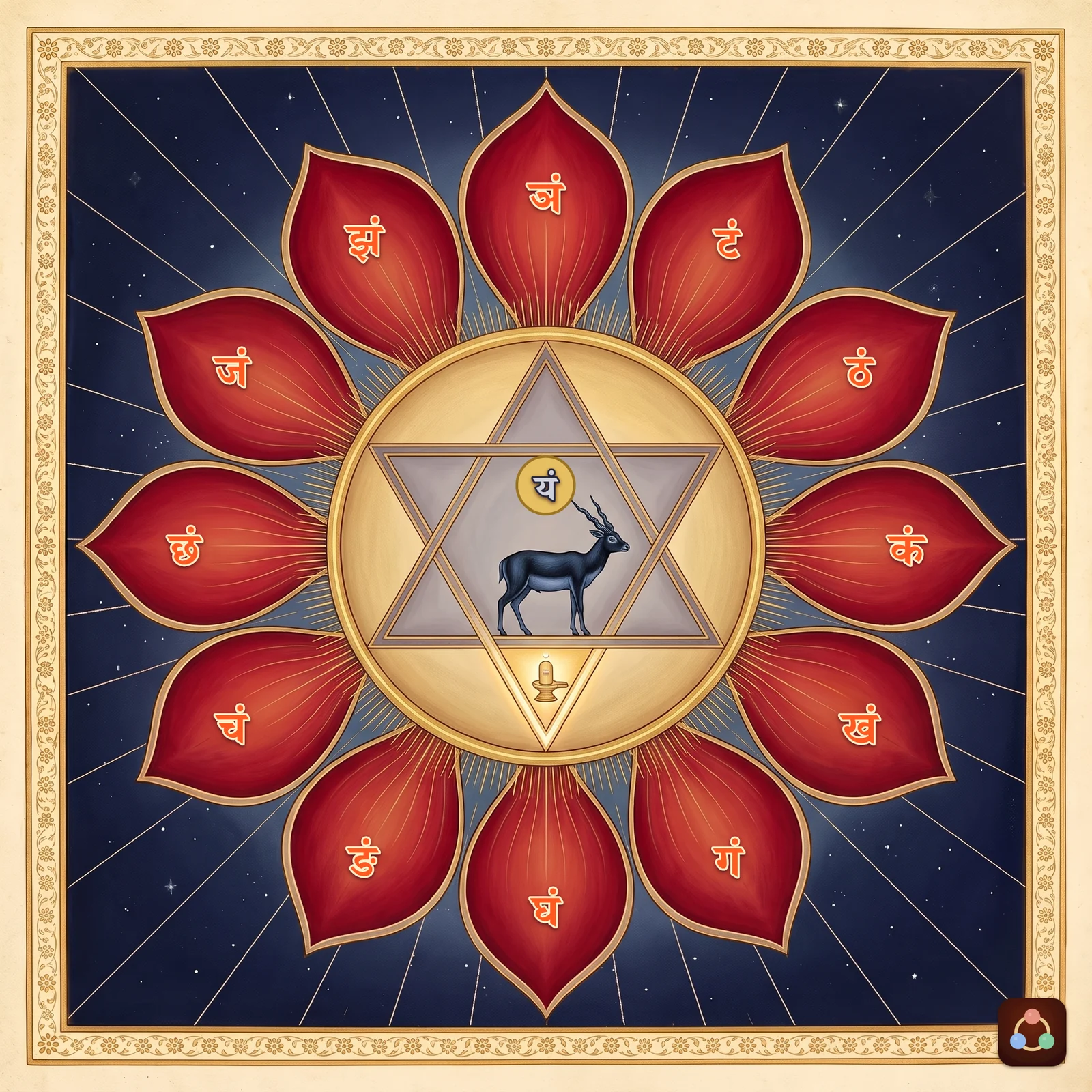
ಬಂಧೂಕ ಹೂವಿನಂತೆ ಕೆಂಪಾಗಿರುವ ಕಮಲದ ನಡುವೆ, ಹೊಗೆಬಣ್ಣದ ಎರಡು ತ್ರಿಕೋನಗಳ ನಕ್ಷತ್ರವಿದೆ.
ಆ ನಕ್ಷತ್ರದ ಮೇಲೆ ಕೃಷ್ಣಮೃಗವೊಂದು ನಿಂತಿದೆ; ಅದರ ಮೇಲೆ ಹೊಗೆಬಣ್ಣದ ವಾಯು ಬೀಜಾಕ್ಷರವಿದೆ. ಅದರ ಕೆಳಗೆ, ನಕ್ಷತ್ರದ ಕೆಳ ತುದಿಯಲ್ಲಿ, ಹೊಂಬಣ್ಣದ ಲಿಂಗ ಹೊಳೆಯುತ್ತಿದೆ. ಇವೆಲ್ಲವುಗಳ ಸುತ್ತಲೂ ಕೆಂಪು ಬಣ್ಣದ ಹನ್ನೆರಡು ದಳಗಳು ಅರಳಿವೆ; ಪ್ರತಿಯೊಂದು ದಳದ ಮೇಲೂ ಸಿಂಧೂರ ವರ್ಣದ ಅಕ್ಷರವಿದೆ.
ಇದು ನಾಲ್ಕನೆಯ ಕಮಲವಾದ ಅನಾಹತ, ಇರುವುದು ಎದೆಯಲ್ಲಿ. ಇಲ್ಲಿ ಷಟ್ಚಕ್ರ ನಿರೂಪಣ ಮತ್ತು ಸೌಂದರ್ಯ ಲಹರಿ ಎರಡೂ ಒಂದೇ ಮಾತನ್ನು ಹೇಳುತ್ತವೆ: ಎರಡೂ ಇಲ್ಲಿ ವಾಯುತತ್ವವನ್ನು ಕಾಣುತ್ತವೆ. ಸೌಂದರ್ಯ ಲಹರಿಯು ಈ ಕೇಂದ್ರಕ್ಕೆ ಒಂದು ಪ್ರತ್ಯೇಕ ಶ್ಲೋಕವನ್ನೇ ನೀಡಿದೆ, ಅದು ಹಂಸ ಜೋಡಿಯ ಶ್ಲೋಕ.
ಈ ಪುಟದಲ್ಲಿಹೆಸರು · ಇದು ಎಲ್ಲಿದೆ? · ಗ್ರಂಥಗಳು ವರ್ಣಿಸುವ ಕಮಲದ ರೂಪ · ಷಟ್ಚಕ್ರ ನಿರೂಪಣ ಏನು ಹೇಳುತ್ತದೆ? · ಸೌಂದರ್ಯ ಲಹರೀ ಏನು ಹೇಳುತ್ತದೆ? · ಲಲಿತಾ ಸಹಸ್ರನಾಮ ಏನು ಹೇಳುತ್ತದೆ? · ಮೂರು ಗ್ರಂಥಗಳು, ಒಂದೇ ಕಮಲ · ಅಂತರಂಗದ ಬದುಕಿಗೆ ಇದರ ಅರ್ಥವೇನು? · ದೇಹದ ಈ ಜಾಗದಲ್ಲಿ ಏನಿದೆ? · ಆಕರಗಳು
ಹೆಸರು
ಅನಾಹತ ಎಂದರೆ ‘ಹೊಡೆಯದೆ ಇರುವುದು’ ಅಥವಾ ‘ಆಘಾತವಿಲ್ಲದ್ದು’. ಷಟ್ಚಕ್ರ ನಿರೂಪಣದ ವ್ಯಾಖ್ಯಾನ ಇದನ್ನು ಬಿಡಿಸಿ ಹೇಳುತ್ತದೆ: ಯಾವುದೇ ಎರಡು ವಸ್ತುಗಳು ಒಂದಕ್ಕೊಂದು ತಾಗದೆ ಹುಟ್ಟುವ ಶಬ್ದಬ್ರಹ್ಮದ ನಾದ ಇಲ್ಲಿ ಕೇಳಿಸುವುದರಿಂದ, ಮುನಿಗಳು ಈ ಕಮಲಕ್ಕೆ ಈ ಹೆಸರಿಟ್ಟರು. 1937ರ ಸೌಂದರ್ಯ ಲಹರಿ ವ್ಯಾಖ್ಯಾನವೂ ಇದೇ ಮಾತನ್ನು ತನ್ನದೇ ಮಾತುಗಳಲ್ಲಿ ಹೇಳುತ್ತದೆ. ಎದೆಯ ಆಳದಲ್ಲಿ ಯಾವುದೇ ತಾಕಲಾಟವಿಲ್ಲದೆ ಹುಟ್ಟುವ ನಾದ ಎಂಬ ಅರ್ಥದಿಂದಲೇ ಈ ಕೇಂದ್ರಕ್ಕೆ ಈ ಹೆಸರು ಬಂದಿದೆ.
ಆಂತರಿಕ ನಾದವನ್ನು ಕೇಳುವ ಸಾಧನೆಯನ್ನು ವಿವರಿಸುವಾಗ ವುಡ್ರಫ್ ಒಂದು ಹಂತದ ಬಗ್ಗೆ ಹೇಳುತ್ತಾರೆ. ಮೊದಲ ಗ್ರಂಥಿಯನ್ನು ಭೇದಿಸಿದ ಮೇಲೆ, ಎದೆಯ ಆಕಾಶದಲ್ಲಿ ಆಭರಣಗಳ ಕಿಣಿಕಿಣಿ ನಾದದಂತಹ ಶಬ್ದ ಕೇಳಿಸುತ್ತದೆ ಎನ್ನುತ್ತಾರೆ ಅವರು.
ಇದು ಎಲ್ಲಿದೆ?
ಷಟ್ಚಕ್ರ ನಿರೂಪಣವು ಇದನ್ನು ಮಣಿಪೂರದ ‘ಮೇಲೆ’, ‘ಹೃದಯದಲ್ಲಿ’ ಎಂದು ಗುರುತಿಸುತ್ತದೆ (ಶ್ಲೋಕ 22). ವ್ಯಾಖ್ಯಾನವು ಇದನ್ನು ಹೃದಯ ಕಮಲ ಎಂದು ಕರೆಯುತ್ತದೆ. ಚಕ್ರಗಳು ಸುಷುಮ್ನೆಯಲ್ಲಿ ಇವೆ ಎಂದು ವುಡ್ರಫ್ ಹೇಳುತ್ತಾರೆ; ಅದು ಬೆನ್ನುಹುರಿಯ ಒಳಗಿನ ಮಾರ್ಗ.
ಈ ಗ್ರಂಥಗಳಲ್ಲಿ ಬರುವ ಪ್ರತಿಯೊಂದು ಕಮಲದಂತೆಯೇ, ಇದು ಕೂಡ ಚರ್ಮದ ಮೇಲಿನ ಜಾಗವಲ್ಲ; ದೇಹದ ಈ ಭಾಗಕ್ಕೆ ಸರಿಯಾಗಿ ಬೆನ್ನುಹುರಿಯ ಒಳಗೆ ಇರುವ ಶಕ್ತಿ ಕೇಂದ್ರ.
ಗ್ರಂಥಗಳು ವರ್ಣಿಸುವ ಕಮಲದ ರೂಪ

| ದಳಗಳು | ಹನ್ನೆರಡು, ಬಂಧೂಕ ಹೂವಿನ ಹೊಳೆಯುವ ಕೆಂಪು ಬಣ್ಣ |
| ದಳಗಳ ಮೇಲಿನ ಅಕ್ಷರಗಳು | ಕಂ ಖಂ ಗಂ ಘಂ ಙಂ ಚಂ ಛಂ ಜಂ ಝಂ ಞಂ ಟಂ ಠಂ, ಪ್ರತಿಯೊಂದರ ಮೇಲೆ ಬಿಂದು, ಸಿಂಧೂರದ ಬಣ್ಣ, ಬಲದಿಂದ ಸುತ್ತಿ ಓದಬೇಕು |
| ತತ್ತ್ವ | ವಾಯು: ಷಟ್ಚಕ್ರ ನಿರೂಪಣದಲ್ಲೂ ಸೌಂದರ್ಯ ಲಹರಿಯಲ್ಲೂ |
| ಸಂಬಂಧ | ಸ್ಪರ್ಶ ತತ್ತ್ವ ಮತ್ತು ಸ್ಪರ್ಶದ ಇಂದ್ರಿಯ; ಇವು ಇಲ್ಲಿ ಲೀನವಾಗುತ್ತವೆ (ವುಡ್ರಫ್ ಅವರ ಪಟ್ಟಿಯಂತೆ) |
| ಆಕಾರ | ಹೊಗೆಯ ಬಣ್ಣದ ಆರು ಮೂಲೆಗಳ ವಾಯುಮಂಡಲ, ಅಂದರೆ ಒಂದರೊಳಗೊಂದು ಹೆಣೆದ ಎರಡು ತ್ರಿಕೋನಗಳು; ಅದರೊಳಗೆ ಕೆಳಮುಖ ತ್ರಿಕೋನ |
| ಬೀಜ | ಯಂ, ಹೊಗೆಯಂತೆ ಬೂದು ಬಣ್ಣ, ಕಪ್ಪು ಕೃಷ್ಣಮೃಗದ ಮೇಲೆ ಕುಳಿತಿದೆ, ನಾಲ್ಕು ಕೈಗಳು |
| ದೇವತೆ | ಈಶ: ಸೂರ್ಯನಂತೆ ಹೊಳೆಯುವವನು, ಮೂರು ಕಣ್ಣುಗಳು, ಎರಡು ಕೈಗಳಲ್ಲಿ ವರ ಮತ್ತು ಅಭಯ. 1937ರ ವ್ಯಾಖ್ಯಾನದ ಪಟ್ಟಿಯಲ್ಲಿ ಮಹೇಶ್ವರ |
| ಅಧಿದೇವತೆ | ಷಟ್ಚಕ್ರ ನಿರೂಪಣದಲ್ಲಿ ಕಾಕಿನೀ; ಲಲಿತಾ ಸಹಸ್ರನಾಮದಲ್ಲಿ ರಾಕಿಣೀ |
| ನಡುವೆ | ಚಿನ್ನದ ಬಾಣಲಿಂಗವಿರುವ ತ್ರಿಕೋನ; ಗಾಳಿಯಿಲ್ಲದ ಜಾಗದ ದೀಪದ ಜ್ವಾಲೆಯಂತೆ ನಿಶ್ಚಲವಾದ ಜೀವಾತ್ಮ, ಅಂದರೆ ಹಂಸ |
| ಕಿರಣಗಳು | ಐವತ್ತನಾಲ್ಕು (ಸೌಂದರ್ಯ ಲಹರೀ 14) |
| ಸೌಂದರ್ಯ ಲಹರೀ | ಶ್ಲೋಕ 9, 14, 38, 41 ಮತ್ತು 99 (1937ರ ಪುಸ್ತಕದಲ್ಲಿ 101) |
ಷಟ್ಚಕ್ರ ನಿರೂಪಣ ಏನು ಹೇಳುತ್ತದೆ?
ಷಟ್ಚಕ್ರ ನಿರೂಪಣವು ಅನಾಹತಕ್ಕೆ 22 ರಿಂದ 27 ರವರೆಗೆ ಆರು ಶ್ಲೋಕಗಳನ್ನು ನೀಡಿದೆ. ಹೊರಗಿನಿಂದ ಒಳಕ್ಕೆ ಸಾಗುತ್ತಾ ಅವು ಏನು ತೋರಿಸುತ್ತವೆ ಎಂಬುದು ಇಲ್ಲಿದೆ.
ದಳಗಳು. ‘ಹೊಳೆಯುವ ಬಂಧೂಕ ಹೂವಿನ ಬಣ್ಣದ’ ಹನ್ನೆರಡು ದಳಗಳು (ಶ್ಲೋಕ 22). ವುಡ್ರಫ್ ಅವರ ಟಿಪ್ಪಣಿ ಈ ಹೂವನ್ನು ಪೆಂಟಾಪೆಟಿಸ್ ಫೀನೀಷಿಯಾ (Pentapetes phoenicea) ಎಂದು ಗುರುತಿಸುತ್ತದೆ. ದಳಗಳ ಮೇಲೆ ಕ ದಿಂದ ಠ ವರೆಗೆ ಹನ್ನೆರಡು ಅಕ್ಷರಗಳಿವೆ: ಕ, ಖ, ಗ, ಘ, ಙ, ಚ, ಛ, ಜ, ಝ, ಞ, ಟ ಮತ್ತು ಠ. ಇವು ‘ಸಿಂಧೂರ ವರ್ಣ’ದಲ್ಲಿದ್ದು, ಪ್ರತಿಯೊಂದರ ಮೇಲೂ ಬಿಂದುವಿದೆ. ಈ ಕಮಲವು ದೇವಲೋಕದ ಕಲ್ಪವೃಕ್ಷದಂತಿದ್ದು, ‘ಬೇಡಿದವನ ಇಷ್ಟಕ್ಕಿಂತಲೂ ಹೆಚ್ಚಿನದನ್ನು ನೀಡುತ್ತದೆ’ ಎಂದೂ ಶ್ಲೋಕ ಹೇಳುತ್ತದೆ. ಇದು ಸಾಧಕನನ್ನು ಮುಕ್ತಿಯತ್ತ ಕೊಂಡೊಯ್ಯುವುದರಿಂದಲೇ ಹೆಚ್ಚಿನದನ್ನು ನೀಡುತ್ತದೆ ಎಂದು ಟಿಪ್ಪಣಿಯೊಂದು ವಿವರಿಸುತ್ತದೆ.
ವಾಯು ಮಂಡಲ. ಕಮಲದ ಮಧ್ಯಭಾಗದಲ್ಲಿ ‘ಹೊಗೆಯ ಬಣ್ಣವನ್ನು ಹೋಲುವ, ಆರು ಮೂಲೆಗಳುಳ್ಳ ಸುಂದರವಾದ ವಾಯು ಮಂಡಲ’ವಿದೆ. ಪರಸ್ಪರ ಹೆಣೆದುಕೊಂಡಿರುವ ಎರಡು ತ್ರಿಕೋನಗಳೇ ಈ ಆರು ಮೂಲೆಗಳು ಎಂದು ವುಡ್ರಫ್ ಟಿಪ್ಪಣಿ ಹೇಳುತ್ತದೆ. ಹೊಗೆಯ ಬಣ್ಣಕ್ಕೆ ವ್ಯಾಖ್ಯಾನ ಹೀಗೆ ಕಾರಣ ನೀಡುತ್ತದೆ: ಇಲ್ಲಿನ ವಾಯುವಿನ ಸುತ್ತಲೂ ಹಬೆಯ ರಾಶಿ ಆವರಿಸಿಕೊಂಡಿದೆ.
ಬೀಜ ಮತ್ತು ಕೃಷ್ಣಮೃಗ. ವಾಯು ಮಂಡಲದಲ್ಲಿ ವಾಯುವಿನ ಬೀಜಾಕ್ಷರವಾದ ‘ಯಂ’ ಕುಳಿತಿದೆ. ಅದನ್ನು ಮೂರ್ತಿಯಾಗಿ ಕಂಡಾಗ, ‘ಹೊಗೆಯ ರಾಶಿಯಂತೆ ಬೂದುಬಣ್ಣ ಹೊಂದಿದ್ದು, ನಾಲ್ಕು ತೋಳುಗಳಿದ್ದು, ಕೃಷ್ಣಮೃಗದ ಮೇಲೆ ಆಸೀನವಾಗಿದೆ’ (ಶ್ಲೋಕ 23). ವೇಗಕ್ಕೆ ಹೆಸರಾದ ಕೃಷ್ಣಮೃಗವು ವಾಯುವಿನ ವಾಹನ ಎಂದು ವ್ಯಾಖ್ಯಾನ ಹೇಳುತ್ತದೆ; ನೀರಿನ ದೇವರು ಪಾಶವನ್ನು ಹಿಡಿಯುವಂತೆ ವಾಯು ಅಂಕುಶವನ್ನು ಹಿಡಿಯುತ್ತಾನೆ ಎಂದೂ ಅದು ಹೇಳುತ್ತದೆ. ಆತನ ಕೈಗಳಲ್ಲಿ ಅಂಕುಶವಿದೆ ಎಂದು ಸಾರಾಂಶವೂ ಹೇಳುತ್ತದೆ. ವುಡ್ರಫ್ ಉಲ್ಲೇಖಿಸುವ ವ್ಯಾಖ್ಯಾನಕಾರರೊಬ್ಬರು, ಇಲ್ಲಿ ಜ್ಯೋತಿಯ ರೂಪದಲ್ಲಿರುವ ಜೀವಾತ್ಮನಿಂದಲೇ ಈ ಹೊಗೆ ಬರುತ್ತದೆ ಎಂದು ಹೇಳುತ್ತಾರೆ.
ಈಶ. ಇದೇ ಶ್ಲೋಕದ ಪ್ರಕಾರ, ಆ ಬೀಜದೊಳಗೆ ‘ಕರುಣೆಯ ತಾಣವೂ, ಸೂರ್ಯನಂತೆ ತೇಜಸ್ವಿಯೂ ಆದ ಕಳಂಕವಿಲ್ಲದ ಈಶ್ವರ’ನನ್ನು ಧ್ಯಾನಿಸಬೇಕು; ಆತನ ಎರಡು ಕೈಗಳು ವರಗಳನ್ನು ನೀಡುತ್ತಾ ತ್ರಿಲೋಕಗಳ ಭಯವನ್ನು ನಿವಾರಿಸುತ್ತವೆ. ಈತನೇ ಈಶ. ಶಿವನನ್ನು ಎಲ್ಲೆಡೆಯೂ ಮುಕ್ಕಣ್ಣನೆಂದೇ ಹೇಳುವುದರಿಂದ ಈಶನಿಗೂ ಮೂರು ಕಣ್ಣುಗಳಿವೆ ಎಂದು ವ್ಯಾಖ್ಯಾನ ವಾದಿಸುತ್ತದೆ; ಜೊತೆಗೆ ರೇಷ್ಮೆ ವಸ್ತ್ರ ಧರಿಸಿ, ರತ್ನದ ಹಾರವನ್ನು ತೊಟ್ಟು, ಜಟೆಯಲ್ಲಿ ಕೋಟಿ ಚಂದ್ರರ ಮೃದು ಬೆಳಕನ್ನು ಹೊಂದಿರುವಂತೆ ವರ್ಣಿಸುವ ಇತರ ಶ್ಲೋಕಗಳನ್ನು ಉಲ್ಲೇಖಿಸುತ್ತದೆ. ಸಾರಾಂಶವು ಈತನನ್ನು ಬೀಜದ ಮಡಿಲಲ್ಲಿ ಇರಿಸುತ್ತದೆ.
ಕಾಕಿನೀ. ‘ಇಲ್ಲಿ ಹೊಚ್ಚಹೊಸ ಮಿಂಚಿನಂತೆ ಹಳದಿ ಬಣ್ಣದ ಕಾಕಿನೀ ನೆಲೆಸಿದ್ದಾಳೆ’ (ಶ್ಲೋಕ 24). ಅವಳು ಆನಂದಮಯಿ, ಮಂಗಳಕರಳು, ಮುಕ್ಕಣ್ಣಿ ಮತ್ತು ‘ಎಲ್ಲರಿಗೂ ಒಳಿತನ್ನು ಮಾಡುವವಳು’. ಅವಳು ಅನೇಕ ಆಭರಣಗಳನ್ನು ಧರಿಸಿದ್ದಾಳೆ. ತನ್ನ ನಾಲ್ಕು ಕೈಗಳಲ್ಲಿ ಪಾಶ ಮತ್ತು ಕಪಾಲವನ್ನು ಹಿಡಿದಿದ್ದು, ಉಳಿದೆರಡು ಕೈಗಳಿಂದ ವರದ ಮುದ್ರೆ ಮತ್ತು ಅಭಯ ಮುದ್ರೆಯನ್ನು ತೋರುತ್ತಾಳೆ. ಅಮೃತವನ್ನು ಕುಡಿದು ಅವಳ ಹೃದಯ ಮೃದುವಾಗಿದೆ; ಆ ಅಮೃತ ಸಹಸ್ರಾರ ಕಮಲದಿಂದ ತೊಟ್ಟಿಕ್ಕುತ್ತದೆ ಎಂದು ವ್ಯಾಖ್ಯಾನ ಹೇಳುತ್ತದೆ. ವ್ಯಾಖ್ಯಾನಕಾರರು ಉಲ್ಲೇಖಿಸುವ ಧ್ಯಾನಶ್ಲೋಕವೊಂದು ಅವಳನ್ನು ಕೃಷ್ಣಮೃಗದ ಚರ್ಮ ಧರಿಸಿದವಳೆಂದು ಚಿತ್ರಿಸುತ್ತದೆ. ಶ್ಲೋಕಗಳ ಸಾರಾಂಶವು ಚಿನ್ನದ ಬಣ್ಣ, ಹಳದಿ ಬಟ್ಟೆ, ಮೂಳೆಗಳ ಮಾಲೆ ಮತ್ತು ಕೆಂದಾವರೆಯ ಮೇಲಿನ ಆಸನವನ್ನು ಸೇರಿಸುತ್ತದೆ. ವ್ಯಾಖ್ಯಾನಕಾರ ವಿಶ್ವನಾಥರು ಉಲ್ಲೇಖಿಸುವ ಇನ್ನೊಂದು ಧ್ಯಾನಶ್ಲೋಕವು, ಪಾಶ ಮತ್ತು ಕಪಾಲಗಳ ಜೊತೆಗೆ ತ್ರಿಶೂಲ ಮತ್ತು ಡಮರುಗಗಳನ್ನು ನೀಡಿ, ಅವಳು ಹಳದಿ ಬಣ್ಣದವಳು, ಮೊಸರನ್ನ ಇಷ್ಟಪಡುವವಳು ಮತ್ತು ದೇಹದ ಮೇದಸ್ಸಿನಲ್ಲಿ ನೆಲೆಸಿದವಳು ಎನ್ನುತ್ತದೆ. ನಮ್ಮ ಚಿತ್ರದಲ್ಲಿ ಅವಳನ್ನು ತೋರಿಸಿಲ್ಲ.
ತ್ರಿಕೋನ ಮತ್ತು ಲಿಂಗ. ಕಮಲದ ಕರ್ಣಿಕೆಯಲ್ಲಿ ಒಂದು ತ್ರಿಕೋನವಿದೆ; ಅದು ‘ಕೋಟಿ ಮಿಂಚುಗಳಂತೆ ಕೋಮಲ ಶರೀರವುಳ್ಳ ಶಕ್ತಿ’ (ಶ್ಲೋಕ 25). ಇದರ ತುದಿ ಕೆಳಮುಖವಾಗಿದೆ ಎಂದು ವ್ಯಾಖ್ಯಾನ ಹೇಳುತ್ತದೆ. ಇದರೊಳಗೆ ‘ಹೊಳೆಯುವ ಚಿನ್ನದಂತಿರುವ’ ಬಾಣಲಿಂಗವೆಂಬ ಶಿವಲಿಂಗವಿದೆ; ಕೊರೆದ ರತ್ನದ ರಂಧ್ರದಂತೆ ಅದರ ತಲೆಯ ಮೇಲೆ ಒಂದು ಪುಟ್ಟ ಸಂದು ಇದೆ. ಲಿಂಗದ ಮೇಲಿರುವ ಅರ್ಧಚಂದ್ರನ ಬಿಂದುವಿನೊಳಗಿನ ಶೂನ್ಯ ಜಾಗವೇ ಇದು ಎಂದು ವ್ಯಾಖ್ಯಾನ ವಿವರಿಸುತ್ತದೆ. ಶ್ಲೋಕವು ಇದನ್ನು ‘ಲಕ್ಷ್ಮಿಯ ಉಜ್ವಲ ತಾಣ’ ಎಂದು ಕರೆಯುತ್ತದೆ; ಕಾಮದ ಉಕ್ಕಿಹರಿಯುವಿಕೆಯಿಂದ ಬರುವ ಲಿಂಗದ ಪರಮ ಸೌಂದರ್ಯವೇ ಇದು ಎಂದು ವ್ಯಾಖ್ಯಾನ ಹೇಳುತ್ತದೆ. ವ್ಯಾಖ್ಯಾನಕಾರರು ಉಲ್ಲೇಖಿಸುವ ಇನ್ನೊಂದು ಶ್ಲೋಕವು, ಆ ಲಿಂಗವನ್ನು ‘ತಲೆಯ ಮೇಲೆ ಅರ್ಧಚಂದ್ರನನ್ನು ಹೊತ್ತಿರುವಂತೆ’ ಅಲ್ಲಿರಿಸುತ್ತದೆ. ಕ್ರಮದಲ್ಲಿ ಚಿತ್ರ ಮತ್ತು ಗ್ರಂಥ ಎರಡೂ ಒಪ್ಪುತ್ತವೆ: ಬೀಜ ಮೇಲೆ ಇದ್ದರೆ, ಲಿಂಗ ಕೆಳಗೆ ಇದೆ.
ಸಜೀವ ಜ್ಯೋತಿ. ‘ಗಾಳಿಯಿಲ್ಲದ ಜಾಗದಲ್ಲಿ ಅಲುಗಾಡದೆ ನೇರವಾಗಿ ಉರಿಯುವ ದೀಪದ ಜ್ಯೋತಿಯಂತಿರುವ’, ‘ಹಂಸನಿಂದ ಶೋಭಿಸುವ’ ಕಮಲವಿದು ಎಂದು 26ನೆಯ ಶ್ಲೋಕ ಹೇಳುತ್ತದೆ. ಹಂಸ ಎಂದರೆ ಜೀವಾತ್ಮ ಎಂದು ವ್ಯಾಖ್ಯಾನ ಹೇಳುತ್ತದೆ. ಈ ರೂಪಕವನ್ನು ಏಕೆ ಆರಿಸಿಕೊಳ್ಳಲಾಯಿತು ಎಂಬುದಕ್ಕೆ ವುಡ್ರಫ್ ಒಂದು ಟಿಪ್ಪಣಿ ಸೇರಿಸುತ್ತಾರೆ: ಗಾಳಿಯಿಲ್ಲದ ಜಾಗದಲ್ಲಿ ಜ್ಯೋತಿ ಹೇಗೆ ಕದಲುವುದಿಲ್ಲವೋ, ಹಾಗೆಯೇ ಲೌಕಿಕ ಜಗತ್ತಿನ ತಲ್ಲಣಗಳಿಂದ ಆತ್ಮವು ಕದಲುವುದಿಲ್ಲ.
ಸೂರ್ಯ ಮತ್ತು ಕೆಳಗಿರುವ ಕೆಂದಾವರೆ. ಕರ್ಣಿಕೆಯ ಸುತ್ತಲಿನ ಕೇಸರಗಳು ಸೂರ್ಯ ಮಂಡಲದಿಂದ ಪ್ರಕಾಶಿಸುತ್ತವೆ ಎಂದು ಶ್ಲೋಕ ಹೇಳುತ್ತದೆ. ವ್ಯಾಖ್ಯಾನವು ಇದಕ್ಕೆ ಒತ್ತು ನೀಡುತ್ತದೆ: ಉಳಿದ ಕಮಲಗಳ ಕೇಸರಗಳು ಹೀಗೆ ಬಣ್ಣ ಪಡೆದಿಲ್ಲ, ಮತ್ತು ಇದುವೇ ಈ ಕಮಲದ ವೈಶಿಷ್ಟ್ಯ. ಅದು ಮಂಡಲಗಳ ಕ್ರಮವನ್ನು ಹೀಗೆ ನಿಗದಿಪಡಿಸುತ್ತದೆ: ಇಡೀ ಕರ್ಣಿಕೆಯ ಮೇಲೆ ವಾಯು ಹರಡಿದೆ, ಅದರ ಮೇಲೆ ಸೂರ್ಯ ಮಂಡಲವಿದೆ, ಇವೆರಡರ ಮೇಲೆ ಬೀಜ ಮತ್ತು ತ್ರಿಕೋನಗಳು ಬರುತ್ತವೆ. ಕರ್ಣಿಕೆಯ ಕೆಳಗೆ, ಮೇಲ್ಮುಖವಾಗಿರುವ ಎಂಟು ದಳಗಳ ಕೆಂದಾವರೆ ಇದೆ ಎಂದು ಸಾರಾಂಶವು ಸೇರಿಸುತ್ತದೆ. ಅದರಲ್ಲಿ ಕಲ್ಪವೃಕ್ಷ ಮತ್ತು ಮೇಲ್ಕಟ್ಟಿನ ಕೆಳಗೆ ರತ್ನದ ವೇದಿಕೆಯಿದೆ; ಇದು ಮಾನಸ ಪೂಜೆಯ ಸ್ಥಳ. ವುಡ್ರಫ್ ಅವರ ಟಿಪ್ಪಣಿ ಹೇಳುವಂತೆ, ಇದು ಆರು ಚಕ್ರಗಳಲ್ಲಿ ಒಂದಲ್ಲ, ಬದಲಿಗೆ ಆನಂದಕಂದ ಎಂದು ಕರೆಯಲಾಗುವ ಕಮಲ. ನಮ್ಮ ಚಿತ್ರದಲ್ಲಿ ಇದನ್ನು ತೋರಿಸಿಲ್ಲ.
ಫಲಶ್ರುತಿ. ಈ ಹೃದಯ ಕಮಲವನ್ನು ಧ್ಯಾನಿಸುವವರಿಗೆ 26 ಮತ್ತು 27ನೆಯ ಶ್ಲೋಕಗಳು ಬಹಳಷ್ಟನ್ನು ಭರವಸೆ ನೀಡುತ್ತವೆ. ಆತ ದೇವಗುರು ಬೃಹಸ್ಪತಿಯಂತಾಗುತ್ತಾನೆ, ಮತ್ತು ಈಶ್ವರನಂತೆ ಲೋಕಗಳನ್ನು ರಕ್ಷಿಸಲೂ ಲಯಗೊಳಿಸಲೂ ಸಮರ್ಥನಾಗುತ್ತಾನೆ. ಯೋಗಿಗಳಲ್ಲಿ ಅಗ್ರಗಣ್ಯನೂ, ಜ್ಞಾನಿಯೂ, ಇಂದ್ರಿಯಗಳನ್ನು ಗೆದ್ದವನೂ ಆಗುತ್ತಾನೆ; ಆತನ ಮಾತು ತಿಳಿನೀರಿನಂತೆ ಹರಿಯುತ್ತದೆ; ಮತ್ತು, ಶ್ಲೋಕ ಹೇಳುವಂತೆ, ಇನ್ನೊಬ್ಬನ ದೇಹವನ್ನು ಪ್ರವೇಶಿಸಬಲ್ಲನು. ವುಡ್ರಫ್ ತಮ್ಮ ಟಿಪ್ಪಣಿಯಲ್ಲಿ ‘ಶತ್ರುವಿನ ಕೋಟೆ’ ಎಂಬುದಕ್ಕಿಂತ ‘ಇನ್ನೊಬ್ಬನ ದೇಹ’ ಎಂಬ ಪಾಠವನ್ನು ಮೆಚ್ಚುತ್ತಾರೆ; ಶಂಕರಾಚಾರ್ಯರು ಬಳಸಿದರೆನ್ನಲಾದ ಶಕ್ತಿ ಅದು. ಇವು ಧ್ಯಾನದ ಬಗ್ಗೆ ಪರಂಪರೆ ನೀಡುವ ಭರವಸೆಗಳು ಅಷ್ಟೇ, ಯಾವುದೇ ವೈದ್ಯಕೀಯ ಹೇಳಿಕೆಗಳಲ್ಲ.
ಸೌಂದರ್ಯ ಲಹರೀ ಏನು ಹೇಳುತ್ತದೆ?
ಸೌಂದರ್ಯ ಲಹರಿಯೂ ಇದೇ ತತ್ವವನ್ನು ಇಲ್ಲಿರಿಸುತ್ತದೆ, ಮತ್ತು ಈ ಕೇಂದ್ರಕ್ಕೆ 38ನೆಯ ಶ್ಲೋಕವನ್ನು ಮೀಸಲಾಗಿಡುತ್ತದೆ. ವ್ಯಾಖ್ಯಾನವು ಇನ್ನೂ ಅನೇಕ ಶ್ಲೋಕಗಳಲ್ಲಿ ಅನಾಹತವನ್ನು ತರುತ್ತದೆ.
9ನೆಯ ಶ್ಲೋಕವು ವಾಯುವನ್ನು ಎದೆಯಲ್ಲಿರಿಸುತ್ತದೆ: 1937ರ ವ್ಯಾಖ್ಯಾನವು ಇದನ್ನು ಸ್ಪರ್ಶ ತನ್ಮಾತ್ರೆಯ ರೂಪದಲ್ಲಿರುವ ವಾಯು ಎನ್ನುತ್ತದೆ. ಇದು ಈ ಕೇಂದ್ರವನ್ನು ಶ್ರೀಚಕ್ರದ ಹೊರಗಿನ ಹತ್ತು ಕೋನಗಳ ಚಕ್ರಕ್ಕೆ ಜೋಡಿಸುತ್ತದೆ, ಮತ್ತು ಇದನ್ನು ಗೆದ್ದವನು ವಾಯುವಿನ ವೇಗವನ್ನೂ ತೇಲುವ ಶಕ್ತಿಯನ್ನೂ ಪಡೆಯುತ್ತಾನೆ ಎಂಬ ಮಾತನ್ನೂ ಅದು ಹೇಳುತ್ತದೆ. ವಾಯುವಿನ ವಿಚಾರದಲ್ಲಿ ಎರಡೂ ಗ್ರಂಥಗಳು ಒಪ್ಪುತ್ತವೆ. ಷಟ್ಚಕ್ರ ನಿರೂಪಣವನ್ನು ಬರೆದ ಪೂರ್ಣಾನಂದರು, ದೇಹದ ಕೆಳಗಿನ ಐದು ಕೇಂದ್ರಗಳಿಗೆ ಕ್ರಮವಾಗಿ ಪೃಥ್ವಿ, ಜಲ, ಅಗ್ನಿ, ವಾಯು ಮತ್ತು ಆಕಾಶಗಳನ್ನು ನೀಡುವುದರಿಂದ, ನೀರು ಮತ್ತು ಬೆಂಕಿಯ ವಿಷಯದಲ್ಲಿ ಸೌಂದರ್ಯ ಲಹರಿಗಿಂತ ಭಿನ್ನವಾಗುತ್ತಾರೆ, ಆದರೆ ವಾಯುವಿನ ವಿಷಯದಲ್ಲಲ್ಲ ಎಂದು 1937ರ ಪುಸ್ತಕವು ಗುರುತಿಸುತ್ತದೆ. ಶ್ಲೋಕ 9 ಓದಿ
14ನೆಯ ಶ್ಲೋಕವು ಪ್ರತಿಯೊಂದು ಕೇಂದ್ರದಲ್ಲಿರುವ ಕಿರಣಗಳನ್ನು ಲೆಕ್ಕಹಾಕುತ್ತದೆ. ವಾಯು ಕೇಂದ್ರವಾದ ಅನಾಹತದಲ್ಲಿ ಐವತ್ತನಾಲ್ಕು ಕಿರಣಗಳಿವೆ. ಶ್ಲೋಕ 14 ಓದಿ
38ನೆಯ ಶ್ಲೋಕವು ಈ ಕೇಂದ್ರದ ಸ್ವಂತ ಶ್ಲೋಕ.
ಸಮುನ್ಮೀಲತ್ ಸಂವಿತ್-ಕಮಲಮಕರಂದೈಕ-ರಸಿಕಂಭಜೇ ಹಂಸದ್ವಂದ್ವಂ ಕಿಮಪಿ ಮಹತಾಂ ಮಾನಸಚರಮ್ ।ಯದಾಲಾಪಾದಷ್ಟಾ-ದಶಗುಣಿತವಿದ್ಯಾಪರಿಣತಿ-ರ್ಯದಾದತ್ತೇ ದೋಷಾದ್ ಗುಣಮಖಿಲಮದ್ಭ್ಯಃ ಪಯ ಇವ
ಅರ್ಥಹೃದಯದ ಅನಾಹತ ಚಕ್ರದಲ್ಲಿ ನೆಲೆಸಿರುವ ಶಿವ ಮತ್ತು ಶಕ್ತಿಯೆಂಬ ಅದ್ಭುತ ಹಂಸದ ಜೋಡಿಯನ್ನು ನಾನು ಪೂಜಿಸುತ್ತೇನೆ. ಅರಳುತ್ತಿರುವ ಅರಿವಿನ ಕಮಲದ ಮಕರಂದವನ್ನಷ್ಟೇ ಅವರು ಸವಿಯುತ್ತಾರೆ. ಮಾನಸ ಸರೋವರದಲ್ಲಿ ಹಂಸಗಳು ಈಜುವಂತೆ ಅವರು ಮಹಾತ್ಮರ ಮನಸ್ಸಿನಲ್ಲಿ ವಿಹರಿಸುತ್ತಾರೆ. ಅವರ ಮಾತಿನಿಂದ ಹದಿನೆಂಟು ವಿದ್ಯೆಗಳು ಹುಟ್ಟುತ್ತವೆ. ಹಂಸವು ಹಾಲನ್ನು ಕುಡಿದು ನೀರನ್ನು ಬಿಡುವಂತೆ, ಅವರು ಒಳ್ಳೆಯದನ್ನು ಮಾತ್ರ ಸ್ವೀಕರಿಸಿ ದೋಷಗಳನ್ನು ಬಿಡುತ್ತಾರೆ. ಶ್ಲೋಕ 38 ಓದಿ
ಇಲ್ಲಿನ ‘ಹಂಸ ಜೋಡಿ’ ಎಂದರೆ ಶಿವ ಮತ್ತು ಶಕ್ತಿ ಎಂದು ವ್ಯಾಖ್ಯಾನ ಹೇಳುತ್ತದೆ. ಹಂಸಃ ಎಂಬುದರಲ್ಲಿ ‘ಹಂ’ ಶಿವನಾದರೆ, ‘ಸಃ’ ಶಕ್ತಿ; ಮತ್ತು ಹಾಲಿನಲ್ಲಿ ಬೆರೆತ ನೀರನ್ನು ಬೇರ್ಪಡಿಸುವ ಗುಣ ಹಂಸಕ್ಕಿದೆ ಎಂಬುದು ಪರಂಪರೆಯ ಮಾತು. ಈ ದೇವತೆಗಳನ್ನು ಹಂಸೇಶ್ವರ ಮತ್ತು ಹಂಸೇಶ್ವರೀ ಎಂದು ಕರೆಯಲಾಗಿದ್ದು, ವಾಯುವಿನ ಐವತ್ತನಾಲ್ಕು ಕಿರಣಗಳಿಂದ ಆವೃತವಾಗಿರುವ ಕಮಲದ ಮಧ್ಯದಲ್ಲಿ ಇವರನ್ನು ಧ್ಯಾನಿಸಬೇಕು. ‘ಪರಸ್ಪರ ಸಂಭಾಷಣೆ’ ಎಂದರೆ ಅವರ ನಡುವಿನ ಮಾತುಕತೆ: ಸತ್ತ್ವಗುಣವು ಹೆಚ್ಚಾದಾಗ, ಅವರು ನೆಲೆಸಿರುವ ಯೋಗಿಗಳ ಹೃದಯದ ಮೂಲಕ ವೇದ ಮತ್ತು ಇತರ ಶಾಸ್ತ್ರಗಳ ಉಪದೇಶದ ರೂಪವನ್ನು ತಳೆಯುತ್ತದೆ; ರಜೋಗುಣವು ಹೆಚ್ಚಾದಾಗ, ಹಸಿವು ಮತ್ತು ಬಾಯಾರಿಕೆಯನ್ನು ತಣಿಸುತ್ತದೆ; ತಮೋಗುಣವು ಹೆಚ್ಚಾದಾಗ, ಕೋಪ ಮತ್ತು ಭಯವನ್ನು ತರುತ್ತದೆ. ವ್ಯಾಖ್ಯಾನವು ಪಟ್ಟಿ ಮಾಡುವ ಹದಿನೆಂಟು ವಿದ್ಯೆಗಳು ಶಿಕ್ಷಾ, ಕಲ್ಪ, ವ್ಯಾಕರಣಗಳಿಂದ ಹಿಡಿದು ಜ್ಯೋತಿಷ್ಯ, ನಾಲ್ಕು ವೇದಗಳು, ತರ್ಕ, ಪುರಾಣಗಳು, ಜೀವ ವಿಜ್ಞಾನ, ಧನುರ್ವೇದ, ಸಂಗೀತ ಮತ್ತು ಧರ್ಮಶಾಸ್ತ್ರಗಳವರೆಗೆ ವಿಸ್ತರಿಸಿವೆ. ಹೃದಯ ಕಮಲದಲ್ಲಿ ನಡೆಯುವ ಈ ಹಂಸಗಳ ಆರಾಧನೆಯನ್ನು ಕೆಲವು ಸಮಯ ಮಾರ್ಗದವರು ಅನುಸರಿಸುತ್ತಾರೆ ಎಂದು ವ್ಯಾಖ್ಯಾನ ಸೇರಿಸುತ್ತದೆ. ಅದು ಇನ್ನೊಂದು ಅಭಿಪ್ರಾಯವನ್ನೂ ತಿಳಿಸುತ್ತದೆ, ಮತ್ತು ಅದನ್ನು ಶಂಕರ ಭಗವತ್ಪಾದರದೆಂದು ಹೇಳುತ್ತದೆ; ಸುಭಗೋದಯದ ಮೇಲಿನ ಅವರ ವ್ಯಾಖ್ಯಾನದಲ್ಲಿ ಅದು ಹೀಗಿದೆ: ಶಿಖೀ ಎಂಬ ಹೆಸರಿನ ಜ್ಯೋತಿ ರೂಪದ ಶಿವನು, ಶಿಖಿನೀ ಎಂಬ ದೇವಿಯ ಜೊತೆಗೂಡಿ ಬೆಳಕಿನ ಕಾರಂಜಿಯಂತೆ ಇಲ್ಲಿ ಬೆಳಗುತ್ತಾನೆ. ಶ್ಲೋಕ 38 ಓದಿ
41ನೆಯ ಶ್ಲೋಕ. 1937ರ ಪುಸ್ತಕವು ನೀಡುವ ಮತ್ತು ಲಕ್ಷ್ಮೀಧರರ ಅಭಿಪ್ರಾಯವೆಂದು ಹೇಳುವ ಪೂಜಾ ವಿವರಣೆಯಲ್ಲಿ, ದೇವಿಯನ್ನು ಮೊದಲು ಮಣಿಪೂರದಲ್ಲಿ ಪ್ರತ್ಯಕ್ಷಗೊಳಿಸಿ ಆಭರಣಗಳವರೆಗಿನ ಉಪಚಾರಗಳನ್ನು ಸಮರ್ಪಿಸಲಾಗುತ್ತದೆ. ಆಮೇಲೆ, ‘ಅಲ್ಲಿಂದ ದೇವಿಯನ್ನು ಹೃದಯದ ಅನಾಹತ ಮಂದಿರಕ್ಕೆ ತರಬೇಕು’ ಎಂದು ವ್ಯಾಖ್ಯಾನ ಹೇಳುತ್ತದೆ; ಅಲ್ಲಿ ಧೂಪದಿಂದ ಹಿಡಿದು ನೈವೇದ್ಯ ಮತ್ತು ತೀರ್ಥಗಳವರೆಗಿನ ಪೂಜೆ ನಡೆಸಿ, ನಂತರ ಅವಳನ್ನು ವಿಶುದ್ಧಿಯಲ್ಲಿ ಪ್ರತಿಷ್ಠಾಪಿಸಲಾಗುತ್ತದೆ. ಶ್ಲೋಕ 41 ಓದಿ
32ನೆಯ ಶ್ಲೋಕ. ಈ ಶ್ಲೋಕದ ವ್ಯಾಖ್ಯಾನವು ಅನಾಹತದ ಹನ್ನೆರಡು ದಳಗಳ ಮೇಲೆ ಹನ್ನೆರಡು ಆದಿತ್ಯರನ್ನು, ಅಂದರೆ ಹನ್ನೆರಡು ಸೂರ್ಯರನ್ನು ಇರಿಸುತ್ತದೆ; ವರ್ಷದ ಒಂದೊಂದು ತಿಂಗಳ ಮೇಲೆ ಒಬ್ಬೊಬ್ಬರು. ಹದಿನಾರು ನಿತ್ಯೆಯರು ಹೀಗೆಯೇ ವಿಶುದ್ಧಿಯ ಹದಿನಾರು ದಳಗಳಲ್ಲಿ ನೆಲೆಸುತ್ತಾರೆ.
ಕಾವ್ಯದ ಕೊನೆಯ ಭಾಗದಲ್ಲಿ, 1937ರ ಪುಸ್ತಕದ ಲೆಕ್ಕದ 101ನೆಯ ಶ್ಲೋಕದಲ್ಲಿ (ಈ ತಾಣದಲ್ಲಿ ಅದು 99ನೆಯ ಶ್ಲೋಕ), ವ್ಯಾಖ್ಯಾನವು ಮತ್ತೆ ಈ ಕೇಂದ್ರಗಳತ್ತ ಮರಳುತ್ತದೆ. ಪುಸ್ತಕ ತಿಳಿಸುವಂತೆ, ಲಕ್ಷ್ಮೀಧರರ ಪ್ರಕಾರ, ಅನಾಹತದಲ್ಲಿ ತಾಯಿಯನ್ನು ಆರಾಧಿಸುವವರು ಸಾಲೋಕ್ಯ ಮುಕ್ತಿಯನ್ನು ಪಡೆಯುತ್ತಾರೆ: ಅಂದರೆ ಅವಳ ನಗರದಲ್ಲೇ ವಾಸಿಸುತ್ತಾರೆ. ಹನ್ನೆರಡು ದಳಗಳು ಏಕೆ ಎಂಬುದನ್ನೂ ಅವರು ವಿವರಿಸುತ್ತಾರೆ. ಅನಾಹತದ ಹನ್ನೆರಡರಲ್ಲಿ ಹತ್ತು ದಳಗಳು ಮಣಿಪೂರದ ಸ್ವಭಾವದವು, ಉಳಿದೆರಡು ಮೂಲಾಧಾರ ಮತ್ತು ಸ್ವಾಧಿಷ್ಠಾನಗಳನ್ನು ಸೂಚಿಸುತ್ತವೆ ಎನ್ನುತ್ತಾರೆ ಅವರು. ಶ್ಲೋಕ 99 ಓದಿ
ಲಲಿತಾ ಸಹಸ್ರನಾಮ ಏನು ಹೇಳುತ್ತದೆ?
ಕುಂಡಲಿನಿಯ ಆರೋಹಣ (ನಾಮಗಳು 97 ರಿಂದ 111). ಅವಳ ಏರಿಕೆಯನ್ನು ಗುರುತಿಸುವ ನಾಮಗಳು ಕೆಲವು ಹಂತಗಳನ್ನು ಮಾತ್ರ ಹೆಸರಿಸುತ್ತವೆ: ಅವಳು ಬ್ರಹ್ಮಗ್ರಂಥಿಯನ್ನು ಭೇದಿಸುತ್ತಾಳೆ (100), ಮಣಿಪೂರದಲ್ಲಿ ಪ್ರಕಟಗೊಳ್ಳುತ್ತಾಳೆ (101), ವಿಷ್ಣುಗ್ರಂಥಿಯನ್ನು ಭೇದಿಸುತ್ತಾಳೆ (102), ಆಜ್ಞಾ ಚಕ್ರದಲ್ಲಿ ನೆಲೆಸುತ್ತಾಳೆ (103), ರುದ್ರಗ್ರಂಥಿಯನ್ನು ಭೇದಿಸುತ್ತಾಳೆ (104) ಮತ್ತು ಸಹಸ್ರಾರ ಕಮಲಕ್ಕೆ ಏರುತ್ತಾಳೆ (105). ಈ ಸಾಲಿನಲ್ಲಿ ಅನಾಹತದ ಹೆಸರೇ ಬರುವುದಿಲ್ಲ. ವಿಷ್ಣುಗ್ರಂಥಿಯು ಮಣಿಪೂರದ ನಂತರ ಮತ್ತು ಆಜ್ಞಾ ಚಕ್ರದ ಮೊದಲು ಬರುತ್ತದೆ, ಮತ್ತು ಪಟ್ಟಿಯು ಇವೆರಡರ ನಡುವೆ ಬೇರೇನನ್ನೂ ಹೇಳುವುದಿಲ್ಲ. ವುಡ್ರಫ್ ಅವರ ವಿವರಣೆ ಇನ್ನಷ್ಟು ಸರಳವಾಗಿದೆ: ಅವರು ಅನಾಹತವನ್ನು ‘ವಿಷ್ಣುಗ್ರಂಥಿ ಎಂದು ಕರೆಯಲಾಗುತ್ತದೆ’ ಎನ್ನುತ್ತಾರೆ. 1937ರ ಸೌಂದರ್ಯ ಲಹರಿ ವ್ಯಾಖ್ಯಾನವು ಅನಾಹತದ ವಿಷಯದಲ್ಲಿ ಒಪ್ಪುತ್ತದೆ, ಆದರೆ ಉಳಿದ ಗ್ರಂಥಿಗಳನ್ನು ಬೇರೆಯಾಗಿಯೇ ಇರಿಸುತ್ತದೆ. ಎರಡು ಚಕ್ರಗಳ ಜೋಡಿಗಳ ಕೊನೆಯಲ್ಲಿ ಗ್ರಂಥಿಗಳು ಬರುತ್ತವೆ ಎಂದು ಅದು ಹೇಳುತ್ತದೆ; 253ನೇ ಪುಟದಲ್ಲಿ ‘ಅನಾಹತದ ಕೊನೆಯಲ್ಲಿ ವಿಷ್ಣುಗ್ರಂಥಿ’ ಎಂದಿದೆ. ಸ್ವಾಧಿಷ್ಠಾನಕ್ಕೆ ರುದ್ರಗ್ರಂಥಿಯನ್ನೂ ಆಜ್ಞಾ ಚಕ್ರಕ್ಕೆ ಬ್ರಹ್ಮಗ್ರಂಥಿಯನ್ನೂ ನೀಡುತ್ತದೆ.
ಅನಾಹತದ ಯೋಗಿನಿ (ನಾಮಗಳು 485 ರಿಂದ 494). ಈ ಕೇಂದ್ರಕ್ಕೆ ಲಲಿತಾ ಸಹಸ್ರನಾಮವು ರಾಕಿಣೀಯನ್ನು ಹೆಸರಿಸುತ್ತದೆ.
| ಸಂಖ್ಯೆ | ನಾಮ | ಅರ್ಥ |
|---|---|---|
| 485 | ಅನಾಹತಾಬ್ಜನಿಲಯಾ | ಹೃದಯದ ಅನಾಹತ ಕಮಲದಲ್ಲಿ ನೆಲೆಸಿರುವವಳು |
| 486 | ಶ್ಯಾಮಾಭಾ | ಕಪ್ಪು ಬಣ್ಣದವಳು |
| 487 | ವದನದ್ವಯಾ | ಎರಡು ಮುಖಗಳುಳ್ಳವಳು |
| 488 | ದಂಷ್ಟ್ರೋಜ್ಜ್ವಲಾ | ಹೊಳೆಯುವ ಕೋರೆಹಲ್ಲುಗಳುಳ್ಳವಳು |
| 489 | ಅಕ್ಷಮಾಲಾದಿಧರಾ | ರುದ್ರಾಕ್ಷಿ ಮಾಲೆ ಮೊದಲಾದವನ್ನು ಧರಿಸಿದವಳು |
| 490 | ರುಧಿರಸಂಸ್ಥಿತಾ | ಜೀವಿಗಳ ರಕ್ತಧಾತುವಿನ ಅಧಿದೇವತೆ |
| 491 | ಕಾಲರಾತ್ರ್ಯಾದಿಶಕ್ತ್ಯೌಘವೃತಾ | ಕಾಲರಾತ್ರಿ ಮೊದಲಾದ ಶಕ್ತಿಗಳ ಸಮೂಹದಿಂದ ಸುತ್ತುವರಿದವಳು |
| 492 | ಸ್ನಿಗ್ಧೌದನಪ್ರಿಯಾ | ತುಪ್ಪ, ಎಣ್ಣೆ ಮೊದಲಾದ ಜಿಡ್ಡಿನ ಅನ್ನದಲ್ಲಿ ಪ್ರೀತಿಯುಳ್ಳವಳು |
| 493 | ಮಹಾವೀರೇಂದ್ರವರದಾ | ಮಹಾವೀರರಿಗೆ ವರ ಕೊಡುವವಳು |
| 494 | ರಾಕಿಣ್ಯಂಬಾಸ್ವರೂಪಿಣೀ | ರಾಕಿಣೀ ಮಾತೆಯ ರೂಪದಲ್ಲಿರುವವಳು |
ಇಲ್ಲಿ ಎರಡು ಪಟ್ಟಿಗಳು ಬೇರೆ ಬೇರೆ ದೇವಿಯರನ್ನು ಹೆಸರಿಸುತ್ತವೆ. ಷಟ್ಚಕ್ರ ನಿರೂಪಣದಲ್ಲಿ ಹೃದಯವು ಕಾಕಿನೀಗೆ ಸೇರಿದ್ದರೆ, ಲಲಿತಾ ಸಹಸ್ರನಾಮದಲ್ಲಿ ಅದು ರಾಕಿಣೀಗೆ ಸೇರಿದ್ದು. ಇನ್ನೊಂದು ಗ್ರಂಥದಿಂದ ವುಡ್ರಫ್ ನೀಡುವ ಪಟ್ಟಿಯು ಲಲಿತಾ ಸಹಸ್ರನಾಮದ ಪರವಾಗಿದೆ: ಅದು ರಾಕಿಣೀಯನ್ನು ಅನಾಹತದಲ್ಲೂ, ಕಾಕಿನೀಯನ್ನು ಸ್ವಾಧಿಷ್ಠಾನದಲ್ಲೂ ಇರಿಸುತ್ತದೆ. ದೇಹದ ಧಾತುವಿನ ವಿಚಾರದಲ್ಲೂ 1937ರ ಸೌಂದರ್ಯ ಲಹರಿ ವ್ಯಾಖ್ಯಾನ ಮತ್ತು ಲಲಿತಾ ಸಹಸ್ರನಾಮ ಒಂದೇ ಮಾತನ್ನು ಹೇಳುತ್ತವೆ: ರಕ್ತವು ಅನಾಹತಕ್ಕೆ ಸೇರಿದ್ದು. ಷಟ್ಚಕ್ರ ನಿರೂಪಣದ ವ್ಯಾಖ್ಯಾನದಲ್ಲೇ ಉಲ್ಲೇಖವಾಗಿರುವ ಕಾಕಿನೀಯ ಬಗೆಗಿನ ವಿಶ್ವನಾಥರ ಧ್ಯಾನಶ್ಲೋಕವು ಅವಳನ್ನು ಮೇದಸ್ಸಿನಲ್ಲಿ ಇರಿಸುತ್ತದೆ; ಆ ಪಟ್ಟಿಗಳಲ್ಲಿ ಮೇದಸ್ಸು ಸ್ವಾಧಿಷ್ಠಾನಕ್ಕೆ ಸೇರಿದ್ದು. ದೇವಿಯ ರೂಪದಲ್ಲೂ ಅವು ಬೇರೆಯಾಗುತ್ತವೆ. ಲಲಿತಾ ಸಹಸ್ರನಾಮದ ದೇವಿಯು ಕಪ್ಪು ಬಣ್ಣದವಳು, ಎರಡು ಮುಖಗಳಿದ್ದು, ಕೋರೆದಾಡೆಗಳು ಹೊಳೆಯುತ್ತಿದ್ದು, ಜಪಮಾಲೆ ಹಿಡಿದಿದ್ದಾಳೆ; ಷಟ್ಚಕ್ರ ನಿರೂಪಣದ ದೇವಿಯು ಹೊಸ ಮಿಂಚಿನಂತೆ ಹಳದಿ ಬಣ್ಣದವಳು, ಮುಕ್ಕಣ್ಣಿ, ಪಾಶ ಮತ್ತು ಕಪಾಲಗಳನ್ನು ಹಿಡಿದಿದ್ದಾಳೆ.
ಇನ್ನೂ ಎರಡು ನಾಮಗಳು ಹೃದಯ ಅಥವಾ ನಾದವನ್ನು ಮುಟ್ಟುತ್ತವೆ. ನಾನು ಪೂರ್ಣವಾಗಿ ಓದಿದ ನಾಮಗಳಲ್ಲಿ, 299ನೇ ನಾಮವು ಅವಳನ್ನು ‘ನಾದರೂಪಿಣಿ’ ಎಂದೂ, 303ನೇ ನಾಮವು ‘ಹೃದಯಸ್ಥಾ’ (ಹೃದಯದಲ್ಲಿ ನೆಲೆಸಿದವಳು) ಎಂದೂ ಕರೆಯುತ್ತದೆ.
ಮೂರು ಗ್ರಂಥಗಳು, ಒಂದೇ ಕಮಲ
ಹನ್ನೆರಡು ದಳಗಳು ಮತ್ತು ವಾಯುತತ್ವದ ವಿಷಯದಲ್ಲಿ ಗ್ರಂಥಗಳು ಒಪ್ಪುತ್ತವೆ. ಆದರೆ ದೇವಿ, ದೇವರು, ಗ್ರಂಥಿ ಮತ್ತು ಈ ಕೇಂದ್ರದಲ್ಲಿ ಏನೇನಿದೆ ಎನ್ನುವ ವಿಚಾರದಲ್ಲಿ ಅವು ಬೇರೆಯಾಗುತ್ತವೆ.
| ಷಟ್ಚಕ್ರ ನಿರೂಪಣ | ಲಲಿತಾ ಸಹಸ್ರನಾಮ | ಸೌಂದರ್ಯ ಲಹರೀ | |
|---|---|---|---|
| ತತ್ತ್ವ | ವಾಯು (ಶ್ಲೋಕ 22) | ವಾಯು (ಶ್ಲೋಕ 9 ಮತ್ತು 14) | |
| ಬೀಜ | ಯಂ, ಕಪ್ಪು ಕೃಷ್ಣಮೃಗದ ಮೇಲೆ | ಯಂ, 1937ರ ವ್ಯಾಖ್ಯಾನದ ಕ್ರಮದಂತೆ | |
| ಇಲ್ಲಿ ನೆಲೆಸಿರುವವರು | ಬೀಜದ ಮಡಿಲಲ್ಲಿ ಈಶ | ಹಂಸೇಶ್ವರ ಮತ್ತು ಹಂಸೇಶ್ವರೀ, ಹಂಸಗಳ ಜೋಡಿ (ಶ್ಲೋಕ 38); 35ನೆಯ ಶ್ಲೋಕದ 1937ರ ವ್ಯಾಖ್ಯಾನದ ಪಟ್ಟಿಯಲ್ಲಿ ಮಹೇಶ್ವರ; ಶಂಕರರದೆಂದು ಪುಸ್ತಕ ಹೇಳುವ ಅಭಿಪ್ರಾಯದಲ್ಲಿ, ಶಿಖೀ ಎಂಬ ಜ್ವಾಲೆಯ ರೂಪದ ಶಿವ ಮತ್ತು ಶಿಖಿನೀ | |
| ಅಧಿದೇವತೆ | ಕಾಕಿನೀ | ರಾಕಿಣೀ | |
| ರೂಪ | ಹೊಸ ಮಿಂಚಿನಂತೆ ಹಳದಿ ಬಣ್ಣ, ಮೂರು ಕಣ್ಣುಗಳು, ನಾಲ್ಕು ಕೈಗಳು; ಪಾಶ ಮತ್ತು ಕಪಾಲ, ವರ ಮತ್ತು ಅಭಯದ ಮುದ್ರೆಗಳು (ಶ್ಲೋಕ 24) | ಕಪ್ಪು ಬಣ್ಣ, ಎರಡು ಮುಖಗಳು, ಹೊಳೆಯುವ ಕೋರೆಹಲ್ಲುಗಳು, ರುದ್ರಾಕ್ಷಿ ಮಾಲೆ | |
| ದೇಹದ ಧಾತು | ಶ್ಲೋಕಗಳಲ್ಲಿ ಇಲ್ಲ. ವಿಶ್ವನಾಥ ಉಲ್ಲೇಖಿಸುವ ಧ್ಯಾನ ಶ್ಲೋಕ ಕಾಕಿನಿಯನ್ನು ಮೇದಸ್ಸಿನಲ್ಲಿ (ಕೊಬ್ಬಿನಲ್ಲಿ) ಇಡುತ್ತದೆ | ರಕ್ತ | 14ನೆಯ ಶ್ಲೋಕದ 1937ರ ವ್ಯಾಖ್ಯಾನದಲ್ಲಿ ರಕ್ತ |
| ಪ್ರಿಯವಾದ ಆಹಾರ | ಮೊಸರನ್ನ (ವಿಶ್ವನಾಥನ ಧ್ಯಾನ ಶ್ಲೋಕ) | ತುಪ್ಪ, ಎಣ್ಣೆಯ ಜಿಡ್ಡಿನ ಅನ್ನ | |
| ಗ್ರಂಥಿಗಳು | 22ರಿಂದ 27ರ ಶ್ಲೋಕಗಳಲ್ಲಿ ಹೆಸರಿಲ್ಲ; ಕುಂಡಲಿನಿಯ ಏರುವಿಕೆಯ ವುಡ್ರಫ್ ಅವರ ವಿವರಣೆಯಲ್ಲಿ ಅನಾಹತ ವಿಷ್ಣುಗ್ರಂಥಿ | ವಿಷ್ಣುಗ್ರಂಥಿಯ ಭೇದನ ಮಣಿಪೂರದ ನಂತರ, ಆಜ್ಞೆಯ ಮೊದಲು (ನಾಮ 101ರಿಂದ 103); ಅನಾಹತದ ಹೆಸರಿಲ್ಲ | ಜೋಡಿ ಕೇಂದ್ರಗಳ ಕೊನೆಯಲ್ಲಿ ಗ್ರಂಥಿಗಳು; ನಾನು ಓದಿದ ಪುಟಗಳಲ್ಲಿ ವಿಷ್ಣುಗ್ರಂಥಿಯ ಸ್ಥಾನ ಹೇಳಿಲ್ಲ |
| ಪೂಜೆಯ ಫಲ | ಬೃಹಸ್ಪತಿಯ ವಾಕ್ಚಾತುರ್ಯ, ಲೋಕಗಳನ್ನು ಕಾಯುವ ಮತ್ತು ನಾಶಮಾಡುವ ಶಕ್ತಿ (ಶ್ಲೋಕ 26) | ತಾಯಿಯ ನಗರದಲ್ಲಿ ವಾಸ (ಸಾಲೋಕ್ಯ), ಲಕ್ಷ್ಮೀಧರ, ಪುಸ್ತಕ ಹೇಳುವಂತೆ | |
| ಕಿರಣಗಳು | ಐವತ್ತನಾಲ್ಕು (ಶ್ಲೋಕ 14) |
ಅಂತರಂಗದ ಬದುಕಿಗೆ ಇದರ ಅರ್ಥವೇನು?
ಗ್ರಂಥಗಳು ಅನಾಹತವನ್ನು ಕೆಲವು ಸರಳ ನೆಲೆಗಳಲ್ಲಿ ನೋಡುತ್ತವೆ.
ಇದು ಯಾರೂ ಹೊಡೆಯದ ನಾದದ ಕೇಂದ್ರ. ಹೆಸರೇ ಅದನ್ನು ಹೇಳುತ್ತದೆ. ಇಲ್ಲಿ ಧ್ಯಾನಿಸುವ ನಾದವು ಯಾವುದೇ ವಸ್ತು ಇನ್ನೊಂದಕ್ಕೆ ಬಡಿದು ಉಂಟಾಗುವಂಥದ್ದಲ್ಲ; ಪ್ರಯತ್ನಕ್ಕಿಂತ ಮೊದಲೇ ಅದು ಅಲ್ಲಿದೆ. 1937ರ ವ್ಯಾಖ್ಯಾನವು ಇದನ್ನು ಹೃದಯದ ನಾದ ಎಂದು ಕರೆಯುತ್ತದೆ.
ಇದು ನಿಶ್ಚಲ ಜ್ಯೋತಿ. ಗಾಳಿಯಿಲ್ಲದ ಜಾಗದಲ್ಲಿರುವ ದೀಪದ ರೂಪಕವನ್ನು ಉಲ್ಲೇಖಿಸುವ ವುಡ್ರಫ್ ಅದರ ಒಳಾರ್ಥವನ್ನು ಬಿಡಿಸಿಡುತ್ತಾರೆ: ಗಾಳಿಯಿಲ್ಲದ ಕಡೆ ದೀಪದ ಕುಡಿ ಹೇಗೆ ಅಲುಗಾಡುವುದಿಲ್ಲವೋ, ಹಾಗೆಯೇ ಲೌಕಿಕ ಜಗತ್ತಿನ ತಲ್ಲಣಗಳಿಗೆ ಆತ್ಮವು ಕದಲುವುದಿಲ್ಲ. ಚಲನೆಯ, ಅಂದರೆ ವಾಯುವಿನ ಕೇಂದ್ರವು ನಿಶ್ಚಲತೆಯ ಕೇಂದ್ರವೂ ಹೌದು. ಈ ಗ್ರಂಥವು ವಾಯುವಿಗೆ ಕೃಷ್ಣಮೃಗವನ್ನೂ ಹೊಗೆಯನ್ನೂ ಕೊಟ್ಟರೆ, ಆತ್ಮಕ್ಕೆ ಅಲುಗಾಡದ ಜ್ಯೋತಿಯನ್ನು ನೀಡುತ್ತದೆ.
ಕತ್ತಲು ಮುಗಿಯುವ ಜಾಗವಿದು. 32ನೆಯ ಶ್ಲೋಕದ 1937ರ ವ್ಯಾಖ್ಯಾನದಲ್ಲಿ, ಅನಾಹತವು ‘ಬೆಳಕಿನ ಪ್ರದೇಶ’. ಇದರ ಕೆಳಗಿನ ಕೇಂದ್ರಗಳು ಕತ್ತಲೆಯಾಗಿವೆ ಅಥವಾ ಕತ್ತಲೆ ಬೆರೆತಂತಿವೆ, ಮತ್ತು ಇದರ ಮೇಲಿರುವ ವಿಶುದ್ಧಿಯು ಚಂದ್ರ ಮಂಡಲದಲ್ಲಿದೆ.
ಇದು ಪೂಜೆಯ ಪೀಠ. ಷಟ್ಚಕ್ರ ನಿರೂಪಣದಲ್ಲಿ, ಕರ್ಣಿಕೆಯ ಕೆಳಗಿರುವ ಕಲ್ಪವೃಕ್ಷ ಮತ್ತು ರತ್ನವೇದಿಕೆಗಳುಳ್ಳ ಎಂಟು ದಳಗಳ ಕೆಂದಾವರೆಯು ಮಾನಸ ಪೂಜೆಯ ತಾಣ. 1937ರ ಪುಸ್ತಕದಲ್ಲಿ, ಕೆಲವು ಸಮಯ ಮಾರ್ಗದವರು ಹೃದಯ ಕಮಲದಲ್ಲಿ ಹಂಸ ಜೋಡಿಯನ್ನು ಆರಾಧಿಸುತ್ತಾರೆ; ಮತ್ತು ದೇವಿಯ ಪೂಜಾ ವಿವರಣೆಯಲ್ಲಿ ಧೂಪ ಹಾಗೂ ನೈವೇದ್ಯಗಳನ್ನು ಸ್ವೀಕರಿಸಲು ಅವಳನ್ನು ಹೃದಯ ಮಂದಿರಕ್ಕೆ ಕರೆತರಲಾಗುತ್ತದೆ.
ಇಲ್ಲಿನ ಸಿದ್ಧಿಗಳೇ ಅಂತಿಮ ಗುರಿಯಲ್ಲ. ವಾಯುವನ್ನು ಗೆದ್ದವನು ಗಾಳಿಯ ವೇಗವನ್ನು ಪಡೆಯುತ್ತಾನೆ ಎಂಬ ಮಾತಿದೆ ಎಂದು 9ನೆಯ ಶ್ಲೋಕದ 1937ರ ವ್ಯಾಖ್ಯಾನ ಹೇಳುತ್ತದೆ. ಆದರೆ ಅದೇ ವ್ಯಾಖ್ಯಾನ ಇಂತಹ ಸಿದ್ಧಿಗಳನ್ನು ‘ಅಪಾಯದ ಹಳ್ಳಗಳು’ ಎಂದು ಕರೆಯುತ್ತದೆ. ನಿಜವಾದ ಗುರಿ ಇರುವುದು ಇನ್ನೂ ಮೇಲೆ.
ದೇಹದ ಈ ಜಾಗದಲ್ಲಿ ಏನಿದೆ?
ನಾನು ವೈದ್ಯ. ಹಾಗಾಗಿ ದೇಹದ ಈ ಮಟ್ಟದಲ್ಲಿ ಏನಿದೆ ಎಂದು ನೇರವಾಗಿ ಹೇಳುತ್ತೇನೆ.
ಎದೆಮೂಳೆಯ ಹಿಂದೆ, ಮಧ್ಯಭಾಗಕ್ಕಿಂತ ಸ್ವಲ್ಪ ಎಡಕ್ಕೆ ಹೃದಯವಿದೆ, ಮತ್ತು ಅದರ ಎರಡೂ ಬದಿಗಳಲ್ಲಿ ಶ್ವಾಸಕೋಶಗಳಿವೆ. ಹೃದಯವೆಂದರೆ ಕೇವಲ ನರಗಳು ಬಂದು ಮುಗಿಯುವ ಜಾಗವಲ್ಲ. ನಾವು ಯೋಚಿಸದೆಯೇ ಕೆಲಸ ಮಾಡುವ ಸ್ವಯಂಚಾಲಿತ ನರವ್ಯೂಹದ ನರಗಳು ಇದನ್ನು ನಡೆಸುತ್ತವೆ. ವೇಗಸ್ ನರವು ಇದರ ಬಡಿತವನ್ನು ನಿಧಾನಗೊಳಿಸಿದರೆ, ಎದೆಯ ಮೇಲ್ಭಾಗದ ಸಹಾನುಭೂತ ನರಗಳು ಇದನ್ನು ವೇಗಗೊಳಿಸುತ್ತವೆ. ಹೃದಯದ ಬುಡದ ಹತ್ತಿರ ಈ ನರಗಳು ಒಟ್ಟಾಗಿ ಸೇರಿಕೊಳ್ಳುತ್ತವೆ; ವೈದ್ಯರು ಇದನ್ನು ಕಾರ್ಡಿಯಾಕ್ ಪ್ಲೆಕ್ಸಸ್ ಎಂದು ಕರೆಯುತ್ತಾರೆ. ಮನುಷ್ಯನ ಹೃದಯದ ನರಗಳ ಬಗ್ಗೆ ತಿಳಿದಿರುವುದನ್ನೆಲ್ಲ ಒಟ್ಟುಗೂಡಿಸಿ 2020ರಲ್ಲಿ ನಡೆದ ವಿಮರ್ಶೆಯೊಂದು, ಹೃದಯದ ಮಟ್ಟದಲ್ಲಿರುವ ನರಜಾಲಗಳ ರಚನೆಯ ಬಗ್ಗೆ ಒಮ್ಮತವಿಲ್ಲ ಎಂದೂ, ಈ ಜೋಡಣೆಯು ವ್ಯಕ್ತಿಯಿಂದ ವ್ಯಕ್ತಿಗೆ ಬಹಳಷ್ಟು ಬದಲಾಗುತ್ತದೆ ಎಂದೂ ಹೇಳಿದೆ.
ನೂರು ವರ್ಷಗಳ ಹಿಂದೆ, ಕೆಲವು ಲೇಖಕರು ಚಕ್ರಗಳನ್ನು ಇಂತಹ ನರಕೇಂದ್ರಗಳಿಗೆ ಹೊಂದಿಸಲು ಪ್ರಯತ್ನಿಸಿದರು. ವುಡ್ರಫ್ ಪ್ರಸ್ತಾಪಿಸುವ ಪ್ರೊಫೆಸರ್ ಸರ್ಕಾರ್ ಅವರ ಬರಹವು ಹೃದಯ ಕಮಲವನ್ನು ಕಾರ್ಡಿಯಾಕ್ ಪ್ಲೆಕ್ಸಸ್ಗೆ ಜೋಡಿಸುತ್ತದೆ. ಬ್ರಜೇಂದ್ರನಾಥ ಶೀಲರು ಅನಾಹತವು ‘ಬಹುಶಃ ಹನ್ನೆರಡು ಕವಲುಗಳುಳ್ಳ ಸಹಾನುಭೂತ ಸರಪಳಿಯ ಕಾರ್ಡಿಯಾಕ್ ಪ್ಲೆಕ್ಸಸ್ ಇರಬಹುದು’ ಎಂದು ಬರೆದರು. ಯಾವ ನರಜಾಲವು ಯಾವ ಕೇಂದ್ರಕ್ಕೆ ಸರಿಹೊಂದುತ್ತದೆ ಎಂಬುದು ‘ಕೇವಲ ಅಭಿಪ್ರಾಯದ ವಿಷಯ’ ಎಂದೂ, ‘ಚಕ್ರಗಳು ಸುಷುಮ್ನೆಯಲ್ಲಿ ಇವೆ’ ಎಂದು ಮೂಲ ಗ್ರಂಥವು ಸ್ಪಷ್ಟಪಡಿಸುತ್ತದೆ ಎಂದೂ ವುಡ್ರಫ್ ಉತ್ತರಿಸಿದರು. ನಂತರದ ಪಾಶ್ಚಿಮಾತ್ಯ ಲೇಖಕರು ಇದನ್ನು ಹೆಚ್ಚಾಗಿ ಹಾರ್ಟ್ ಚಕ್ರ ಎಂದು ಕರೆದು ಹಸಿರು ಬಣ್ಣ ಬಳಿಯುತ್ತಾರೆ. ಆದರೆ ಷಟ್ಚಕ್ರ ನಿರೂಪಣವು ಇದಕ್ಕೆ ಕೆಂಪು ದಳಗಳನ್ನೂ ಹೊಗೆಬಣ್ಣದ ನಕ್ಷತ್ರವನ್ನೂ ನೀಡುತ್ತದೆ.
ದೇಹದ ಈ ಭಾಗಕ್ಕೆ ನಿಧಾನ ಉಸಿರಾಟ ಅಥವಾ ಯೋಗದಿಂದ ಪ್ರಯೋಜನವಿದೆಯೇ ಎಂದು ತಿಳಿಯಲು ಯಾವುದಾದರೂ ಅಧ್ಯಯನ ನಡೆದಿದೆಯೇ? ಒಂದು ವಿಷಯವನ್ನು ಪದೇಪದೇ ಅಳೆಯಲಾಗಿದೆ. ನಾವು ಉಸಿರು ತೆಗೆದುಕೊಂಡಾಗ ಹೃದಯದ ಬಡಿತ ಸ್ವಲ್ಪ ವೇಗವಾಗುತ್ತದೆ, ಮತ್ತು ಉಸಿರು ಬಿಟ್ಟಾಗ ವೇಗಸ್ ನರದ ಮೂಲಕ ಅದು ನಿಧಾನವಾಗುತ್ತದೆ. ಈ ಏರಿಳಿತದ ಪ್ರಮಾಣವನ್ನು ವೈದ್ಯರು ಹೃದಯ ಬಡಿತದ ವ್ಯತ್ಯಾಸ (ಹಾರ್ಟ್ ರೇಟ್ ವೇರಿಯಬಿಲಿಟಿ) ಎಂದು ಅಳೆಯುತ್ತಾರೆ. ನಿಧಾನವಾದ ಸ್ವಯಂಪ್ರೇರಿತ ಉಸಿರಾಟದ ಬಗ್ಗೆ ನಡೆದ 223 ಅಧ್ಯಯನಗಳನ್ನು 2022ರ ವಿಮರ್ಶೆಯೊಂದು ಒಟ್ಟುಗೂಡಿಸಿತು. ಉಸಿರಾಟದ ಸಮಯದಲ್ಲಿ, ಕೇವಲ ಒಂದು ಅವಧಿಯ ನಂತರ, ಮತ್ತು ಹಲವಾರು ಅವಧಿಗಳ ಕಾರ್ಯಕ್ರಮಗಳ ನಂತರವೂ ವೇಗಸ್ ನರಕ್ಕೆ ಸಂಬಂಧಿಸಿದ ಹೃದಯ ಬಡಿತದ ವ್ಯತ್ಯಾಸವು ಹೆಚ್ಚಾಯಿತು ಎಂದು ಅದು ಕಂಡುಕೊಂಡಿತು; ಜೊತೆಗೆ ಕಡಿಮೆ ಖರ್ಚಿನ, ಅಡ್ಡಪರಿಣಾಮಗಳು ಕಡಿಮೆ ಇರಬಹುದಾದ ವಿಧಾನವೆಂದು ಲೇಖಕರು ಇದನ್ನು ಸೂಚಿಸಿದರು. ಆದರೆ ಅಳತೆಯೊಂದು ಹೆಚ್ಚಾಗುವುದು ಎಂದರೆ ಹೃದಯಾಘಾತಗಳು ಕಡಿಮೆಯಾದವು ಎಂದರ್ಥವಲ್ಲ; ಆ ವಿಮರ್ಶೆಯೂ ಹಾಗೆ ಹೇಳಿಕೊಳ್ಳುವುದಿಲ್ಲ.
ರಕ್ತದೊತ್ತಡದ ವಿಷಯದಲ್ಲಿ ಪುರಾವೆಗಳು ಮಿಶ್ರವಾಗಿವೆ. ಹಿಂದಿನ 51 ವಿಮರ್ಶೆಗಳನ್ನು ಪರಿಶೀಲಿಸಿದ 2025ರ ವಿಮರ್ಶೆಗಳ ವಿಮರ್ಶೆಯೊಂದು, ರಕ್ತದೊತ್ತಡ, ಖಿನ್ನತೆ, ರಕ್ತದಲ್ಲಿನ ಸಕ್ಕರೆ ಮತ್ತು ದಣಿವನ್ನು ಕಡಿಮೆ ಮಾಡುವಲ್ಲಿ ಯೋಗದ ಪ್ರಭಾವ ಪ್ರಬಲವಾಗಿದೆ ಎಂದು ಕಂಡುಕೊಂಡಿತು. ಆದರೆ ವ್ಯಾಯಾಮದ ಪ್ರಕಾರಗಳ ಬಗೆಗಿನ 16 ವಿಮರ್ಶೆಗಳನ್ನು ನೋಡಿದ 2026ರ ವಿಮರ್ಶೆಯು, ಏರೋಬಿಕ್ ವ್ಯಾಯಾಮ ಮತ್ತು ತಾಯ್ ಚೀ (tai chi) ಗಳಿಂದ ಪ್ರಯೋಜನ ಕಂಡರೂ, ರಕ್ತದೊತ್ತಡ ಮತ್ತು ಇತರ ಹೃದಯ ಹಾಗೂ ಚಯಾಪಚಯ ತೊಂದರೆಗಳ ವಿಷಯದಲ್ಲಿ ಯೋಗದಿಂದ ಸ್ಪಷ್ಟ ಪ್ರಯೋಜನವಿದೆ ಎಂಬುದಕ್ಕೆ ಬಲವಾದ ಪುರಾವೆಗಳಿಲ್ಲ ಎಂದು ಹೇಳಿತು. ಇವೆರಡೂ ಬೇರೆ ಬೇರೆ ಪ್ರಶ್ನೆಗಳನ್ನು ಕೇಳುತ್ತವೆ ಮತ್ತು ಬೇರೆ ಬೇರೆ ಅಧ್ಯಯನಗಳನ್ನು ಒಟ್ಟುಗೂಡಿಸುತ್ತವೆ; ಹಾಗಾಗಿ ಇಲ್ಲಿ ಇವೆರಡರ ನಡುವೆ ತೀರ್ಮಾನ ನೀಡಲು ನನ್ನಿಂದ ಸಾಧ್ಯವಿಲ್ಲ. ನಿಮ್ಮ ವೈದ್ಯರೊಂದಿಗೆ ಮಾತನಾಡದೆ ಹೃದ್ರೋಗ ಅಥವಾ ಅಧಿಕ ರಕ್ತದೊತ್ತಡದ ಚಿಕಿತ್ಸೆಯನ್ನು ಬದಲಾಯಿಸಲು ಇವ್ಯಾವುದೂ ಕಾರಣವಾಗಲಾರದು.
ಅನಾಹತದ ಹೆಸರನ್ನು ಪ್ರಸ್ತಾಪಿಸಿದ ನನಗೆ ಸಿಕ್ಕ ಒಂದೇ ಒಂದು ಅಧ್ಯಯನವೆಂದರೆ, ನಾದ ಧ್ಯಾನದ ಒಂದು ಅವಧಿಯ ನಂತರ 15 ಸ್ವಯಂಸೇವಕರಲ್ಲಿ ಬೆರಳ ತುದಿಗಳ ಸುತ್ತಲಿನ ಪ್ರಭೆಯನ್ನು ಗ್ರಹಿಸುವ ಕ್ಯಾಮೆರಾದ ಮೂಲಕ ಅದರ ‘ಶಕ್ತಿ’ಯನ್ನು ಅಳೆದದ್ದು. ಆ ಉಪಕರಣವು ದೇಹದ ಯಾವುದೇ ಕಾರ್ಯವನ್ನು ಅಳೆಯುವ ಮಾನ್ಯತೆ ಪಡೆದ ಸಾಧನವಲ್ಲ. ವೈದ್ಯಕೀಯ ಜಗತ್ತು ಒಪ್ಪುವ ರೀತಿಯಲ್ಲಿ ಅನಾಹತವನ್ನೇ ಸ್ವತಃ ಪರೀಕ್ಷಿಸಿದ ಯಾವುದೇ ಅಧ್ಯಯನ ನನಗೆ ಸಿಗಲಿಲ್ಲ.
ಆಕರಗಳು
- ಆರ್ಥರ್ ಅವಲಾನ್ (ಸರ್ ಜಾನ್ ವುಡ್ರಫ್), ದಿ ಸರ್ಪೆಂಟ್ ಪವರ್, ಗಣೇಶ್ ಅಂಡ್ ಕೋ, ಮದ್ರಾಸ್. ಷಟ್ಚಕ್ರ ನಿರೂಪಣ, ಶ್ಲೋಕ 22ರಿಂದ 27, ಕಾಳೀಚರಣರ ವ್ಯಾಖ್ಯಾನದೊಂದಿಗೆ, ಪುಟ 371ರಿಂದ 383; 4ನೆಯ ಶ್ಲೋಕದ ವ್ಯಾಖ್ಯಾನ, ಪುಟ 332; ಪೀಠಿಕೆ, ಪುಟ 11ರಿಂದ 12; ಪುಟ 93; ಐದನೆಯ ಅಧ್ಯಾಯ, ಪುಟ 120ರಿಂದ 121, 141ರಿಂದ 142, 145, 153ರಿಂದ 155 ಮತ್ತು 158ರಿಂದ 159; ಪುಟ 221ರಿಂದ 222 ಮತ್ತು 237ರಿಂದ 238.
- ಜಗದ್ಗುರು ಶ್ರೀ ಆದಿ ಶಂಕರಾಚಾರ್ಯ ಭಗವತ್ಪಾದ ಅವರ ಸೌಂದರ್ಯ ಲಹರೀ; ಎಸ್. ಸುಬ್ರಹ್ಮಣ್ಯ ಶಾಸ್ತ್ರಿ ಮತ್ತು ಟಿ. ಆರ್. ಶ್ರೀನಿವಾಸ ಅಯ್ಯಂಗಾರ್ ಅವರ ಲಿಪ್ಯಂತರ, ಇಂಗ್ಲಿಷ್ ಅನುವಾದ ಮತ್ತು ವ್ಯಾಖ್ಯಾನ (ಲಕ್ಷ್ಮೀಧರರೂ ಸೇರಿದಂತೆ ಹಲವು ವ್ಯಾಖ್ಯಾನಕಾರರನ್ನು ಆಧರಿಸಿದ್ದು). ಥಿಯಾಸಫಿಕಲ್ ಪಬ್ಲಿಷಿಂಗ್ ಹೌಸ್, ಅಡಯಾರ್, 1937. ಪೀಠಿಕೆ, ಪುಟ 29ರಿಂದ 30; ಶ್ಲೋಕ 9, ಪುಟ 54ರಿಂದ 58; ಶ್ಲೋಕ 14, ಪುಟ 75ರಿಂದ 78; ಶ್ಲೋಕ 32, ಪುಟ 128ರಿಂದ 130; ಶ್ಲೋಕ 35, ಪುಟ 143; ಶ್ಲೋಕ 38, ಪುಟ 149ರಿಂದ 151; ಶ್ಲೋಕ 41, ಪುಟ 158 ಮತ್ತು 161ರಿಂದ 164; ಶ್ಲೋಕ 101, ಪುಟ 252 ಮತ್ತು 256.
- 9, 14, 38, 41 ಮತ್ತು 99ನೆಯ ಶ್ಲೋಕಗಳ ಅರ್ಥ, ಜೀವನ ಸೂತ್ರ ತಾಣದಲ್ಲಿ ಮತ್ತು ಸೌಂದರ್ಯ ಲಹರೀ ಆ್ಯಪ್ನಲ್ಲಿ.
- ಲಲಿತಾ ಸಹಸ್ರನಾಮ, ನಾಮ 97ರಿಂದ 111, 299, 303 ಮತ್ತು 485ರಿಂದ 494. ಸಂಖ್ಯೆಗಳು ಮತ್ತು ಅರ್ಥಗಳು ಸಂಸ್ಕೃತ ಡಾಕ್ಯುಮೆಂಟ್ಸ್, lalita1000 ಪ್ರಕಾರ.
- ವಿಂಕ್ ಮತ್ತು ಸಹಲೇಖಕರು, ಆಟೋನಾಮಿಕ್ ನ್ಯೂರೋಸೈನ್ಸ್, 2020: ಮನುಷ್ಯನ ಹೃದಯದ ಸ್ವಯಂಚಾಲಿತ ನರಗಳ ರಚನೆಯ ಬಗ್ಗೆ ಇರುವ ಭಿನ್ನಾಭಿಪ್ರಾಯಗಳು. doi:10.1016/j.autneu.2020.102674
- ಲಬೋರ್ಡ್ ಮತ್ತು ಸಹಲೇಖಕರು, ನ್ಯೂರೋಸೈನ್ಸ್ ಅಂಡ್ ಬಯೋಬಿಹೇವಿಯರಲ್ ರಿವ್ಯೂಸ್, 2022: ನಿಧಾನ ಉಸಿರಾಟ ಮತ್ತು ಹೃದಯ ಬಡಿತದ ವ್ಯತ್ಯಾಸ, ವಿಮರ್ಶೆ ಮತ್ತು ಮೆಟಾ ವಿಶ್ಲೇಷಣೆ. doi:10.1016/j.neubiorev.2022.104711
- ವಾಂಗ್ ಮತ್ತು ಸಹಲೇಖಕರು, ಮೆಡಿಕಲ್ ರಿವ್ಯೂ, 2025: ಯೋಗ ಮತ್ತು ದೀರ್ಘಕಾಲದ ರೋಗಗಳು, ವಿಮರ್ಶೆಗಳ ವಿಮರ್ಶೆ. doi:10.1515/mr-2024-0078
- ಚಾಟ್ಜಿ ಮತ್ತು ಸಹಲೇಖಕರು, ಜರ್ನಲ್ ಆಫ್ ಡಯಾಬಿಟಿಸ್ ಅಂಡ್ ಇಟ್ಸ್ ಕಾಂಪ್ಲಿಕೇಶನ್ಸ್, 2026: ವಿವಿಧ ವ್ಯಾಯಾಮಗಳು ಮತ್ತು ಹೃದಯ ಚಯಾಪಚಯ ಅಪಾಯದ ಅಂಶಗಳು, ವಿಮರ್ಶೆಗಳ ವಿಮರ್ಶೆ. doi:10.1016/j.jdiacomp.2026.109305
- ವೀರಬ್ರಹ್ಮಾಚಾರ್ ಮತ್ತು ಸಹಲೇಖಕರು, ಅಡ್ವಾನ್ಸಸ್ ಇನ್ ಮೈಂಡ್ ಬಾಡಿ ಮೆಡಿಸಿನ್, 2023: ನಾದಯೋಗ ಧ್ಯಾನ ಮತ್ತು ಚಕ್ರಗಳ ಎಲೆಕ್ಟ್ರೋ ಫೋಟೋನಿಕ್ ಚಿತ್ರಣ. PubMed 37119541
All seven chakras · Before: Manipura · Next: Vishuddha
A smoke-grey star of two triangles rests in the middle of a lotus as red as the bandhuka flower.
On the star stands a black antelope, and on the antelope is the seed-syllable of air, the colour of smoke. Below it, at the star’s lower point, glows a golden linga. Around it all open twelve scarlet petals, and on each petal is a letter the colour of vermilion.
This is the Anahata, the fourth lotus, in the heart. Here the Shat-chakra-nirupana and the Soundarya Lahari agree: both see air. The Soundarya Lahari gives the centre its own verse, the verse of a pair of swans.
On this pageThe name · Where it is · The lotus, as the texts describe it · What the Shat-chakra-nirupana says · What the Soundarya Lahari says · What the Lalita Sahasranama says · Three texts, one lotus · What it means for the inner life · What lies here in the body · Sources
The name
Anahata means “unstruck”. The Shat-chakra-nirupana’s commentary explains it: the sages call the lotus by this name because the sound of Shabdabrahman is heard here, the sound that arises without any two things being struck together. The 1937 Soundarya Lahari commentary says the same in its own words. The word means the nada, sound, produced without impact in the recess of the heart, and so it gives the centre its name.
Woodroffe, when he describes the practice of listening to inner sound, tells of a stage in which a sound like the tinkling of ornaments is heard in the void of the heart, after the first knot has been pierced.
Where it is
The Shat-chakra-nirupana places it “above that”, above the Manipura, “in the heart” (verse 22). The commentary calls it the heart lotus. Woodroffe says that “the Chakras are in the Sushumna”, the channel within the spine.
As with every lotus in these texts, it is a centre within the spine, at the level of this part of the body, not a spot on the skin.
The lotus, as the texts describe it
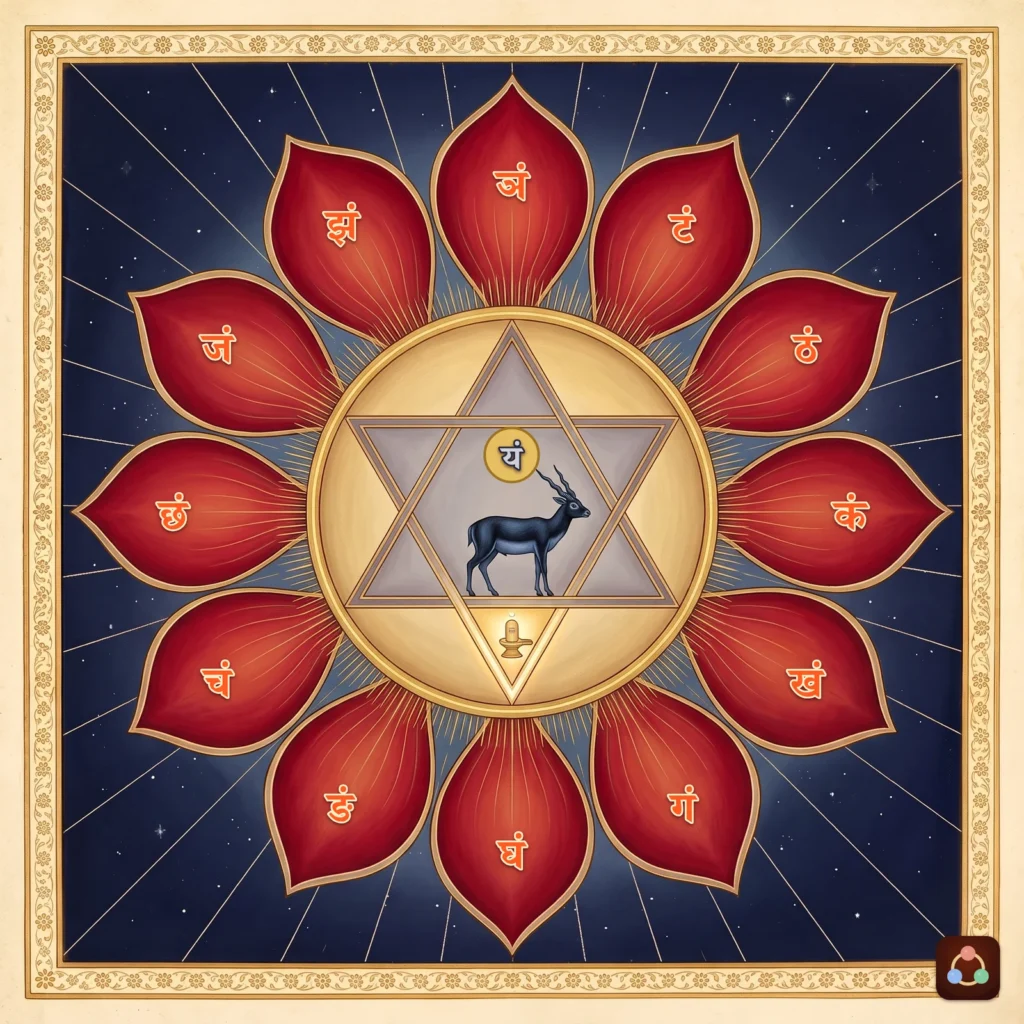
| Petals | Twelve, the shining scarlet of the bandhuka flower |
| Letters on the petals | कं खं गं घं ङं चं छं जं झं ञं टं ठं (ka, kha, ga, gha, nga, cha, chha, ja, jha, nya, ṭa, ṭha), each with the bindu, the colour of vermilion, read round from the right |
| Element | Air (vayu), in the Shat-chakra-nirupana and in the Soundarya Lahari alike |
| Linked with | Touch: the principle (tattva) of touch and the sense of touch, which are dissolved here (Woodroffe’s table) |
| Its shape | A six-cornered region of air, the colour of smoke, made of two interlaced triangles; inside it, a downward triangle |
| Bija | यं (yam), grey as smoke, seated on a black antelope, four-armed |
| Deity | Isha: lustrous like the sun, three-eyed, his two hands granting boons and dispelling fear. The table in the 1937 Soundarya Lahari commentary names Maheshvara |
| Ruling goddess | Kakini in the Shat-chakra-nirupana; Rakini in the Lalita Sahasranama |
| In the middle | A triangle with a golden Bana linga; the living self as a still flame, the hamsa |
| Rays | Fifty-four (Soundarya Lahari 14) |
| Soundarya Lahari | Verses 9, 14, 38, 41 and 99 (101 in the 1937 book) |
What the Shat-chakra-nirupana says
The Shat-chakra-nirupana gives the Anahata six verses, 22 to 27. Here is what they show, from the outside in.
The petals. Twelve petals, “of the shining colour of the Bandhuka flower” (verse 22). Woodroffe’s note names the flower as Pentapetes phoenicea. On the petals are twelve letters, from ka to tha: ka, kha, ga, gha, nga, cha, chha, ja, jha, nya, ṭa and ṭha. They are “of the colour of vermilion”, and above each is the bindu. The verse also says the lotus is like the celestial wishing-tree, “bestowing even more than the supplicant’s desire”. A note explains that this lotus gives more, because it leads the seeker to liberation.
The region of air. In the middle of the lotus is “the Region of Vayu, beautiful and with six corners, which is like unto the smoke in colour”. Woodroffe’s note says the six corners are two interlaced triangles. The commentary explains the smoke colour: air here is surrounded by masses of vapour.
The bija and the antelope. In the region of air sits the seed-syllable of air, yam. Pictured as a being, it is “grey as a mass of smoke, with four arms, and seated on a black antelope” (verse 23). The commentary says the black antelope, noted for its speed, is the carrier of air, and that air carries the goad as its weapon, as the god of water carries the noose. The summary also puts the goad in his hands. One of the commentators Woodroffe cites says the smoke comes from the jivatma, the living self, which here has the form of a flame.
Isha. Within the bija, the same verse says, one should meditate on “the Abode of Mercy, the Stainless Lord who is lustrous like the Sun”, whose two hands grant boons and dispel the fears of the three worlds. This is Isha. The commentary argues that since Shiva is everywhere spoken of as three-eyed, Isha has three eyes too, and quotes other verses that picture him in silken clothes, with a jewelled necklace, and with the soft light of ten million moons on his matted hair. The summary places him in the bija’s lap.
Kakini. “Here dwells Kakini, who in colour is yellow like unto new lightning” (verse 24). She is happy, auspicious and three-eyed, and she is “the benefactress of all”. She wears many ornaments. In her four hands she holds a noose and a skull, and with the other two she gives the sign of blessing and the sign that drives away fear. Her heart is softened by drinking nectar, which the commentary says drops from the thousand-petalled lotus. A meditation verse that the commentator quotes pictures her in the skin of a black antelope. The summary of the verses adds a golden colour, yellow clothes, a garland of bones, and a seat on a red lotus. A different meditation verse, quoted by the commentator Vishvanatha, gives her a trident and a drum as well as the noose and the skull, makes her yellow, fond of curd and rice, and puts her in the body’s fat. Our painting does not show her.
The triangle and the linga. In the pericarp of the lotus is a triangle, “a Shakti whose tender body is like ten million flashes of lightning” (verse 25). The commentary says its point is downward. Inside it is a Shivalinga called Bana, “like shining gold”, with a tiny opening at its head, like the hole in a pierced gem. The commentary explains this as the empty space inside the bindu on the linga’s crescent. The verse calls it “the resplendent abode of Lakshmi”, and the commentary says this means the linga’s great beauty, which comes from a rush of desire. Another verse the commentator quotes puts the linga there “with the half-moon on his head”. Here the painting and the text agree on the order: the bija above, the linga below.
The living flame. Verse 26 says the lotus is “beautified by the Hamsa”, “like unto the steady tapering flame of a lamp in a windless place”. The commentary says Hamsa is the jivatma. Woodroffe adds a note on why the image is chosen: as a flame is not disturbed where there is no wind, the Atma is not disturbed by the motions of the world.
The sun and the red lotus below. The verse says the filaments around the pericarp are lit by the region of the sun. The commentary stresses this: the filaments of the other lotuses are not so tinged, and it is what marks this lotus out. It sets the order of the regions: air spreads over the whole pericarp, the region of the sun lies above it, and above both come the bija and the triangle. The summary adds, below the pericarp, a red lotus of eight petals with its head turned up. In it are the wishing-tree and a jewelled altar under an awning, the place for mental worship. Woodroffe’s note says this is not one of the six chakras but a lotus called Ananda-kanda. Our painting does not show it.
The fruit. Verses 26 and 27 promise much to whoever meditates on this heart lotus. He becomes like Brihaspati, the teacher of the gods, and like Ishvara he can protect and destroy the worlds. He is the first among yogis, wise, in control of his senses, his speech flows like clear water, and, the verse says, he can enter another’s body. Woodroffe’s note prefers the reading “another man’s body”, the power Shankaracharya is said to have used, over “an enemy’s fort”. These are a tradition’s promises about meditation. They are not medical claims.
What the Soundarya Lahari says
The Soundarya Lahari places the same element here, and gives the centre one verse of its own, 38. The commentary brings the Anahata into several more.
Verse 9 places air in the heart: the 1937 commentary calls it air in the form of sparsha-tanmatra, the subtle element of touch. It ties the centre to the outer ten-spoked figure of the Sri Chakra, and says one who masters it is said to gain the fleetness of the wind and buoyancy. On air the two texts agree. The 1937 book notes that Purnananda, who wrote the Shat-chakra-nirupana, gives earth, water, fire, air and ether to the five lower centres in the order of the body, and so differs from the Soundarya Lahari on water and fire, but not on air. Read verse 9
Verse 14 counts the rays of light in each centre. In the Anahata, the centre of air, there are fifty-four. Read verse 14
Verse 38 is this centre’s own verse.
ಸಮುನ್ಮೀಲತ್ ಸಂವಿತ್-ಕಮಲಮಕರಂದೈಕ-ರಸಿಕಂಭಜೇ ಹಂಸದ್ವಂದ್ವಂ ಕಿಮಪಿ ಮಹತಾಂ ಮಾನಸಚರಮ್ ।ಯದಾಲಾಪಾದಷ್ಟಾ-ದಶಗುಣಿತವಿದ್ಯಾಪರಿಣತಿ-ರ್ಯದಾದತ್ತೇ ದೋಷಾದ್ ಗುಣಮಖಿಲಮದ್ಭ್ಯಃ ಪಯ ಇವ
MeaningI worship the wondrous pair of swans, Shiva and Shakti, who dwell in the anahata chakra at the heart. They taste only the nectar of the lotus of awareness as it opens, and they swim in the minds of the great as swans swim on the Manasa lake. From their speech the eighteen branches of learning come forth. And as a swan is said to drink the milk and leave the water, they take all that is good and leave aside what is faulty. Read verse 38
The commentary says the “pair of swans” is Shiva and Shakti. Ham in Hamsah stands for Shiva, and sah for Shakti; and tradition says a swan can separate milk from the water mixed in it. The deities are named Hamsheshvara and Hamsheshvari, to be meditated on in the middle of the lotus, ringed by fifty-four rays of air. The “mutual cackle” is their talk with each other: when the quality of rhythm (sattva) is strongest, it takes the form of the teaching of the Vedas and the other scriptures, spoken through the yogis in whose hearts they dwell; when mobility is strongest, it brings the easing of hunger and thirst; when inertia is strongest, it brings anger and fear. The eighteen branches of learning the commentary lists run from phonetics, ritual and grammar to astronomy, the four Vedas, logic, the Puranas, the science of life and the science of the bow, to music and the science of conduct. The commentary adds that this worship of the swans in the heart lotus is followed by some Samayins. It also reports another view, which it gives as Shankara-bhagavat-pada’s, as he explains it in his commentary on the Subhagodaya: Shiva, in the form of a flame called Shikhin, shines here like a spout of light, together with the Devi called Shikhini. Read verse 38
Verse 41. In the account of worship that the 1937 book gives, and then names as Lakshmidhara’s view, the Devi is first made manifest in the Manipura, with the offerings up to jewels. Then, the commentary says, the Devi “should thence be transposed to the Anahata chamber of the heart”, where the offerings from incense to food and water are made, and after that she is enthroned in the Vishuddhi. Read verse 41
Verse 32. The commentary on this verse places the twelve Adityas, the twelve suns, on the twelve petals of the Anahata, one over each month of the year. The sixteen Nityas take the sixteen petals of the Vishuddhi in the same way.
Near the end of the poem, at verse 101 in the 1937 book’s numbering, which is verse 99 on this site, the commentary returns to the centres. Lakshmidhara, as the book reports him, holds that those who worship the Mother in the Anahata attain the liberation called salokya: they live in her city. He also explains the twelve petals. Of the Anahata’s twelve, ten are of the character of the Manipura, he says, and the other two stand for the Muladhara and the Svadhishthana. Read verse 99
What the Lalita Sahasranama says
The rise of Kundalini (names 97 to 111). The names that trace her rise name only some of the stations: she breaks through the knot of Brahma (100), emerges in the Manipura (101), breaks through the knot of Vishnu (102), resides at the Ajna (103), breaks through the knot of Rudra (104) and ascends to the thousand-petalled lotus (105). The Anahata is not named in this run. The knot of Vishnu comes after the Manipura and before the Ajna, and the list says nothing between them. Woodroffe’s account of the rise is plainer: he says the Anahata is “known as the Knot of Vishnu”. The 1937 Soundarya Lahari commentary agrees on the Anahata but sets the other knots differently. It says they lie at the ends of pairs of centres, and on p. 253 it speaks of the knot of Vishnu “at the end of the Anahata”. It gives Rudra’s knot to the Svadhishthana and Brahma’s to the Ajna.
The yogini of the Anahata (names 485 to 494). For this centre the Lalita Sahasranama names Rakini.
| No. | Name | Meaning |
|---|---|---|
| 485 | anāhatābja-nilayā | Who dwells in the lotus of the Anahata, in the heart |
| 486 | śyāmābhā | Dark in colour |
| 487 | vadana-dvayā | Who has two faces |
| 488 | daṃṣṭrojjvalā | With shining tusks |
| 489 | akṣamālādi-dharā | Who wears rosaries of rudraksha beads and other things |
| 490 | rudhira-saṃsthitā | Who presides over the blood of living beings |
| 491 | kālarātryādi-śaktyaugha-vṛtā | Surrounded by Kalaratri and a host of other Shaktis |
| 492 | snigdhaudana-priyā | Fond of rice offerings rich in ghee, oil and other fats |
| 493 | mahāvīrendra-varadā | Who gives boons to great heroes |
| 494 | rākiṇy-ambā-svarūpiṇī | In the form of the mother Rakini |
Here the two lists name different goddesses. In the Shat-chakra-nirupana the heart belongs to Kakini; in the Lalita Sahasranama it belongs to Rakini. A list that Woodroffe gives from another text sides with the Lalita Sahasranama: it puts Rakini at the Anahata, and Kakini at the Svadhishthana. So do the 1937 Soundarya Lahari commentary and the Lalita Sahasranama on the body’s tissue: blood belongs to the Anahata. Vishvanatha’s meditation verse on Kakini, quoted in the Shat-chakra-nirupana’s own commentary, puts her in fat, the tissue that belongs to the Svadhishthana in those lists. They also differ on her appearance. The Lalita Sahasranama’s goddess is dark, two-faced, with shining tusks and a rosary; the Shat-chakra-nirupana’s is yellow like new lightning, three-eyed, with a noose and a skull.
Two other names touch the heart or sound. Among the names I read in full, 299 calls her “she who is in the form of sound” and 303 “she who abides in the heart”.
Three texts, one lotus
On the twelve petals and on air, the texts agree. They differ on the goddess, on the god, on the knot, and on what the centre holds.
| Shat-chakra-nirupana | Lalita Sahasranama | Soundarya Lahari | |
|---|---|---|---|
| Element | Air (verse 22) | Air (verses 9 and 14) | |
| Bija | यं (yam), on a black antelope | यं (yam), in the 1937 commentary’s scheme | |
| Who dwells here | Isha, in the lap of the bija | Hamsheshvara and Hamsheshvari, the pair of swans (verse 38); Maheshvara, in the table in the 1937 commentary on verse 35; Shiva as the flame Shikhin with Shikhini, in the view the book gives as Shankara’s | |
| Ruling goddess | Kakini | Rakini | |
| Her form | Yellow like new lightning, three-eyed, four arms; a noose and a skull, and the signs of boon and of fear removed (verse 24) | Dark, with two faces, shining tusks and a rosary of rudraksha beads | |
| Bodily tissue | Not in the verses. The meditation verse quoted from Vishvanatha puts Kakini in fat | Blood | Blood, in the 1937 commentary on verse 14 |
| Favourite food | Curd and rice (Vishvanatha’s meditation verse) | Food rich in ghee and oil | |
| The knots | Not named in verses 22 to 27; Woodroffe’s account of the rise calls the Anahata the knot of Vishnu | The knot of Vishnu is broken after the Manipura and before the Ajna (names 101 to 103); the Anahata is not named | Knots at the ends of pairs of centres; the pages I read do not place Vishnu’s |
| Fruit of worship | The speech of Brihaspati, and the power to protect and destroy the worlds (verse 26) | Residence in the Mother’s city (salokya), Lakshmidhara, as the book reports him | |
| Rays | Fifty-four (verse 14) |
What it means for the inner life
The texts read the Anahata in a few simple ways.
It is the centre of the sound that no one strikes. The name says it. The sound meditated on here is not made by anything hitting anything else; it is there before the effort. The 1937 commentary calls it the nada of the heart.
It is the still flame. Woodroffe quotes the picture of the lamp in a windless place and draws its meaning: the Atma is not moved by the movements of the world, as a flame is not moved where there is no wind. The centre of air, of movement, is also the centre of stillness. The text gives air its antelope and its smoke, and gives the self a flame that does not flicker.
It is where the dark ends. In the 1937 commentary on verse 32, the Anahata is “the region of brightness”. The centres below it are dark or mixed with darkness, and the Vishuddhi above it lies in the region of the Moon.
It is the seat of worship. In the Shat-chakra-nirupana the red eight-petalled lotus below the pericarp, with its wishing-tree and its jewelled altar, is the place of mental worship. In the 1937 book, some Samayins worship the pair of swans in the heart lotus, and in the account of the Devi’s worship she is brought to the heart chamber to receive the offerings of incense and food.
Its powers are not the goal. The 1937 commentary on verse 9 says that one who masters air is said to gain the fleetness of the wind. The same commentary calls such powers “pitfalls”. The goal lies above.
What lies here in the body
I am a physician, so let me say plainly what sits at this level.
Behind the breastbone, a little left of the middle, lies the heart, and on either side of it the lungs. The heart is not a place where nerves simply end. It is run by the nerves of the autonomic system, which work without our thinking. The vagus nerve slows it and the sympathetic nerves from the upper chest speed it up. Near the base of the heart these nerves mingle in what doctors call the cardiac plexus. A review in 2020 that gathered what is known of the human cardiac nerves found no agreement on the exact make-up of the nerve plexuses at the heart’s level, and said that the arrangement varies a great deal from person to person.
A century ago, some writers tried to match the chakras to such nerve centres. Professor Sarkar’s work, which Woodroffe mentions, lines up the heart lotus with the cardiac plexus. Brajendranath Seal wrote that the Anahata is “possibly the cardiac plexus of the sympathetic chain with twelve branches”. Woodroffe replied that which plexus fits which centre “must be a matter of opinion”, and that the text makes it plain “the Chakras are in the Sushumna”. Later writers in the West often call it the heart chakra and paint it green. The Shat-chakra-nirupana gives red petals and a smoke-grey star.
Is there any study of slow breathing or yoga for this part of the body? One thing has been measured often. When we breathe in, the heart speeds up a little, and when we breathe out it slows, through the vagus nerve. Doctors measure the size of this swing as heart rate variability. A review in 2022 gathered 223 studies of slow voluntary breathing. It found that the vagus-linked part of heart rate variability rose during the breathing, just after a single session, and after programmes of many sessions, and the authors suggested it as a low-cost technique with few side effects expected. A rise in a measurement is not the same as fewer heart attacks, and that review does not claim it is.
On blood pressure, the evidence is mixed. A 2025 review of 51 earlier reviews found strong effects of yoga on blood pressure, depression, blood sugar and tiredness. A 2026 review of 16 reviews of exercise types found no convincing evidence of benefit from yoga for blood pressure and other measures of heart and metabolic risk, though it did for aerobic exercise and tai chi. The two ask different questions and pool different studies, and I cannot settle between them here. None of this is a reason to change treatment for heart disease or high blood pressure without speaking to your own doctor.
The one study I found that named the Anahata measured its “energy” with a camera that reads the glow around the fingertips, in 15 volunteers after a session of sound meditation. That device is not an accepted measure of any function of the body. I found no study that has tested the Anahata itself in a way medicine accepts.
Sources
- Arthur Avalon (Sir John Woodroffe), The Serpent Power, Ganesh and Co, Madras. Shat-chakra-nirupana, verses 22 to 27, with the commentary of Kalicharana, pp. 371 to 383; commentary on verse 4, p. 332; Introduction, pp. 11 to 12; p. 93; chapter V, pp. 120 to 121, 141 to 142, 145, 153 to 155 and 158 to 159; pp. 221 to 222 and 237 to 238.
- Adi Shankaracharya, Saundarya-Lahari, with transliteration, English translation and commentary by S. Subrahmanya Sastri and T. R. Srinivasa Ayyangar, drawing on Lakshmidhara and other commentators. Theosophical Publishing House, Adyar, 1937. Introduction, pp. 29 to 30; verse 9, pp. 54 to 58; verse 14, pp. 75 to 78; verse 32, pp. 128 to 130; verse 35, p. 143; verse 38, pp. 149 to 151; verse 41, pp. 158 and 161 to 164; verse 101, pp. 252 and 256.
- The meanings of verses 9, 14, 38, 41 and 99 on Jeevana Sutra, and in the Soundarya Lahari app.
- Lalita Sahasranama, names 97 to 111, 299, 303 and 485 to 494. Numbers and meanings as in Sanskrit Documents, lalita1000.
- Wink J and others. Human adult cardiac autonomic innervation: controversies in anatomical knowledge and relevance for cardiac neuromodulation. Autonomic Neuroscience 2020; 227: 102674. doi:10.1016/j.autneu.2020.102674
- Laborde S and others. Effects of voluntary slow breathing on heart rate and heart rate variability: a systematic review and a meta-analysis. Neuroscience and Biobehavioral Reviews 2022; 138: 104711. doi:10.1016/j.neubiorev.2022.104711
- Wang F and others. Yoga and chronic diseases: an umbrella review of systematic reviews and meta-analyses. Medical Review 2025; 5: 244 to 255. doi:10.1515/mr-2024-0078
- Chatzi C and others. Effect of different types of exercise interventions on cardiometabolic risk factors: an umbrella review of systematic reviews and meta-analyses. Journal of Diabetes and its Complications 2026; 40: 109305. doi:10.1016/j.jdiacomp.2026.109305
- Veerabrahmachar R and others. Immediate effect of Nada Yoga meditation on energy levels and alignment of seven chakras as assessed by electro-photonic imaging: a randomized controlled crossover pilot study. Advances in Mind-Body Medicine 2023; 37: 11 to 16. PubMed 37119541