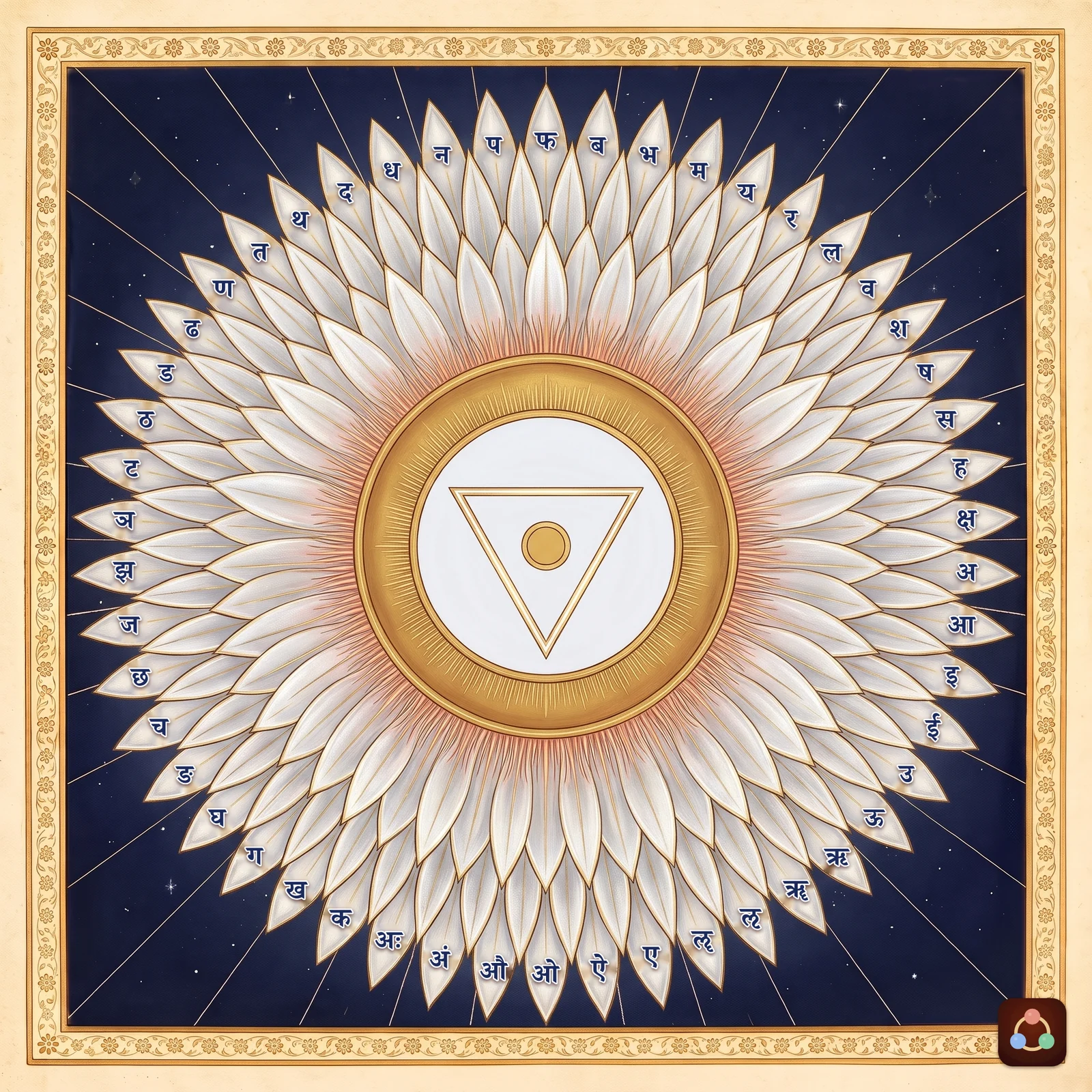
ಬಿಳಿ ಎಸಳುಗಳ ಸಾಲು ಸಾಲು ಸುತ್ತುಗಳು; ಎಷ್ಟು ಸೂಕ್ಷ್ಮ ಮತ್ತು ಎಷ್ಟೊಂದು ಎಸಳುಗಳೆಂದರೆ, ಎಣಿಸಲು ಹೋದ ಕಣ್ಣುಗಳು ಸುಮ್ಮನಾಗಬೇಕು.
ಹೊರಗಿನ ಸುತ್ತಿನ ತುಂಬ ಐವತ್ತು ಅಕ್ಷರಗಳು ಒಮ್ಮೆ ಬಂದುಹೋಗುತ್ತವೆ. ನಡುವೆ ಚಿನ್ನದ ಬಣ್ಣದ ಒಂದು ವೃತ್ತವಿದೆ, ಅದರೊಳಗೆ ಕೆಳಮುಖವಾಗಿರುವ ತ್ರಿಕೋನವಿರುವ ಬಿಳಿಯ ಮಂಡಲವಿದೆ. ಆ ತ್ರಿಕೋನದೊಳಗೆ ಪುಟ್ಟದೊಂದು ಚಿನ್ನದ ಬಣ್ಣದ ಮಂಡಲವಿದೆ; ಅದು ಬರಿದಾಗಿದೆ.
ಇದೇ ಸಹಸ್ರಾರ, ‘ಸಾವಿರ ಎಸಳುಗಳ’ ಕಮಲ. ಇದು ಕೆಳಗಿನ ಆರು ಚಕ್ರಗಳಲ್ಲಿ ಒಂದಲ್ಲ. ಷಟ್ಚಕ್ರ ನಿರೂಪಣ ಗ್ರಂಥವು ಆ ಆರರ ವಿವರಣೆ ಮುಗಿದ ಮೇಲೆ, 40 ರಿಂದ 49 ರವರೆಗಿನ ಹತ್ತು ಶ್ಲೋಕಗಳಲ್ಲಿ ಇದನ್ನು ಪ್ರತ್ಯೇಕವಾಗಿ ವಿವರಿಸುತ್ತದೆ. ಸೌಂದರ್ಯ ಲಹರೀಯು ಕೆಳಗಿನ ಆರು ಚಕ್ರಗಳನ್ನು ಹೇಳುವ 36 ರಿಂದ 41 ರವರೆಗಿನ ಶ್ಲೋಕಗಳಲ್ಲಿ ಇದಕ್ಕೆ ಸ್ಥಾನ ಕೊಟ್ಟಿಲ್ಲ; ಆದರೆ 9ನೆಯ ಶ್ಲೋಕ ಬಂದು ಮುಕ್ತಾಯವಾಗುವುದು ಇಲ್ಲಿಯೇ: ಆರೂ ಚಕ್ರಗಳನ್ನು ಭೇದಿಸಿಕೊಂಡು ಬಂದ ದೇವಿ, ತನ್ನ ಪ್ರಭುವಿನೊಂದಿಗೆ ಏಕಾಂತದಲ್ಲಿ ವಿಹರಿಸುವುದು ಇದೇ ಜಾಗದಲ್ಲಿ.
ಈ ಪುಟದಲ್ಲಿಹೆಸರು · ಇದು ಎಲ್ಲಿದೆ? · ಗ್ರಂಥಗಳು ವರ್ಣಿಸುವ ಕಮಲ · ಷಟ್ಚಕ್ರ ನಿರೂಪಣ ಏನು ಹೇಳುತ್ತದೆ? · ಸೌಂದರ್ಯ ಲಹರೀ ಏನು ಹೇಳುತ್ತದೆ? · ಲಲಿತಾ ಸಹಸ್ರನಾಮ ಏನು ಹೇಳುತ್ತದೆ? · ಮೂರು ಗ್ರಂಥಗಳು, ಒಂದೇ ಕಮಲ · ಅಂತರಂಗದ ಬದುಕಿಗೆ ಇದರ ಅರ್ಥವೇನು? · ದೇಹದ ಈ ಜಾಗದಲ್ಲಿ ಏನಿದೆ? · ಆಕರಗಳು
ಹೆಸರು
ಸಹಸ್ರ ಎಂದರೆ ಸಾವಿರ. ಶ್ಲೋಕವು ಈ ಕಮಲವನ್ನು ‘ಸಾವಿರ ಎಸಳುಗಳ ಕಮಲ’ ಎಂದು ಕರೆಯುತ್ತದೆ. ವ್ಯಾಖ್ಯಾನಕಾರರು ಇದರ ವಿವರಣೆ ಶುರು ಮಾಡುವಾಗ, ಇದನ್ನು ‘ಸಹಸ್ರಾರ’ ಎನ್ನುತ್ತಾರೆ. ಈ ಸರಣಿಯ ಮುಖ್ಯ ಪುಟದಲ್ಲಿ ‘ಸಾವಿರ ಕಡ್ಡಿಗಳುಳ್ಳ ಚಕ್ರ’ ಎಂದು ಅರ್ಥ ಹೇಳಿದೆ; ಸಂಸ್ಕೃತದಲ್ಲಿ ಅರ ಎಂದರೆ ಚಕ್ರದ ಕಡ್ಡಿ (ಆರೆ). ಲಲಿತಾ ಸಹಸ್ರನಾಮದಲ್ಲಿ ಈ ಎರಡೂ ರೂಪಗಳು ಬರುತ್ತವೆ: 105ನೆಯ ಹೆಸರು ಆಕೆ ಸಹಸ್ರಾರ ಕಮಲವನ್ನು ಏರುತ್ತಾಳೆ ಎಂದೂ, 528ನೆಯ ಹೆಸರು ಆಕೆ ‘ಸಾವಿರ ಎಸಳುಗಳ’ ಕಮಲದಲ್ಲಿ ನೆಲೆಸಿದ್ದಾಳೆ ಎಂದೂ ಹೇಳುತ್ತದೆ.
ಹಳೆಯ ಗ್ರಂಥಗಳಲ್ಲಿ ಈ ಜಾಗಕ್ಕೆ ಬೇರೆ ಬೇರೆ ಹೆಸರುಗಳು ಕಾಣಸಿಗುತ್ತವೆ. ವಿಶ್ವನಾಥರ ಮೂಲಕ ಸ್ವಚ್ಛಂದ ಸಂಗ್ರಹದ ಮಾತನ್ನು ಹೇಳುವ ಟಿಪ್ಪಣಿಯೊಂದು, ಸಹಸ್ರಾರವನ್ನು ‘ಅಕುಲ’ ಎಂದೂ, ಅದರ ಸುತ್ತಲಿನ ಖಾಲಿ ಜಾಗವನ್ನು ‘ಪರಮವ್ಯೋಮ’ ಎಂದೂ ಕರೆಯುತ್ತದೆ. ಸತ್ಯಲೋಕ ಎಂಬ ಲೋಕವು ಮನುಷ್ಯನ ದೇಹದಲ್ಲಿ ಈ ಸಹಸ್ರದಳ ಕಮಲದ ಕರ್ಣಿಕೆಯಲ್ಲೇ ಇದೆ ಎಂದು ವುಡ್ರಫ್ ಹೇಳುತ್ತಾರೆ. 35ನೆಯ ಶ್ಲೋಕಕ್ಕೆ 1937ರ ವ್ಯಾಖ್ಯಾನದಲ್ಲಿ ಕೊಟ್ಟಿರುವ ಪಟ್ಟಿಯು ಸತ್ಯಲೋಕವನ್ನು ಸಹಸ್ರಾರಕ್ಕೆ ಎದುರಾಗಿ ಇಡುತ್ತದೆ. ಹಾಗೆಯೇ 9ನೆಯ ಶ್ಲೋಕದ 1937ರ ವ್ಯಾಖ್ಯಾನವು ಸಹಸ್ರಾರವನ್ನು ದೇವಿಯ ‘ಶಾಶ್ವತ ನೆಲೆ’ ಎಂದೂ, ಕೆಳಗಿನ ಆರು ಕೇಂದ್ರಗಳನ್ನು ‘ತಾತ್ಕಾಲಿಕ ಹಂತಗಳು’ ಎಂದೂ ಕರೆಯುತ್ತದೆ.
ಇದು ಎಲ್ಲಿದೆ?
40ನೆಯ ಶ್ಲೋಕವು ಇದನ್ನು ‘ಇವೆಲ್ಲವುಗಳಿಗಿಂತ ಮೇಲೆ, ಶಂಖಿನೀ ನಾಡಿಯಿರುವ ಶೂನ್ಯ ಜಾಗದಲ್ಲಿ ಮತ್ತು ವಿಸರ್ಗದ ಕೆಳಗೆ’ ಇರಿಸುತ್ತದೆ. ಸುಷುಮ್ನಾ ನಾಡಿ ಕೊನೆಗೊಳ್ಳುವ ಮೇಲ್ಭಾಗದಲ್ಲಿ ‘ಯಾವ ನಾಡಿಗಳೂ ಇಲ್ಲದ’ ಆ ಬರಿದಾದ ಜಾಗವೇ ಈ ಶೂನ್ಯ ಸ್ಥಳ ಎಂದೂ, ಬ್ರಹ್ಮರಂಧ್ರದ ಮೇಲ್ಭಾಗದಲ್ಲಿ ವಿಸರ್ಗವಿದೆ ಎಂದೂ ವ್ಯಾಖ್ಯಾನ ವಿವರಿಸುತ್ತದೆ. ಈ ಕಮಲವು ‘ಸುಷುಮ್ನಾ ನಾಡಿಯ (ಕೊನೆಯ) ಮೇಲಿದೆ’ ಎಂದು ಸಂಕ್ಷಿಪ್ತ ಸಾರಾಂಶ ಹೇಳುತ್ತದೆ.
ವ್ಯಾಖ್ಯಾನಕಾರರು ಎತ್ತಿ ಹೇಳುವ ಪ್ರಾಚೀನ ಗ್ರಂಥಗಳು ಇದು ತಲೆಯಲ್ಲಿದೆ ಎಂದೇ ಹೇಳುತ್ತವೆ. ‘ತಲೆಯಲ್ಲಿರುವ ಕಮಲದಲ್ಲಿ ಪರಮ ಗುರು ಮಹಾದೇವನಿದ್ದಾನೆ’ ಎನ್ನುತ್ತದೆ ನಿರ್ವಾಣ ತಂತ್ರ. ಅನ್ನದಿಕಲ್ಪ ತಂತ್ರವು ‘ತಲೆಯಲ್ಲಿರುವ ಸಾವಿರ ಎಸಳುಗಳ ಬಿಳಿಯ ಕಮಲ’ದ ಬಗ್ಗೆ ಮಾತನಾಡುತ್ತದೆ. ವುಡ್ರಫ್ ಅವರು ತಮ್ಮ ಅಡಿಟಿಪ್ಪಣಿಯಲ್ಲಿ, ‘ಸಹಸ್ರಾರವು ಕಪಾಲದ ತುದಿಯಲ್ಲಿ ಅಥವಾ ಮಿದುಳಿನ ಮೇಲ್ಭಾಗದಲ್ಲಿದೆ’ ಎಂದು ಬರೆಯುತ್ತಾರೆ, ಮತ್ತು ತಮ್ಮ ಮುನ್ನುಡಿಯಲ್ಲಿ ಇದನ್ನು ಮಿದುಳಿನ ಅತ್ಯುನ್ನತ ಕೇಂದ್ರವಾದ ಮಸ್ತಿಷ್ಕ (ಸೆರಿಬ್ರಮ್) ಎಂದು ಕರೆಯುತ್ತಾರೆ. ನಮ್ಮ ಈ ಸರಣಿಯ ಮುಖ್ಯ ಪುಟವು ‘ನೆತ್ತಿಯ ಮೇಲ್ಭಾಗದಲ್ಲಿ’ ಎನ್ನುತ್ತದೆ. ಆದರೆ ನಾನು ಓದಿದ ಹಳೆಯ ಗ್ರಂಥಗಳು ಇದು ತಲೆಯೊಳಗೆ, ನಾಡಿಯ ತುದಿಯ ಮೇಲಿದೆ ಎಂದೇ ಹೇಳುತ್ತವೆ; ಕಪಾಲದ ಹೊರಗೆ ಮೇಲಿದೆ ಎಂದು ಹೇಳುವ ಯಾವ ಮಾತೂ ನನಗೆ ಅಲ್ಲಿ ಸಿಗಲಿಲ್ಲ.
ಈ ಗ್ರಂಥಗಳಲ್ಲಿ ಬರುವ ಪ್ರತಿಯೊಂದು ಕಮಲದಂತೆಯೇ, ಇದು ಕೂಡ ಆ ಮಟ್ಟದಲ್ಲಿ ಬೆನ್ನುಹುರಿಯ ನಾಡಿಯ ಒಳಗಿರುವ ಒಂದು ಕೇಂದ್ರವೇ ಹೊರತು ಚರ್ಮದ ಮೇಲಿನ ಜಾಗವಲ್ಲ.
ಗ್ರಂಥಗಳು ವರ್ಣಿಸುವ ಕಮಲ

| ದಳಗಳು | ಒಂದು ಸಾವಿರ, ಬಿಳಿ ಬಣ್ಣ, ತಲೆ ಕೆಳಮುಖವಾಗಿದೆ (ಶ್ಲೋಕ 40) |
| ದಳಗಳ ಮೇಲಿನ ಅಕ್ಷರಗಳು | ವರ್ಣಮಾಲೆಯ ಐವತ್ತು ಅಕ್ಷರಗಳು, ಅ ಯಿಂದ ಕ್ಷ ವರೆಗೆ, ದಳಗಳ ಸುತ್ತ ಇಪ್ಪತ್ತು ಬಾರಿ ಸುತ್ತುತ್ತವೆ, ಬಿಳಿ ಬಣ್ಣ (ವ್ಯಾಖ್ಯಾನ ಮತ್ತು ಸಾರಾಂಶ) |
| ಇಲ್ಲಿ ಇರುವುದು | ಯಾವ ತತ್ತ್ವವೂ ಇಲ್ಲ. ಪೂರ್ಣಚಂದ್ರ, ತ್ರಿಕೋನ ಮತ್ತು ಮಹಾಶೂನ್ಯ (ಶ್ಲೋಕ 41 ಮತ್ತು 42) |
| ಆಕಾರ | ಕರ್ಣಿಕೆಯಲ್ಲಿ “ಮೊಲದ ಕಲೆಯಿಲ್ಲದ” ಪೂರ್ಣಚಂದ್ರ; ಅದರೊಳಗೆ “ಮಿಂಚಿನಂತೆ ಹೊಳೆಯುವ” ತ್ರಿಕೋನ; ಅದರೊಳಗೆ ಮಹಾಶೂನ್ಯ (ಶ್ಲೋಕ 41) |
| ಬೀಜ | ಶ್ಲೋಕಗಳಲ್ಲಿ ಇಲ್ಲ. ವ್ಯಾಖ್ಯಾನವು ಹಂಸ ಎಂಬ ಹಂ ಮತ್ತು ಸಃ ಅಕ್ಷರಗಳನ್ನು ಹೇಳುತ್ತದೆ |
| ದೇವತೆ | ಶೂನ್ಯದಲ್ಲಿ ಪರಮಶಿವ (ಶ್ಲೋಕ 42); ವ್ಯಾಖ್ಯಾನವು ಅವನನ್ನು ಗುರು ಎಂದೂ ಕರೆಯುತ್ತದೆ. ಸೌಂದರ್ಯ ಲಹರಿಯಲ್ಲಿ ದೇವಿ ತನ್ನ ಪತಿಯೊಂದಿಗೆ ಇಲ್ಲಿ ವಿಹರಿಸುತ್ತಾಳೆ (ಶ್ಲೋಕ 9) |
| ಅಧಿದೇವತೆ | ಮಧ್ಯದಲ್ಲಿ ನಿರ್ವಾಣ ಶಕ್ತಿ (ಶ್ಲೋಕ 48). ಲಲಿತಾ ಸಹಸ್ರನಾಮ ಯಾಕಿನೀ ಎಂದು ಹೆಸರಿಸುತ್ತದೆ (534) |
| ದೇಹದ ಧಾತು | ಶ್ಲೋಕಗಳಲ್ಲಿ ಇಲ್ಲ. ಲಲಿತಾ ಸಹಸ್ರನಾಮದ 531ನೆಯ ನಾಮಕ್ಕೆ “ಶುಕ್ರದಲ್ಲಿ ನೆಲೆಸಿರುವವಳು” ಎಂದು ವಿವರಣೆ ಇದೆ |
| ಗ್ರಂಥಿ | ಇಲ್ಲ. ಕೊನೆಯ ಗ್ರಂಥಿ ಆಜ್ಞಾ ಚಕ್ರದಲ್ಲಿದೆ, ವುಡ್ರಫ್ ಅವರ ವಿವರಣೆಯಲ್ಲೂ 1937ರ ವ್ಯಾಖ್ಯಾನದಲ್ಲೂ |
| ಸೌಂದರ್ಯ ಲಹರೀ | ಶ್ಲೋಕ 9, 10, 14, 21, 32, 35, 36, 40, 41 ಮತ್ತು 99 (1937ರ ಪುಸ್ತಕದಲ್ಲಿ 101) |
ಷಟ್ಚಕ್ರ ನಿರೂಪಣ ಏನು ಹೇಳುತ್ತದೆ?
ಷಟ್ಚಕ್ರ ನಿರೂಪಣ ಗ್ರಂಥವು ಸಹಸ್ರಾರಕ್ಕೆ 40 ರಿಂದ 49 ರವರೆಗೆ ಹತ್ತು ಶ್ಲೋಕಗಳನ್ನು ಮೀಸಲಿಟ್ಟಿದೆ. ಇದನ್ನು ವಿವರಿಸುವ ಹಂಬಲದಿಂದಲೇ ಗ್ರಂಥಕಾರರು ‘ಇನ್ನೂ ಹತ್ತು ಶ್ಲೋಕಗಳಲ್ಲಿ ಇದರ ಬಗ್ಗೆ ಹೇಳುತ್ತಾರೆ’ ಎಂದು ವ್ಯಾಖ್ಯಾನವೇ ಸ್ವತಃ ಸ್ಪಷ್ಟಪಡಿಸುತ್ತದೆ. ಇದಕ್ಕಿಂತ ಮುಂಚಿನ 39ನೆಯ ಶ್ಲೋಕವು ಆಜ್ಞಾ ಚಕ್ರದ ಮೇಲಿರುವ ಮಹಾನಾದದ ಬಗೆಗಿನ ವಿವರಣೆಯಲ್ಲೇ ಮುಗಿಯುತ್ತದೆ. ಈ ಭಾಗದ ಕೊನೆಯಲ್ಲಿರುವ ಸಂಕ್ಷಿಪ್ತ ಸಾರಾಂಶಕ್ಕೆ ‘41 ರಿಂದ 49 ರವರೆಗಿನ ಶ್ಲೋಕಗಳು’ ಎಂಬ ತಲೆಬರಹ ಇದ್ದರೂ, ಅದು 40ನೆಯ ಶ್ಲೋಕದ ಕಮಲದ ವಿವರವನ್ನೂ ಒಟ್ಟುಗೂಡಿಸಿ ಹೇಳುತ್ತದೆ. ಹೊರಗಿನಿಂದ ಒಳಕ್ಕೆ ಸಾಗುತ್ತಾ ಈ ಶ್ಲೋಕಗಳು ತೋರಿಸುವ ಚಿತ್ರಣ ಇಲ್ಲಿದೆ.
ಕಮಲ. 40ನೆಯ ಶ್ಲೋಕದಲ್ಲಿ ಈ ಕಮಲವು ‘ಕಾಂತಿಯುತವಾಗಿದ್ದು, ಹುಣ್ಣಿಮೆಯ ಚಂದ್ರನಿಗಿಂತಲೂ ಬಿಳಿಯಾಗಿದೆ’. ಇದರ ‘ಮುಖವು ಕೆಳಮುಖವಾಗಿದೆ’. ಇದು ‘ಮನಸ್ಸನ್ನು ಸೆಳೆಯುತ್ತದೆ’. ಇದರ ‘ಕೇಸರಗಳ ಸಮೂಹವು ಉದಯಿಸುವ ಎಳೆಬಿಸಿಲಿನ ಸೂರ್ಯನ ಬಣ್ಣದಿಂದ ಕೂಡಿದೆ’. ಇದರ ಶರೀರವು ‘ಅ ಕಾರದಿಂದ ಮೊದಲುಗೊಂಡು ಅಕ್ಷರಗಳಿಂದ ಬೆಳಗುತ್ತಿದೆ’, ಮತ್ತು ಇದು ‘ಪರಮ ಆನಂದದ ಸ್ವರೂಪ’. ಸಾರಾಂಶವು ಇದನ್ನು ಇನ್ನಷ್ಟು ಸರಳವಾಗಿ ಹೇಳುತ್ತದೆ: ಇದು ಬಿಳಿಯ ಬಣ್ಣದಲ್ಲಿದೆ, ಮುಖ ಕೆಳಕ್ಕಿದೆ, ಮತ್ತು ಕೇಸರಗಳು ಕೆಂಪಾಗಿವೆ. ನಮ್ಮ ಚಿತ್ರದಲ್ಲಿ, ಎಲ್ಲ ವಿವರಗಳು ಕಣ್ಣಿಗೆ ಕಾಣಲಿ ಎಂಬ ಉದ್ದೇಶದಿಂದ, ಇತರ ಪುಟಗಳಂತೆಯೇ ಈ ಕಮಲವನ್ನು ಮೇಲ್ಮುಖವಾಗಿ ತೋರಿಸಿದ್ದೇವೆ.
ಅಕ್ಷರಗಳು. ವ್ಯಾಖ್ಯಾನವು ಅಕ್ಷರಗಳ ಲೆಕ್ಕಾಚಾರದ ಮೇಲೆಯೇ ಅತಿ ದೀರ್ಘವಾದ ಚರ್ಚೆ ನಡೆಸುತ್ತದೆ. ವರ್ಣಮಾಲೆಯ ಐವತ್ತು ಅಕ್ಷರಗಳು ಸಾವಿರ ಎಸಳುಗಳ ಮೇಲೆ ಇಪ್ಪತ್ತು ಬಾರಿ ಸುತ್ತು ಬರುತ್ತವೆ; ಆಗ ಒಟ್ಟು ಸಾವಿರವಾಗುತ್ತದೆ. ಇಲ್ಲಿ ಐವತ್ತೊಂದು ಅಕ್ಷರಗಳು ಇರಲು ಸಾಧ್ಯವಿಲ್ಲ ಎಂದು ವ್ಯಾಖ್ಯಾನಕಾರರು ಹೇಳುತ್ತಾರೆ: ಐವತ್ತೊಂದು ಅಕ್ಷರಗಳು ಇಪ್ಪತ್ತು ಬಾರಿ ಬಂದರೆ 1,020 ಆಗುತ್ತದೆ, ಮತ್ತು ಹತ್ತೊಂಬತ್ತು ಬಾರಿ ಬಂದರೆ 969 ಆಗುತ್ತದೆ. ವೈದಿಕ ‘ಳ’ ಕಾರವನ್ನು ಬಿಟ್ಟು ಅವರು ಐವತ್ತರ ಲೆಕ್ಕ ತರುತ್ತಾರೆ. ಉಳಿಯುವ ಅಕ್ಷರಗಳೆಂದರೆ ಹದಿನಾರು ಸ್ವರಗಳು ಮತ್ತು ‘ಕ’ ದಿಂದ ‘ಕ್ಷ’ ವರೆಗಿನ ವ್ಯಂಜನಗಳು; ಕೆಳಗಿನ ಆರು ಕಮಲಗಳು ಹಂಚಿಕೊಂಡಿರುವ ಅದೇ ಐವತ್ತು ಅಕ್ಷರಗಳು ಇವು. ನಂತರ ಅವರು ಕಂಕಾಳಮಾಲಿನೀ ತಂತ್ರದಿಂದ ಇನ್ನೊಂದು ಬಗೆಯ ಲೆಕ್ಕವನ್ನು ಎತ್ತಿ ಹೇಳುತ್ತಾರೆ; ಅದರಲ್ಲಿ ‘ಕ್ಷ’ ಕಾರವನ್ನು ಬಿಟ್ಟುಬಿಡುತ್ತಾರೆ, ಮತ್ತು ಅಕ್ಷರಗಳು ‘ಕ್ಷ ಕಾರದ ಹಿಂದಿನ ಅಕ್ಷರದೊಂದಿಗೆ’ ಮುಗಿಯುತ್ತವೆ. ಅಕ್ಷರಗಳು ‘ಅ ದಿಂದ ಳ ವರೆಗೆ’ ಸಾಗುತ್ತವೆ ಎಂದು ಸಾರಾಂಶ ಹೇಳುತ್ತದೆ. ಎರಡೂ ದಾರಿಗಳಲ್ಲಿ ಲೆಕ್ಕ ಐವತ್ತಕ್ಕೇ ಬರುತ್ತದೆ. ನಮ್ಮ ಚಿತ್ರವು ಮೊದಲನೆಯ ಕ್ರಮವನ್ನು ಅನುಸರಿಸಿದೆ.
ಅಕ್ಷರಗಳ ಬಣ್ಣದ ಬಗ್ಗೆ ಗ್ರಂಥದಲ್ಲಿ ಏನನ್ನೂ ಹೇಳಿಲ್ಲ ಎಂದೂ, ವರ್ಣಮಾಲೆಯ ಅಕ್ಷರಗಳು ಸಾಮಾನ್ಯವಾಗಿ ಬಿಳಿಯಾಗಿರುವುದರಿಂದ ಎಸಳುಗಳ ಮೇಲೂ ಅವುಗಳನ್ನು ಬಿಳಿಯೆಂದೇ ಭಾವಿಸಬೇಕು ಎಂದೂ ವ್ಯಾಖ್ಯಾನ ಹೇಳುತ್ತದೆ. ಅಷ್ಟೇ ಅಲ್ಲದೆ, ಅವು ‘ಸಹಸ್ರಾರವನ್ನು ಬಲದಿಂದ ಎಡಕ್ಕೆ ಸುತ್ತುವರಿಯುತ್ತವೆ’ ಎಂದೂ ಹೇಳುತ್ತದೆ. ಆ ದಿಕ್ಕನ್ನು ವಿವರಿಸುವ ಅಡಿಟಿಪ್ಪಣಿಯು ನಾನು ಓದಿದ ಪ್ರತಿಯಲ್ಲಿ ಕತ್ತರಿಸಿಹೋಗಿತ್ತು, ಅದನ್ನು ಓದಲು ನನಗೆ ಸಾಧ್ಯವಾಗಲಿಲ್ಲ. ಹಾಗಾಗಿ ಅದು ಯಾವ ಸುತ್ತು ಎಂದು ನಾನು ಕರಾರುವಾಕ್ಕಾಗಿ ಹೇಳಲಾರೆ, ಆ ಬಗ್ಗೆ ನಾನಿಲ್ಲಿ ಯಾವುದೇ ವಾದವನ್ನೂ ಮುಂದಿಡುತ್ತಿಲ್ಲ.
ಚಂದ್ರ, ತ್ರಿಕೋನ ಮತ್ತು ಮಹಾಶೂನ್ಯ. 41ನೆಯ ಶ್ಲೋಕದಲ್ಲಿ, ಕಮಲದೊಳಗೆ ‘ಮೋಡವಿಲ್ಲದ ತಿಳಿ ಆಕಾಶದಲ್ಲಿ ಕಳಂಕವಿಲ್ಲದೆ ಬೆಳಗುವ ಹುಣ್ಣಿಮೆಯ ಪೂರ್ಣಚಂದ್ರ’ನಿದ್ದಾನೆ. ಆತ ‘ಧಾರಾಳವಾಗಿ ಕಿರಣಗಳನ್ನು ಚೆಲ್ಲುತ್ತಾನೆ, ಅಮೃತದಂತೆ ತಂಪಾಗಿಯೂ ತೇವವಾಗಿಯೂ ಇರುತ್ತಾನೆ’. ಚಂದ್ರನ ಒಳಗೆ, ‘ಮಿಂಚಿನಂತೆ ಸದಾ ಹೊಳೆಯುವ’ ತ್ರಿಕೋನವಿದೆ, ಮತ್ತು ಆ ತ್ರಿಕೋನದೊಳಗೆ ‘ಸಕಲ ಸುರರೂ ರಹಸ್ಯವಾಗಿ ಪೂಜಿಸುವ ಮಹಾಶೂನ್ಯ’ ಬೆಳಗುತ್ತದೆ. ಮೊಲದ ಗುರುತೆಂದರೆ ಚಂದ್ರನಲ್ಲಿ ಕಾಣುವ ಕಲೆ ಎಂದು ಟಿಪ್ಪಣಿ ಹೇಳುತ್ತದೆ. ವಿಶ್ವನಾಥರ ಪ್ರಕಾರ ಈ ತ್ರಿಕೋನವು ಅಕಥಾದಿ ತ್ರಿಕೋನ ಎಂದು ಇನ್ನೊಂದು ಟಿಪ್ಪಣಿ ತಿಳಿಸುತ್ತದೆ. ಕರ್ಣಿಕೆಯ ಒಳಗೂ ಮೇಲೂ ಏನೇನಿದೆ ಎಂಬುದಕ್ಕೆ ವ್ಯಾಖ್ಯಾನವು ಕಂಕಾಳಮಾಲಿನೀ ತಂತ್ರವನ್ನು ಉಲ್ಲೇಖಿಸುತ್ತದೆ: ಅಲ್ಲಿ ಅಂತರಾತ್ಮನಿದ್ದಾನೆ, ಅವನ ಮೇಲೆ ಗುರು ಇದ್ದಾನೆ, ಸೂರ್ಯ ಚಂದ್ರರ ಮಂಡಲಗಳಿವೆ, ನಂತರ ಮಹಾವಾಯು, ಆಮೇಲೆ ವಿಸರ್ಗವಿರುವ ಬ್ರಹ್ಮರಂಧ್ರ, ಮತ್ತು ಎಲ್ಲಕ್ಕಿಂತ ಮೇಲೆ ‘ಸೃಷ್ಟಿ, ಸ್ಥಿತಿ, ಲಯಗಳನ್ನು ಮಾಡುವ’ ಶಂಖಿನೀ ದೇವಿ ನೆಲೆಸಿದ್ದಾಳೆ. ಮಹಾಶೂನ್ಯವನ್ನು ಅದು ಪರಮ ಬಿಂದುವಾದ ‘ಪರಬಿಂದುವಿನ ಸ್ವರೂಪ’ ಎಂದು ಕರೆಯುತ್ತದೆ.
ಪರಮಶಿವ. 42ನೆಯ ಶ್ಲೋಕವು ಈ ಶೂನ್ಯವನ್ನು ‘ಬಹಳ ರಹಸ್ಯವಾದದ್ದು ಮತ್ತು ಅಪಾರ ಪರಿಶ್ರಮದಿಂದ ಮಾತ್ರ ದಕ್ಕುವಂತದ್ದು’ ಎನ್ನುತ್ತದೆ. ದೀರ್ಘವಾದ ಮತ್ತು ನಿರಂತರವಾದ ಧ್ಯಾನಾಭ್ಯಾಸದಿಂದ ಮಾತ್ರ ಇದು ಸಾಧ್ಯ ಎಂದೂ, ಆ ಶೂನ್ಯವು ‘ಕೂದಲಿನ ತುದಿಯ ಕೋಟ್ಯಂತರ ಭಾಗದಷ್ಟು ಸೂಕ್ಷ್ಮವಾಗಿದೆ’ ಎಂದೂ ವ್ಯಾಖ್ಯಾನ ಹೇಳುತ್ತದೆ. ಇದು ‘ಮುಕ್ತಿಗೆ ಮುಖ್ಯ ಮೂಲ’. ಇಲ್ಲಿದ್ದಾನೆ ಎಲ್ಲರಿಗೂ ‘ಪರಮಶಿವನೆಂದು ಪರಿಚಿತನಾದ’ ದೇವ; ಆತನೇ ಬ್ರಹ್ಮ, ಸಕಲ ಜೀವಿಗಳ ಆತ್ಮ, ಮತ್ತು ‘ಅಜ್ಞಾನ ಹಾಗೂ ಮೋಹದ ಕತ್ತಲೆಯನ್ನು ಕಳೆಯುವ ಸೂರ್ಯ’. 43ನೆಯ ಶ್ಲೋಕದಲ್ಲಿ ಆತ ‘ಅಮೃತದ ಸಾರದ ನಿರಂತರ ಧಾರೆಯನ್ನು ಸುರಿಸುತ್ತಾನೆ, ಮತ್ತು ಜೀವ ಹಾಗೂ ಪರಮಾತ್ಮ ಒಂದೇ ಎಂಬ ಸತ್ಯವನ್ನು ಶುದ್ಧ ಮನಸ್ಸಿನ ಸಾಧಕನಿಗೆ ಸಾಕ್ಷಾತ್ಕಾರ ಮಾಡಿಸುವ ಜ್ಞಾನವನ್ನು ಬೋಧಿಸುತ್ತಾನೆ. ಇಲ್ಲಿ ಬರುವ ಪರಮಶಿವನನ್ನು ಸಾಕ್ಷಾತ್ ಗುರು ಎಂದೇ ವ್ಯಾಖ್ಯಾನ ಗುರುತಿಸುತ್ತದೆ. ಅದಕ್ಕೆ ಪುಷ್ಟಿಯಾಗಿ ಅದು ನಿರ್ವಾಣ ತಂತ್ರದ ಮಾತನ್ನು ಎತ್ತಿ ಹೇಳುತ್ತದೆ. ಹಾಗೆಯೇ ಹಂಸ ಮಂತ್ರವು ಅಂತರಾತ್ಮನಿಗೆ ಸಮಾನ ಎಂದೂ ಅದು ಹೇಳುತ್ತದೆ. ಗುರು ಎಲ್ಲಿ ಕೂರುತ್ತಾನೆ ಎನ್ನುವ ವಿಷಯದಲ್ಲಿ ಗ್ರಂಥಗಳ ನಡುವೆ ಭಿನ್ನವಾದ ಮಾತುಗಳಿವೆ; ಬೇರೆ ಬೇರೆಯಾಗಿ ಕಾಣುವ ಗ್ರಂಥಗಳು ‘ವಿಭಿನ್ನ ಪದ್ಧತಿಗಳು ಮತ್ತು ಅಭಿಪ್ರಾಯಗಳನ್ನು ಸೂಚಿಸುತ್ತವೆ’ ಎಂದು ಹೇಳುತ್ತಾ ಸಾರಾಂಶ ಮುಕ್ತಾಯವಾಗುತ್ತದೆ.
ಈ ಜಾಗಕ್ಕೆ ಇರುವ ಹೆಸರುಗಳು. 44ನೆಯ ಶ್ಲೋಕವು ಹೀಗೆ ಹೇಳುತ್ತದೆ: ಶೈವರು ಇದನ್ನು ಶಿವನ ನೆಲೆ ಎನ್ನುತ್ತಾರೆ, ವೈಷ್ಣವರು ಪರಮ ಪುರುಷನ ಸ್ಥಾನವೆಂದೂ, ಇತರರು ಹರಿ-ಹರರ ತಾಣವೆಂದೂ ಕರೆಯುತ್ತಾರೆ; ದೇವಿಯ ಪಾದಗಳಲ್ಲಿ ಭಕ್ತಿ ತುಂಬಿದವರು ಇದನ್ನು ದೇವಿಯ ಪರಮ ಧಾಮವೆಂದರೆ, ಇತರ ಮಹರ್ಷಿಗಳು ಪ್ರಕೃತಿ-ಪುರುಷರ ಪವಿತ್ರ ಸ್ಥಾನ ಎನ್ನುತ್ತಾರೆ. ಕರ್ಣಿಕೆಯಲ್ಲಿ ಪ್ರತಿಯೊಬ್ಬ ದೇವತೆಯೂ ಇರುವುದರಿಂದ, ಪ್ರತಿಯೊಬ್ಬ ಉಪಾಸಕನೂ ತಾನು ಪೂಜಿಸುವ ದೇವತೆಯ ಹೆಸರಿನಿಂದಲೇ ಈ ಸ್ಥಾನವನ್ನು ಕರೆಯುತ್ತಾನೆ ಎಂದು ವ್ಯಾಖ್ಯಾನ ಸೇರಿಸುತ್ತದೆ.
ಫಲಶ್ರುತಿ. ಮನಸ್ಸನ್ನು ಗೆದ್ದು ಈ ಸ್ಥಾನವನ್ನು ಅರಿತ ಶ್ರೇಷ್ಠ ಪುರುಷನಿಗೆ ಪುನರ್ಜನ್ಮವಿಲ್ಲ, ತ್ರಿಲೋಕದಲ್ಲಿ ಯಾವುದೂ ಅವನನ್ನು ಕಟ್ಟಿಹಾಕಲಾರದು, ತನಗೆ ಬೇಕಾದ್ದನ್ನು ಸಾಧಿಸುವ ಮತ್ತು ತನ್ನ ಇಷ್ಟಕ್ಕೆ ವಿರುದ್ಧವಾದದ್ದನ್ನು ತಡೆಯುವ ಪೂರ್ಣ ಶಕ್ತಿ ಅವನಿಗೆ ದಕ್ಕುತ್ತದೆ, ಆತ ಸದಾ ಬ್ರಹ್ಮನ ಕಡೆಗೆ ಸಾಗುತ್ತಾನೆ, ಮತ್ತು ಅವನ ಮಾತು ಶುದ್ಧವೂ ಮಧುರವೂ ಆಗಿರುತ್ತದೆ ಎಂದು 45ನೆಯ ಶ್ಲೋಕ ಭರವಸೆ ನೀಡುತ್ತದೆ. ಈ ಬಂಧನಗಳೆಂದರೆ ಪುಣ್ಯ-ಪಾಪಗಳ ಬಂಧನಗಳು, ಅಂತಹ ವ್ಯಕ್ತಿ ಜೀವನ್ಮುಕ್ತನಾಗುತ್ತಾನೆ, ಮತ್ತು ದೇಹ ಬಿದ್ದಾಗ ಪೂರ್ಣ ಮುಕ್ತಿ ಸಿಗುತ್ತದೆ ಎಂದು ವ್ಯಾಖ್ಯಾನ ಹೇಳುತ್ತದೆ. ಬಯಸಿದ್ದನ್ನೆಲ್ಲ ಮಾಡುವ, ಕೇಡನ್ನು ದೂರವಿಡುವ, ಆಕಾಶದಲ್ಲಿ ಚಲಿಸುವ (ಇದು ಕಾಳೀಚರಣರ ವಿವರಣೆ; ಆದರೆ ಅನುವಾದವು ಇದನ್ನು ಬ್ರಹ್ಮ ಎಂದು ಗ್ರಹಿಸುವ ವಿಶ್ವನಾಥರ ಮಾತನ್ನು ಅನುಸರಿಸುತ್ತದೆ) ಮತ್ತು ಶ್ರೇಷ್ಠ ಕಾವ್ಯವನ್ನು ರಚಿಸುವ ಶಕ್ತಿಯೇ ಈ ಸಾಮರ್ಥ್ಯ ಎಂದು ಅದು ವಿವರಿಸುತ್ತದೆ. ಅಂತಹ ಮಹಾತ್ಮ ‘ಆ ಶಕ್ತಿಯನ್ನು ದುರುಪಯೋಗಪಡಿಸಿಕೊಳ್ಳುವುದಿಲ್ಲ’ ಎಂದು ಟಿಪ್ಪಣಿಯೊಂದು ಹೇಳುತ್ತದೆ. ಇವು ಜೀವಮಾನವಿಡೀ ಮಾಡಿದ ಧ್ಯಾನಕ್ಕೆ ಪರಂಪರೆ ಕೊಟ್ಟ ಭರವಸೆಗಳು. ಇವು ವೈದ್ಯಕೀಯ ಹೇಳಿಕೆಗಳಲ್ಲ.
ಎರಡು ಕಲೆಗಳು ಮತ್ತು ನಿರ್ವಾಣ ಶಕ್ತಿ. ಮುಂದಿನ ಮೂರು ಶ್ಲೋಕಗಳು ಹೋದಷ್ಟೂ ಸೂಕ್ಷ್ಮವಾಗುತ್ತಾ ಸಾಗುತ್ತವೆ. 46ನೆಯ ಶ್ಲೋಕದಲ್ಲಿ ಬರುವ ಚಂದ್ರನ ಹದಿನಾರನೆಯ ಕಲೆಯಾದ ಅಮಾಕಲೆಯು ‘ಪವಿತ್ರ’ವಾದದ್ದು ಮತ್ತು ‘(ಬಣ್ಣದಲ್ಲಿ) ಉದಯಿಸುವ ಸೂರ್ಯನಿಗೆ ಹೋಲುತ್ತದೆ’. ಆಕೆ ‘ಕಮಲದ ನಾರಿನ ನೂರನೆಯ ಒಂದು ಭಾಗದಷ್ಟು ಸೂಕ್ಷ್ಮ’, ‘ಕೋಟಿ ಮಿಂಚುಗಳಂತೆ ಕೋಮಲ’, ಮತ್ತು ಕೆಳಮುಖವಾಗಿದ್ದಾಳೆ; ಅವಳಿಂದ ಅಮೃತದ ಧಾರೆ ಹರಿಯುತ್ತದೆ. 47ನೆಯ ಶ್ಲೋಕದಲ್ಲಿ, ಅವಳ ಒಳಗೆ ಹದಿನೇಳನೆಯ ಕಲೆಯಾದ ನಿರ್ವಾಣಕಲೆ ಇದೆ; ಅದು ‘ಕೂದಲಿನ ತುದಿಯ ಸಾವಿರದ ಒಂದು ಭಾಗದಷ್ಟು ಸೂಕ್ಷ್ಮ’, ಚಂದ್ರನ ಚೂರಿನ ಆಕಾರದಲ್ಲಿದೆ, ಮತ್ತು ‘ಒಂದೇ ಸಮಯದಲ್ಲಿ ಹೊಳೆಯುವ ಸಕಲ ಸೂರ್ಯರ ಬೆಳಕಿನಷ್ಟೇ ತೇಜಸ್ವಿಯಾಗಿದೆ’. 48ನೆಯ ಶ್ಲೋಕದಲ್ಲಿ, ಅವಳ ಮಧ್ಯದಲ್ಲಿ ಪರಮ ಆದಿ ನಿರ್ವಾಣ ಶಕ್ತಿ ಬೆಳಗುತ್ತಾಳೆ; ಆಕೆ ‘ಕೋಟಿ ಸೂರ್ಯರಂತೆ ಪ್ರಕಾಶಿಸುವವಳು’, ‘ತ್ರಿಲೋಕ ಜನನಿ’, ‘ಕೂದಲಿನ ತುದಿಯ ಕೋಟ್ಯಂತರ ಭಾಗದಷ್ಟು ಸೂಕ್ಷ್ಮ’, ಮತ್ತು ‘ಸಕಲ ಜೀವಿಗಳ ಪ್ರಾಣಸ್ವರೂಪಿಣಿ’. ಜ್ವಾಲೆಯಿಂದ ಕಿಡಿಗಳು ಹಾರುವಂತೆ ಈಕೆಯಿಂದಲೇ ಜೀವಾತ್ಮರು ಹೊರಹೊಮ್ಮುತ್ತಾರೆ ಎಂದು ವ್ಯಾಖ್ಯಾನ ಹೇಳುತ್ತದೆ. ಅವಳ ಕೆಳಗೆ ಬೆಂಕಿಯ ಸ್ವರೂಪದ, ಅವ್ಯಕ್ತ ನಾದವಾದ ನಿಬೋಧಿಕಾ ಇದೆ ಎಂದು ಅದು ತಿಳಿಸುತ್ತದೆ.
ಶಾಶ್ವತ ನೆಲೆ. 49ನೆಯ ಶ್ಲೋಕ ಹೇಳುತ್ತದೆ: ‘ಅವಳ ಒಳಗಿರುವುದು ಶಿವನ ನೆಲೆ ಎನಿಸಿದ ಶಾಶ್ವತ ತಾಣ; ಅದು ಮಾಯೆಯಿಂದ ಮುಕ್ತವಾದದ್ದು, ಯೋಗಿಗಳಿಗೆ ಮಾತ್ರ ದಕ್ಕುವಂತದ್ದು, ಮತ್ತು ನಿತ್ಯಾನಂದ ಎಂಬ ಹೆಸರಿನಿಂದ ಪ್ರಸಿದ್ಧವಾದದ್ದು.’ ಕೆಲವರು ಇದನ್ನು ಬ್ರಹ್ಮ ಎಂದರೆ, ಇನ್ನು ಕೆಲವರು ಹಂಸ ಎನ್ನುತ್ತಾರೆ. ಜ್ಞಾನಿಗಳು ಇದನ್ನು ವಿಷ್ಣುವಿನ ಪರಮಪದವೆಂದೂ, ಸತ್ಪುರುಷರು ‘ಮಾತಿಗೆ ನಿಲುಕದ ಆತ್ಮಜ್ಞಾನದ ನೆಲೆ ಅಥವಾ ಮುಕ್ತಿಯ ಸ್ಥಾನ’ ಎಂದೂ ಕರೆಯುತ್ತಾರೆ. ‘ಮಳೆನೀರು ಸಮುದ್ರವನ್ನು ಸೇರುವಂತೆ’ ಸಕಲ ಉಪಾಸಕರೂ ಕೊನೆಗೆ ಆ ಒಬ್ಬನೇ ದೇವನಲ್ಲಿ ಒಂದಾಗುತ್ತಾರೆ ಎಂಬ ಪದ್ಮ ಪುರಾಣದ ಮಾತನ್ನು ಟಿಪ್ಪಣಿ ಎತ್ತಿ ಹೇಳುತ್ತದೆ. ನಿರ್ವಾಣ ಶಕ್ತಿಯ ಒಳಗಿರುವ ಆ ಶೂನ್ಯ ಸ್ಥಳವು ‘ಕೂದಲಿನ ತುದಿಯ ಕೋಟ್ಯಂತರ ಭಾಗಕ್ಕಿಂತಲೂ ಸೂಕ್ಷ್ಮವಾದದ್ದು’, ಅದೇ ಬ್ರಹ್ಮನ ನೆಲೆ, ಮತ್ತು ಈ ಬಿಂದುವೇ ಸಗುಣ ಬ್ರಹ್ಮ ಎಂದು ವ್ಯಾಖ್ಯಾನ ಸ್ಪಷ್ಟಪಡಿಸುತ್ತದೆ.
ಸಾರಾಂಶ. 49ನೆಯ ಶ್ಲೋಕದ ನಂತರ ಈ ಸಾರಾಂಶವು ಇಡೀ ಚಿತ್ರಣವನ್ನು ಒಟ್ಟುಗೂಡಿಸುತ್ತದೆ. ಸುಷುಮ್ನಾ ನಾಡಿಯ ತುದಿಯ ಮೇಲೆ ಮುಖ ಕೆಳಗಾಗಿರುವ, ಕೆಂಪು ಕೇಸರಗಳ ಬಿಳಿಯ ಕಮಲವಿದೆ; ಐವತ್ತು ಅಕ್ಷರಗಳು ಅದರ ಸುತ್ತಲೂ ಇಪ್ಪತ್ತು ಬಾರಿ ಬಂದಿವೆ. ಅದರ ಕರ್ಣಿಕೆಯ ಮೇಲೆ ಹಂಸನಿದ್ದಾನೆ, ಅವನ ಮೇಲೆ ಗುರು ಇದ್ದಾನೆ. ಗುರುವಿನ ಮೇಲೆ ಸೂರ್ಯ ಚಂದ್ರರ ಮಂಡಲಗಳಿವೆ, ನಂತರ ಮಹಾವಾಯು, ಬ್ರಹ್ಮರಂಧ್ರ ಮತ್ತು ಶಂಖಿನೀ ಇವೆ. ಚಂದ್ರಮಂಡಲದಲ್ಲಿ ಮಿಂಚಿನಂತಹ ತ್ರಿಕೋನವಿದೆ; ಅದರೊಳಗೆ ಹದಿನಾರನೆಯ ಕಲೆಯೂ, ಅವಳ ಮಡಿಲಲ್ಲಿ ನಿರ್ವಾಣಕಲೆಯೂ ಇವೆ; ಇಬ್ಬರೂ ಕೆಂಪಾಗಿದ್ದಾರೆ ಮತ್ತು ಮುಖ ಕೆಳಗಾಗಿದೆ. ನಿರ್ವಾಣಕಲೆಯ ಕೆಳಗೆ ನಿಬೋಧಿಕಾ ಎಂಬ ಬೆಂಕಿಯಿದೆ, ಮೇಲೆ ಶಿವ-ಶಕ್ತಿ ಇಬ್ಬರೂ ಆಗಿರುವ ಪರಬಿಂದುವಿದೆ. ಆ ಬಿಂದುವಿನೊಳಗೆ ಬ್ರಹ್ಮನ ನೆಲೆಯಾದ ಶೂನ್ಯವಿದೆ. ನಂತರ ಸಾರಾಂಶವು ಆಗಮ ಕಲ್ಪದ್ರುಮ ಗ್ರಂಥದ ಇನ್ನೊಂದು ನೋಟವನ್ನು ಮುಂದಿಡುತ್ತದೆ; ಅದರ ಪ್ರಕಾರ ಮೂರು ಬಿಂದುಗಳುಳ್ಳ ಅಕಥಾದಿ ತ್ರಿಕೋನವು ಕರ್ಣಿಕೆಯಲ್ಲಿದೆ. ಆದರೆ ಆ ಕ್ರಮದಲ್ಲಿ ಬಿಂದು ಮತ್ತು ವಿಸರ್ಗಗಳಿಗಿಂತ ಮೇಲೆ ಗುರುವನ್ನು ಇಟ್ಟಿರುವುದು ‘ಸರಿಯಾಗಲಾರದು’ ಎಂದು ಅದು ಹೇಳುತ್ತದೆ.
ನಮ್ಮ ಚಿತ್ರದಲ್ಲಿ ಏನಿದೆ? ಇದರಲ್ಲಿ ಗುಲಾಬಿ-ಚಿನ್ನದ ಬಣ್ಣದ ಕೇಸರಗಳುಳ್ಳ ಬಿಳಿ ಎಸಳುಗಳ ಸಾಲುಗಳು, ಹೊರಗಿನ ಸುತ್ತಿನಲ್ಲಿ ಒಮ್ಮೆ ಬರುವ ಐವತ್ತು ಅಕ್ಷರಗಳು, ಕರ್ಣಿಕೆಯನ್ನು ಸೂಚಿಸುವ ಬಂಗಾರದ ವೃತ್ತ, ಚಂದ್ರನಿಗೆ ಬರಿಯ ಬಿಳಿಯ ಮಂಡಲ, ಒಂದು ತ್ರಿಕೋನ, ಮತ್ತು ಮಹಾಶೂನ್ಯಕ್ಕಾಗಿ ಬರಿದಾದ ಪುಟ್ಟ ಬಂಗಾರದ ಮಂಡಲ ಕಾಣಿಸುತ್ತವೆ. ಇದರಲ್ಲಿ ಎಸಳುಗಳನ್ನು ಎಣಿಸಿಲ್ಲ, ಇಲ್ಲಿರುವ ಅಕ್ಷರಗಳೇ ಸಾವಿರ ಎಸಳುಗಳ ಪ್ರತೀಕ. ಯಾವುದೇ ಚಿತ್ರದಲ್ಲಿ ಹಿಡಿದಿಡಲು ಸಾಧ್ಯವಾಗದಷ್ಟು ಸೂಕ್ಷ್ಮವೆಂದು ಗ್ರಂಥಗಳು ಹೇಳುವ ಪರಮಶಿವ, ಹಂಸ, ಗುರು, ಎರಡು ಕಲೆಗಳು, ನಿರ್ವಾಣ ಶಕ್ತಿ ಅಥವಾ ಶಂಖಿನೀ ಇವುಗಳನ್ನು ಇಲ್ಲಿ ಬಿಡಿಸಿಲ್ಲ. ತ್ರಿಕೋನವು ಯಾವ ಮುಖ ಮಾಡಿದೆ ಎಂದು ಮೂಲ ಗ್ರಂಥ ಹೇಳುವುದಿಲ್ಲ, ನಾವು ಅದನ್ನು ಕೆಳಮುಖವಾಗಿ ಇರಿಸಿದ್ದೇವೆ. ಚಂದ್ರನಲ್ಲಿ ಮೊಲದ ಗುರುತಿಲ್ಲ. ಬಿಳಿ ಎಸಳುಗಳ ಮೇಲೆ ಅಕ್ಷರಗಳು ಸ್ಪಷ್ಟವಾಗಿ ಓದಲು ಸಿಗಲಿ ಎಂದು ಬಿಳಿ ಅಂಚುಳ್ಳ ಗಾಢ ನೀಲಿ ಬಣ್ಣದಲ್ಲಿ ಅಕ್ಷರಗಳನ್ನು ಇರಿಸಿದ್ದೇವೆ; ಆದರೆ ವ್ಯಾಖ್ಯಾನವು ಅವುಗಳನ್ನು ಬಿಳಿಯೆಂದೇ ಭಾವಿಸುತ್ತದೆ.
ಸೌಂದರ್ಯ ಲಹರೀ ಏನು ಹೇಳುತ್ತದೆ?
ಆರು ಚಕ್ರಗಳನ್ನು ಕೆಳಮುಖವಾಗಿ ವಿವರಿಸುವ ಶ್ಲೋಕಗಳಲ್ಲಿ ಸೌಂದರ್ಯ ಲಹರೀಯು ಸಹಸ್ರಾರಕ್ಕೆ ಯಾವುದೇ ಪ್ರತ್ಯೇಕ ಶ್ಲೋಕವನ್ನು ನೀಡಿಲ್ಲ. ಆ ಎಲ್ಲ ಶ್ಲೋಕಗಳೂ ತಲುಪುವ ಅಂತಿಮ ಗುರಿಯೇ ಇದು; 1937ರ ವ್ಯಾಖ್ಯಾನವು ಅವುಗಳಲ್ಲಿ ಹಲವು ಶ್ಲೋಕಗಳಿಗೆ ಸಹಸ್ರಾರವನ್ನು ತಂದು ಜೋಡಿಸುತ್ತದೆ.
9ನೆಯ ಶ್ಲೋಕದಲ್ಲೇ ಈ ಕಮಲದ ಹೆಸರು ನೇರವಾಗಿ ಬರುವುದು.
ಮಹೀಂ ಮೂಲಾಧಾರೇ ಕಮಪಿ ಮಣಿಪೂರೇ ಹುತವಹಂಸ್ಥಿತಂ ಸ್ವಾಧಿಷ್ಠಾನೇ ಹೃದಿ ಮರುತಮಾಕಾಶಮುಪರಿ ।ಮನೋಽಪಿ ಭ್ರೂಮಧ್ಯೇ ಸಕಲಮಪಿ ಭಿತ್ತ್ವಾ ಕುಲಪಥಂಸಹಸ್ರಾರೇ ಪದ್ಮೇ ಸಹ ರಹಸಿ ಪತ್ಯಾ ವಿಹರಸೇ
ಅರ್ಥನೀನು ಮೂಲಾಧಾರದಲ್ಲಿ ಪೃಥ್ವಿ (ಭೂಮಿ) ತತ್ವವನ್ನು, ಮಣಿಪೂರದಲ್ಲಿ ಜಲವನ್ನು, ಸ್ವಾಧಿಷ್ಠಾನದಲ್ಲಿ ಅಗ್ನಿಯನ್ನು, ಅನಾಹತದಲ್ಲಿ ವಾಯುವನ್ನು, ವಿಶುದ್ಧಿಯಲ್ಲಿ ಆಕಾಶವನ್ನು ಮತ್ತು ಹುಬ್ಬುಗಳ ನಡುವಿನ ಆಜ್ಞಾ ಚಕ್ರದಲ್ಲಿ ಮನಸ್ಸನ್ನು ಹೊಂದಿದ್ದೀಯೆ. ಈ ಆರೂ ಚಕ್ರಗಳನ್ನು ಭೇದಿಸುತ್ತಾ, ಸುಷುಮ್ನಾ ನಾಡಿಯ ಕುಲಪಥದ ಮೂಲಕ ಮೇಲೇರಿ, ಸಾವಿರ ದಳಗಳ ಸಹಸ್ರಾರದಲ್ಲಿ ನಿನ್ನ ಪತಿಯೊಂದಿಗೆ ಏಕಾಂತದಲ್ಲಿ ವಿಹರಿಸುತ್ತೀಯೆ. ಕುಂಡಲಿನಿಯು ಶಿವನೊಂದಿಗೆ ಒಂದಾಗಲು ಮೇಲೇರುವ ಪರಿಯಿದು. ಶ್ಲೋಕ 9 ಓದಿ
1937ರ ವ್ಯಾಖ್ಯಾನವು ಹೀಗೆ ಹೇಳುತ್ತದೆ: ಇಲ್ಲಿ ದೇವಿ ಮನುಷ್ಯನೊಳಗಿನ ಕುಂಡಲಿನೀ ರೂಪದಲ್ಲಿ, ಇಪ್ಪತ್ತೊಂದು ತತ್ತ್ವಗಳನ್ನು ಸೂಚಿಸುವ ಆರೂ ಚಕ್ರಗಳುಳ್ಳ ಇಡೀ ಕುಲ ಮಾರ್ಗವನ್ನು ಭೇದಿಸಿಕೊಂಡು, ‘ಉಳಿದ ನಾಲ್ಕು ಚೇತನ ತತ್ತ್ವಗಳ ನೆಲೆಯಾದ ಸಹಸ್ರಾರದಲ್ಲಿರುವ ತನ್ನ ಪ್ರಭುವನ್ನು ಸೇರಲು’ ಬರುತ್ತಾಳೆ; ಅಲ್ಲಿ ಆತನೊಂದಿಗೆ ರಹಸ್ಯವಾಗಿ ವಿಹರಿಸುತ್ತಾಳೆ. ಅದು ಈ ಸಹಸ್ರದಳ ಕಮಲವನ್ನು ‘ಮೇಲಿನ ಶ್ರೀಚಕ್ರ’ ಎಂದು ಕರೆಯುತ್ತದೆ; ಅದರ ಬಿಂದುವು ಶಿವನನ್ನೂ, ಮಾಯೆಯಿಂದ ಮುಕ್ತವಾದ ಜೀವಾತ್ಮನನ್ನೂ ಸೂಚಿಸುತ್ತದೆ; ಅದೇ ಸಾಧಕನ ಪರಮ ಆಶ್ರಯ, ‘ಸಿದ್ಧ ಸಾಧಕನ ನಿರ್ವಾಣ’. ವರ್ಣಮಾಲೆಯ ‘ಎಲ್ಲಾ ಐವತ್ತೊಂದು ಅಕ್ಷರಗಳುಳ್ಳ’ ಆಂತರಿಕ ಶ್ರೀಚಕ್ರವೆಂದು ಸಹಸ್ರಾರವನ್ನು ಧ್ಯಾನಿಸಬೇಕು ಎಂದು ಅದು ಹೇಳುತ್ತದೆ; ಬಿಂದುವಿಗೆ ಪ್ರತ್ಯೇಕ ಸ್ಥಾನವಿದ್ದು, ಉಳಿದ ಐವತ್ತು ಅಕ್ಷರಗಳು ಸಾವಿರ ಎಸಳುಗಳ ಮೇಲೆ ಇಪ್ಪತ್ತು ಬಾರಿ ಸುತ್ತುತ್ತವೆ ಎಂಬುದು ಕೆಲವರ ಮತ. ಇದು ಷಟ್ಚಕ್ರ ನಿರೂಪಣಕ್ಕಿಂತ ಭಿನ್ನವಾಗಿದೆ; ಅಲ್ಲಿ ಐವತ್ತು ಅಕ್ಷರಗಳಷ್ಟೇ ಇರುವುದು, ಐವತ್ತೊಂದನೆಯ ಅಕ್ಷರವಿಲ್ಲ. ಸಹಸ್ರಾರವೇ ಅವಳ ಶಾಶ್ವತ ತಾಣ ಎಂದೂ, ಕೆಳಗಿನ ಚಕ್ರಗಳಲ್ಲಿ ಸಿಗುವ ಸಿದ್ಧಿಗಳಿಗೆ ಮರುಳಾಗಿ ಸಾಧಕ ತನ್ನ ಗುರಿಯನ್ನು ಮರೆಯಬಾರದು ಎಂದೂ ವ್ಯಾಖ್ಯಾನ ಎಚ್ಚರಿಸುತ್ತದೆ; ದೇವಿ ಮತ್ತೆ ಕೆಳಗೆ ಇಳಿಯುವ ಮುನ್ನ, ಸಹಸ್ರಾರದಲ್ಲಿ ಅವಳು ನೆಲೆಸುವ ಕಾಲವು ಸಾಧಕನ ಅಭ್ಯಾಸ ಬಲ ಮತ್ತು ಹಿಂದಿನ ಅನುಭವದ ಆಧಾರದ ಮೇಲೆ ನಿರ್ಧಾರವಾಗುತ್ತದೆ. ಶ್ಲೋಕ 9 ಓದಿ
10ನೆಯ ಶ್ಲೋಕವು ಮರಳುವಿಕೆಯ ಹಂತ. ದೇವಿಯ ಪಾದಗಳಿಂದ ಹರಿಯುವ ಅಮೃತದ ಧಾರೆ ದೇಹದ ಸಮಸ್ತ ನಾಡಿಗಳನ್ನು ತೋಯಿಸುತ್ತದೆ; ಅದು ‘ಅವನಿಗೆ ಪರಮಾನಂದದ ಸಾಕ್ಷಾತ್ಕಾರ ಮಾಡಿಸುತ್ತದೆ’ ಎಂದು ವ್ಯಾಖ್ಯಾನ ಹೇಳುತ್ತದೆ. ಆಮೇಲೆ ಆಕೆ ಸಹಸ್ರಾರದಿಂದ ಕೆಳಗಿಳಿದು ಬಂದು ಮತ್ತೆ ಮೂಲಾಧಾರದಲ್ಲಿ ವಿಶ್ರಮಿಸುತ್ತಾಳೆ ಎಂದು ಆಪ್ನ ಅರ್ಥ ಹೇಳುತ್ತದೆ. ಶ್ಲೋಕ 10 ಓದಿ
14ನೆಯ ಶ್ಲೋಕವು ದೇವಿಯ ಪಾದಯುಗಲವನ್ನು ‘ಸಹಸ್ರಾರದಲ್ಲಿ ನೆಲೆಸಿರುವಂತದ್ದು’ ಎಂದು ಬಣ್ಣಿಸುತ್ತದೆ. ಕೆಳಗಿನ ಮಂಡಲದಲ್ಲಿ ಹದಿನೈದು ದಿನಗಳ ಕಾಲ ಕ್ಷಯ-ವೃದ್ಧಿಗಳನ್ನು ಹೊಂದುವ ಚಂದ್ರನು, ಸಹಸ್ರಾರದ ನಡುವೆ ಶಾಶ್ವತ ಕಲೆಗಳೊಂದಿಗೆ ಬೆಳಗುವ ಪೂರ್ಣಚಂದ್ರನ ಪ್ರತಿಬಿಂಬವಷ್ಟೇ ಎಂದು ವ್ಯಾಖ್ಯಾನದ ಟಿಪ್ಪಣಿ ತಿಳಿಸುತ್ತದೆ. ಶ್ಲೋಕ 14 ಓದಿ
21ನೆಯ ಶ್ಲೋಕ. ಈ ಶ್ಲೋಕದಲ್ಲಿ ಬರುವ ‘ಮಹಾ ಕಮಲವನ’ ಎಂಬ ಮಾತನ್ನು ವ್ಯಾಖ್ಯಾನವು ‘ದ್ವಾದಶಾಂತದಲ್ಲಿರುವ’ ಸಹಸ್ರದಳ ಕಮಲ ಎಂದು ಗ್ರಹಿಸುತ್ತದೆ. ಸಹಸ್ರಾರದಲ್ಲಿ ದೇವಿಯು ಶಿವನೊಂದಿಗೆ ಸೇರಿದಾಗ, ಬೈಂದವಸ್ಥಾನದಲ್ಲಿ ಚಂದ್ರನ ಕಲೆಯ ರೂಪದಲ್ಲಿರುವ ‘ಪರಾ’ ಎಂಬ ಕಲೆಯನ್ನು ಆಕೆ ಪಡೆಯುತ್ತಾಳೆ ಎಂದು ಅದು ಹೇಳುತ್ತದೆ. 19ನೆಯ ಶ್ಲೋಕದ ಬಾಹ್ಯ ಧ್ಯಾನಕ್ಕೆ ಹೋಲಿಸಿದರೆ, ಈ ಶ್ಲೋಕವು ದೇವಿಯ ಶುದ್ಧ ರೂಪದ ಮೇಲಿನ ಆಂತರಿಕ ಧ್ಯಾನವಾಗಿದೆ. ಶ್ಲೋಕ 21 ಓದಿ
32ನೆಯ ಶ್ಲೋಕ. ಸಹಸ್ರದಳ ಕಮಲದಲ್ಲಿರುವ ಚಂದ್ರನಿಂದ ಹರಿಯುವ ಅಮೃತವು ಆಜ್ಞಾ ಚಕ್ರದ ಚಂದ್ರಮಂಡಲವನ್ನು ಸಂಪೂರ್ಣವಾಗಿ ನೆನೆಸುತ್ತದೆ ಎಂದು ವ್ಯಾಖ್ಯಾನ ವಿವರಿಸುತ್ತದೆ. ಶ್ಲೋಕ 32 ಓದಿ
35ನೆಯ ಶ್ಲೋಕ. ಇದರ ವ್ಯಾಖ್ಯಾನದಲ್ಲಿರುವ ಪಟ್ಟಿಯಲ್ಲಿ, ಸಹಸ್ರಾರವು ಸತ್ಯಲೋಕಕ್ಕೂ ಪರಾಶಕ್ತಿಗೂ ಹೊಂದಿಕೆಯಾಗುತ್ತದೆ.
36ನೆಯ ಶ್ಲೋಕದ ಧ್ಯಾನವು ‘ಸೂರ್ಯ, ಚಂದ್ರ ಮತ್ತು ಅಗ್ನಿಗಳಿಗೆ ನಿಲುಕದ ಆ ಪ್ರಕಾಶಮಾನವಾದ ಲೋಕ’ದಲ್ಲಿ ಮುಕ್ತಾಯವಾಗುತ್ತದೆ. ಆ ಪ್ರಕಾಶಮಾನ ಲೋಕವೇ ‘ನಿತ್ಯ ಚಂದ್ರಿಕೆಯಿಂದ ಬೆಳಗುವ ತಾಣವಾದ’ ಸಹಸ್ರಾರ ಎಂದು ವ್ಯಾಖ್ಯಾನ ಹೇಳುತ್ತದೆ; ಈ ತಾಣದ ವಿವರಣೆಯೂ ಅದನ್ನೇ ಪುಷ್ಟೀಕರಿಸುತ್ತದೆ. ಶ್ಲೋಕ 36 ಓದಿ
40 ಮತ್ತು 41ನೆಯ ಶ್ಲೋಕಗಳು. ಕೊನೆಯ ಎರಡು ಚಕ್ರಗಳ ದೀರ್ಘ ವ್ಯಾಖ್ಯಾನದಲ್ಲಿ, 1937ರ ಪುಸ್ತಕವು ಲಕ್ಷ್ಮೀಧರರ ಸಮಯ ಪಂಥದ ಮತವನ್ನು ಮುಂದಿಡುತ್ತದೆ. ಸಮಯಿಗಳಿಗೆ ಆರು ಚಕ್ರಗಳ ಪೂಜೆ ಅಷ್ಟೇನೂ ಮುಖ್ಯವಲ್ಲ, ಆದರೆ ಸಹಸ್ರಾರದಲ್ಲಿ ಮಾಡುವ ಆರಾಧನೆಯೇ ಅವರ ಸಿದ್ಧಾಂತದ ಜೀವಾಳ: ಸಹಸ್ರಾರದ ನಡುವೆ ಇರುವ ಚಂದ್ರಮಂಡಲವನ್ನು ಬಿಂದುವಿನ ಆಸನವಾದ ಚತುಷ್ಕೋನವೆಂದೂ, ಅದರೊಳಗಿನ ಬಿಂದುವನ್ನು ಇಪ್ಪತ್ತೈದು ತತ್ತ್ವಗಳನ್ನು ಮೀರಿದ ಇಪ್ಪತ್ತಾರನೆಯ ತತ್ತ್ವವಾದ ‘ಸದಾಖ್ಯ’ ಎಂದೂ ಭಾವಿಸುವುದು ಅವರ ಕ್ರಮ. ಅಷ್ಟೇ ಅಲ್ಲದೆ, ‘ಸಹಸ್ರಾರದಿಂದ ಜಿನುಗುವ ಅಮೃತವು’ ಸಮಸ್ತ ನಾಡಿಗಳನ್ನೂ ತುಂಬುತ್ತದೆ ಎಂದು ಆ ಪುಸ್ತಕ ಹೇಳುತ್ತದೆ. ಆ ಪುಸ್ತಕ ನೀಡುವ ಪೂಜಾ ವಿವರಣೆಯ ಪ್ರಕಾರ, ಆಜ್ಞಾ ಚಕ್ರದ ನಂತರ ದೇವಿ ‘ಮಿಂಚಿನ ಬಳ್ಳಿಯಂತೆ ಒಮ್ಮೆಲೇ ಸಹಸ್ರದಳ ಕಮಲದೊಳಗೆ ಹೊಳೆಯುತ್ತಾ ಪ್ರವೇಶಿಸುತ್ತಾಳೆ’; ಅಲ್ಲಿ ‘ಅಮೃತ ಸಾಗರದ ನಡುವೆ’ ಇರುವ ನಂದನವನದಲ್ಲಿ ಸದಾಶಿವನೊಂದಿಗೆ ವಿಹರಿಸುತ್ತಾಳೆ. ನಂತರ ಅಲ್ಲಿ ಪರದೆ ಬೀಳುತ್ತದೆ; ದೇವಿ ಮತ್ತೆ ಮೂಲಾಧಾರಕ್ಕೆ ಹಿಂದಿರುಗಲು ಹೊರಬರುವವರೆಗೆ ಸಾಧಕ ಏಕಾಂಗಿಯಾಗಿ ಕಾಯುತ್ತಾನೆ. ಶ್ಲೋಕ 41 ಓದಿ
ಕಾವ್ಯದ ಕೊನೆಯ ಹಂತದಲ್ಲಿ, 1937ರ ಪುಸ್ತಕದ ಲೆಕ್ಕದಲ್ಲಿ 101ನೆಯ ಶ್ಲೋಕವಾಗಿರುವ (ಈ ತಾಣದಲ್ಲಿ 99ನೆಯ ಶ್ಲೋಕ) ಜಾಗದಲ್ಲಿ, ಈ ಶ್ಲೋಕವು ಸಹಸ್ರಾರದಲ್ಲಿ ದೇವಿಯ ಪೂಜೆಯನ್ನು ಕೊಂಡಾಡುತ್ತದೆ ಎಂಬ ಲಕ್ಷ್ಮೀಧರರ ಮಾತನ್ನು ವ್ಯಾಖ್ಯಾನ ಹೇಳುತ್ತದೆ. ಚಕ್ರಗಳಲ್ಲಿ ಮೊದಲ ಎರಡು ಅಂಧಕಾರದ ಜಾಗದಲ್ಲಿದ್ದು ಪೂಜೆಗೆ ಯೋಗ್ಯವಲ್ಲ; ಉಳಿದ ಐದು ಚಕ್ರಗಳನ್ನು, ಅವುಗಳ ಜೊತೆಗೆ ಸಹಸ್ರಾರವನ್ನು ಮಾತ್ರ ಲೆಕ್ಕಕ್ಕೆ ತೆಗೆದುಕೊಳ್ಳಬೇಕು ಎಂದು ಅದು ಹೇಳುತ್ತದೆ. ಮಣಿಪೂರ, ಅನಾಹತ, ವಿಶುದ್ಧಿ ಮತ್ತು ಆಜ್ಞಾ ಚಕ್ರಗಳ ಉಪಾಸಕರು ನಾಲ್ಕು ಬಗೆಯ ಸಣ್ಣ ಮುಕ್ತಿಗಳನ್ನು ಪಡೆಯುತ್ತಾರೆ; ಇವು ಕೇವಲ ಹೊರಗಿನ ತಾಪಗಳನ್ನು ಮಾತ್ರ ಕಳೆಯುವುದರಿಂದ ಪುಸ್ತಕವು ಇವುಗಳನ್ನು ಗೌಣ ಮುಕ್ತಿಗಳೆಂದು ಕರೆಯುತ್ತದೆ. ‘ಸಹಸ್ರಾರವನ್ನು ಮಾತ್ರವೇ ಪೂಜಿಸುವವರು’ ಸಾಯುಜ್ಯ ಮುಕ್ತಿಯನ್ನು ಪಡೆಯುತ್ತಾರೆ; ‘ಇದರಲ್ಲಿ ಒಳಗಿನ ತಾಪಗಳೂ ಕರಗಿಹೋಗುತ್ತವೆ’, ಮತ್ತು ಉಪಾಸಕನು ‘ಶಿವ-ಶಕ್ತಿಯರ ಒಂದಾದ ರೂಪದಲ್ಲಿ ಲೀನವಾಗುತ್ತಾನೆ’. ಇದೇ ಶ್ಲೋಕದ ವ್ಯಾಖ್ಯಾನವು ಈ ಕಮಲಕ್ಕೆ ಸಾವಿರ ಎಸಳುಗಳಿವೆ ಎಂದೂ, ಅದರ ಕರ್ಣಿಕೆಯ ನಡುವೆ ‘ನಾಲ್ಕು ಬಾಗಿಲುಗಳುಳ್ಳ’ ಬಿಂದುವಿನ ಆಸನವಿದೆ ಎಂದೂ ಹೇಳುತ್ತದೆ. ಶ್ಲೋಕ 99 ಓದಿ
ಲಲಿತಾ ಸಹಸ್ರನಾಮ ಏನು ಹೇಳುತ್ತದೆ?
ಸಹಸ್ರಾರದ ಯೋಗಿನಿ (528 ರಿಂದ 534 ರವರೆಗಿನ ಹೆಸರುಗಳು). ಈ ಕೇಂದ್ರಕ್ಕೆ ಲಲಿತಾ ಸಹಸ್ರನಾಮವು ಯಾಕಿನೀ ಎಂಬ ಹೆಸರನ್ನು ಹೇಳುತ್ತದೆ.
| ಸಂಖ್ಯೆ | ನಾಮ | ಅರ್ಥ |
|---|---|---|
| 528 | ಸಹಸ್ರದಳಪದ್ಮಸ್ಥಾ | ಸಾವಿರ ದಳಗಳ ಕಮಲದಲ್ಲಿ ನೆಲೆಸಿರುವವಳು |
| 529 | ಸರ್ವವರ್ಣೋಪಶೋಭಿತಾ | ಆ ಪುಟದ ವಿವರಣೆಯಂತೆ ನಾನಾ ಬಣ್ಣಗಳಿಂದ ಹೊಳೆಯುವವಳು (ವರ್ಣ ಎಂದರೆ ಅಕ್ಷರವೂ ಆಗಬಹುದು) |
| 530 | ಸರ್ವಾಯುಧಧರಾ | ತಿಳಿದಿರುವ ಎಲ್ಲ ಆಯುಧಗಳನ್ನು ಹಿಡಿದಿರುವವಳು |
| 531 | ಶುಕ್ಲಸಂಸ್ಥಿತಾ | ಆ ಪುಟದ ವಿವರಣೆಯಂತೆ ಶುಕ್ರದಲ್ಲಿ ನೆಲೆಸಿರುವವಳು |
| 532 | ಸರ್ವತೋಮುಖೀ | ಎಲ್ಲ ದಿಕ್ಕುಗಳಿಗೂ ಮುಖಗಳಿರುವವಳು |
| 533 | ಸರ್ವೌದನಪ್ರೀತಚಿತ್ತಾ | ಎಲ್ಲ ಬಗೆಯ ಅನ್ನದ ನೈವೇದ್ಯದಿಂದ ಸಂತೋಷಪಡುವವಳು |
| 534 | ಯಾಕಿನ್ಯಂಬಾಸ್ವರೂಪಿಣೀ | ಯಾಕಿನೀ ದೇವಿಯ ರೂಪದಲ್ಲಿರುವವಳು |
ನಾನು ಓದಿದ ಷಟ್ಚಕ್ರ ನಿರೂಪಣದ ಶ್ಲೋಕಗಳಲ್ಲಿ ಯಾವುದೇ ಯಾಕಿನೀಯ ಹೆಸರು ಬರುವುದಿಲ್ಲ. ಅವು ಕೇಂದ್ರದಲ್ಲಿ ನಿರ್ವಾಣ ಶಕ್ತಿಯನ್ನು (48ನೆಯ ಶ್ಲೋಕ), ಮತ್ತು ವ್ಯಾಖ್ಯಾನಕಾರರು ಉಲ್ಲೇಖಿಸಿದ ಗ್ರಂಥವೊಂದರಲ್ಲಿ ಮೇಲಿರುವ ಶಂಖಿನೀಯನ್ನು ಹೆಸರಿಸುತ್ತವೆ. ಲಲಿತಾ ಸಹಸ್ರನಾಮವು ಇವುಗಳಲ್ಲಿ ಯಾವುದನ್ನೂ ಪ್ರಸ್ತಾಪಿಸುವುದಿಲ್ಲ, ಮತ್ತು ಮೇಲೆ ತಿಳಿಸಿದ ಹೆಸರುಗಳನ್ನು ಬಿಟ್ಟು ಯಾಕಿನೀಯ ರೂಪದ ಬಗ್ಗೆ ಹೆಚ್ಚಿನ ವಿವರವನ್ನೂ ಕೊಡುವುದಿಲ್ಲ. ನಾನು ಓದಿದ ಪುಟವು 529ನೇ ಹೆಸರಿಗೆ ‘ಹಲವು ಬಣ್ಣಗಳಿಂದ ಬೆಳಗುವವಳು’ ಎಂದು ಅರ್ಥ ಕೊಡುತ್ತದೆ; ಆದರೆ ವರ್ಣ ಎಂದರೆ ಅಕ್ಷರ ಎಂದೂ ಆಗುವುದರಿಂದ, ಅಲ್ಲಿ ಯಾವ ಅರ್ಥ ಉದ್ದೇಶಿತವಾಗಿದೆ ಎಂದು ನನಗೆ ಸ್ಪಷ್ಟವಾಗಿ ತಿಳಿಯುತ್ತಿಲ್ಲ. 531ನೇ ಹೆಸರಿಗೆ ಅದು ‘ಶುಕ್ರ ಧಾತುವಿನಲ್ಲಿ ನೆಲೆಸಿದವಳು’ ಎಂದು ಅರ್ಥ ಬರೆಯುತ್ತದೆ. ಆ ಹೆಸರಿನ ಮೇಲಿನ ವ್ಯಾಖ್ಯಾನವನ್ನು ನಾನು ಓದಿಲ್ಲ, ಹಾಗಾಗಿ ಅದರ ವಿವರಣೆಗೆ ಹೋಗುವುದಿಲ್ಲ. 9ನೆಯ ಶ್ಲೋಕದ 1937ರ ವ್ಯಾಖ್ಯಾನದಲ್ಲಿ ಕೊಟ್ಟಿರುವ ಸಪ್ತ ಧಾತುಗಳ ಪಟ್ಟಿಯಲ್ಲಿ, ಮಜ್ಜೆಯ ನಂತರ ಕೊನೆಯದಾಗಿ ಬರುವುದು ಶುಕ್ಲ (ವೀರ್ಯ).
ಮೇಲೇರುವ ಹಂತ (100 ರಿಂದ 108 ರವರೆಗಿನ ಹೆಸರುಗಳು). 105 ರಿಂದ 108 ರವರೆಗಿನ ಹೆಸರುಗಳು ಲಲಿತಾ ಸಹಸ್ರನಾಮವು ಸ್ವತಃ ಸಹಸ್ರಾರದ ಬಗ್ಗೆ ನೇರವಾಗಿ ಹೇಳುವ ಮಾತುಗಳು.
| ಸಂಖ್ಯೆ | ನಾಮ | ಅರ್ಥ |
|---|---|---|
| 100 | ಬ್ರಹ್ಮಗ್ರಂಥಿವಿಭೇದಿನೀ | ಬ್ರಹ್ಮ ಗ್ರಂಥಿಯನ್ನು ಭೇದಿಸುವವಳು |
| 102 | ವಿಷ್ಣುಗ್ರಂಥಿವಿಭೇದಿನೀ | ವಿಷ್ಣು ಗ್ರಂಥಿಯನ್ನು ಭೇದಿಸುವವಳು |
| 103 | ಆಜ್ಞಾಚಕ್ರಾಂತರಾಲಸ್ಥಾ | ಆಜ್ಞಾ ಚಕ್ರದ ಮಧ್ಯದಲ್ಲಿ ನೆಲೆಸಿರುವವಳು |
| 104 | ರುದ್ರಗ್ರಂಥಿವಿಭೇದಿನೀ | ರುದ್ರ ಗ್ರಂಥಿಯನ್ನು ಭೇದಿಸುವವಳು |
| 105 | ಸಹಸ್ರಾರಾಂಬುಜಾರೂಢಾ | ಸಾವಿರ ದಳಗಳ ಕಮಲವನ್ನು ಏರುವವಳು |
| 106 | ಸುಧಾಸಾರಾಭಿವರ್ಷಿಣೀ | ಅಮೃತದ ಧಾರೆಯನ್ನು ಸುರಿಸುವವಳು |
| 107 | ತಡಿಲ್ಲತಾಸಮರುಚಿಃ | ಮಿಂಚಿನ ಹೊಳಪಿನಷ್ಟು ಸುಂದರಳು |
| 108 | ಷಟ್ಚಕ್ರೋಪರಿಸಂಸ್ಥಿತಾ | ಆರು ಚಕ್ರಗಳ ಮೇಲೆ ನೆಲೆಸಿರುವವಳು |
ಈ ಹೆಸರುಗಳು ಮೂರು ಗ್ರಂಥಿಗಳ ಬೆನ್ನಿಗೇ ಬರುತ್ತವೆ: ಬ್ರಹ್ಮ ಗ್ರಂಥಿ (100), ವಿಷ್ಣು ಗ್ರಂಥಿ (102) ಮತ್ತು ರುದ್ರ ಗ್ರಂಥಿ (104). ಈ ಪಟ್ಟಿಯಲ್ಲಿ, ಕೊನೆಯ ಗ್ರಂಥಿಯನ್ನು ಭೇದಿಸುವ (104) ಮುನ್ನವೇ ಆಜ್ಞಾ ಚಕ್ರದಲ್ಲಿ ಅವಳ ಹೆಸರು ಬರುತ್ತದೆ (103); ಹಾಗಾಗಿ ಸಹಸ್ರಾರಕ್ಕೆ ತನ್ನದೇ ಆದ ಪ್ರತ್ಯೇಕ ಗ್ರಂಥಿ ಇಲ್ಲ. ವುಡ್ರಫ್ ಅವರ ಕ್ರಮವು ರುದ್ರ ಗ್ರಂಥಿಯನ್ನು ಆಜ್ಞಾ ಚಕ್ರದಲ್ಲಿ ಇರಿಸಿದರೆ, 1937ರ ವ್ಯಾಖ್ಯಾನವು ಅಲ್ಲಿ ಬ್ರಹ್ಮ ಗ್ರಂಥಿಯನ್ನು ಇರಿಸುತ್ತದೆ; ಆದರೆ ಎರಡೂ ಕ್ರಮಗಳಲ್ಲೂ ಕೊನೆಯ ಗ್ರಂಥಿ ಇರುವುದು ಆಜ್ಞಾ ಚಕ್ರದಲ್ಲೇ.
ಇತರ ಹಲವು ಹೆಸರುಗಳೂ ಈ ಕೇಂದ್ರವನ್ನು ಮುಟ್ಟುತ್ತವೆ. 240ನೆಯ ಹೆಸರು ಆಕೆಯನ್ನು ಚಂದ್ರಮಂಡಲದ ನಡುವೆ ಇರಿಸಿದರೆ, 243ನೆಯ ಹೆಸರು ಕ್ಷಯ-ವೃದ್ಧಿ ಇಲ್ಲದ ಚಂದ್ರಕಲೆಯನ್ನು ಅವಳಿಗೆ ಜೋಡಿಸುತ್ತದೆ. 591 ರಿಂದ 593 ರವರೆಗಿನ ಹೆಸರುಗಳು ಆಕೆಯನ್ನು ತಲೆಯಲ್ಲಿ, ಚಂದ್ರನಂತೆ ಬೆಳಗುವವಳನ್ನಾಗಿ ಮತ್ತು ಹಣೆಯ ಭಾಗದಲ್ಲಿ ಇರಿಸುತ್ತವೆ. 380ನೆಯ ಹೆಸರು ಬಿಂದು ಮಂಡಲದಲ್ಲಿ ಅವಳನ್ನು ಇರಿಸುತ್ತದೆ (ಪುಟವು ಇದನ್ನು ಶ್ರೀಚಕ್ರದ ಬಿಂದು ಎಂದು ವಿವರಿಸುತ್ತದೆ), ಮತ್ತು 974ನೆಯ ಹೆಸರು ಬಿಂದು ತರ್ಪಣದಿಂದ ಆಕೆ ಪ್ರಸನ್ನಳಾಗುತ್ತಾಳೆ ಎನ್ನುತ್ತದೆ. 879ನೆಯ ಹೆಸರು ಆಕೆಯನ್ನು ಅಮೃತದ ಚಿಲುಮೆ ಎಂದು ಕರೆಯುತ್ತದೆ. ಕೊನೆಯ ಹೆಸರುಗಳು ಇಡೀ ನಾಮಾವಳಿಯನ್ನು ಮುಕ್ತಾಯಗೊಳಿಸುತ್ತವೆ: 999ನೆಯ ಹೆಸರು ಶಿವ-ಶಕ್ತಿಯರ ಐಕ್ಯರೂಪ ಎಂದು ಕರೆದರೆ, 1000ನೆಯ ಹೆಸರು ಆಕೆಗೆ ‘ಲಲಿತಾ’ ಎಂಬ ದಿವ್ಯ ನಾಮವನ್ನು ನೀಡುತ್ತದೆ.
ಮೂರು ಗ್ರಂಥಗಳು, ಒಂದೇ ಕಮಲ
ಸಾವಿರ ಎಸಳುಗಳು, ಬಿಳಿಯ ಕಮಲ ಮತ್ತು ಅಮೃತದ ವಿಷಯದಲ್ಲಿ ಈ ಮೂರೂ ಗ್ರಂಥಗಳ ಮಾತು ಒಂದೇ. ಆದರೆ ಅಕ್ಷರಗಳ ವಿಚಾರದಲ್ಲಿ, ಕೇಂದ್ರದಲ್ಲಿ ಏನಿರುತ್ತದೆ ಮತ್ತು ಅಲ್ಲಿ ಯಾರು ನೆಲೆಸಿದ್ದಾರೆ ಎನ್ನುವ ವಿವರಗಳಲ್ಲಿ ಅವುಗಳ ಮಾತು ಬೇರೆಯಾಗುತ್ತದೆ.
| ಷಟ್ಚಕ್ರ ನಿರೂಪಣ | ಲಲಿತಾ ಸಹಸ್ರನಾಮ | ಸೌಂದರ್ಯ ಲಹರೀ | |
|---|---|---|---|
| ದಳಗಳು | ಒಂದು ಸಾವಿರ, ಬಿಳಿ ಬಣ್ಣ, ತಲೆ ಕೆಳಮುಖ (ಶ್ಲೋಕ 40) | ಸಾವಿರ ದಳಗಳ ಕಮಲ (105, 528) | ಸಾವಿರ ದಳಗಳ ಕಮಲ (ಶ್ಲೋಕ 9); 99ನೆಯ ಶ್ಲೋಕದ 1937ರ ವ್ಯಾಖ್ಯಾನದಲ್ಲಿ ಸಾವಿರ ದಳಗಳು, ಕರ್ಣಿಕೆಯ ಮಧ್ಯದಲ್ಲಿ ಬಿಂದುವಿನ ಸ್ಥಾನ |
| ಅಕ್ಷರಗಳು | ಐವತ್ತು ಅಕ್ಷರಗಳು, ಅ ಯಿಂದ ಕ್ಷ ವರೆಗೆ, ಎರಡನೆಯ ಳ ಬಿಟ್ಟು, ಇಪ್ಪತ್ತು ಬಾರಿ ಸುತ್ತು (ಇನ್ನೊಂದು ಪಾಠದಲ್ಲಿ ಕ್ಷ ಬಿಡಲಾಗುತ್ತದೆ; ಸಾರಾಂಶ “ಅ ಯಿಂದ ಲ ವರೆಗೆ” ಎನ್ನುತ್ತದೆ) | “ಎಲ್ಲ ವರ್ಣಗಳಿಂದ ಶೋಭಿಸುವವಳು” (529): ಬಣ್ಣಗಳು ಅಥವಾ ಅಕ್ಷರಗಳು | ಐವತ್ತೊಂದು ಅಕ್ಷರಗಳು, ಬಿಂದುವಿಗೆ ತನ್ನದೇ ಸ್ಥಾನ, ಉಳಿದ ಐವತ್ತು ಸಾವಿರ ದಳಗಳ ಮೇಲೆ ಇಪ್ಪತ್ತು ಬಾರಿ (9ನೆಯ ಶ್ಲೋಕದ 1937ರ ವ್ಯಾಖ್ಯಾನ) |
| ಮಧ್ಯದಲ್ಲಿ | ಪೂರ್ಣಚಂದ್ರ, ತ್ರಿಕೋನ ಮತ್ತು ಮಹಾಶೂನ್ಯ; ಬಿಂದು, ಎರಡು ಕಲೆಗಳು ಮತ್ತು ನಿರ್ವಾಣ ಶಕ್ತಿ (ಶ್ಲೋಕ 41ರಿಂದ 48) | ಚಂದ್ರಮಂಡಲ (240) ಮತ್ತು ಬಿಂದುಮಂಡಲ (380); ಈ ಕಮಲದೊಂದಿಗೆ ಹೆಸರಿಸಿ ಜೋಡಿಸಿಲ್ಲ | ಶಿವನನ್ನು ಮತ್ತು ಮಾಯೆಯಿಂದ ಮುಕ್ತನಾದ ಜೀವನನ್ನು ಸೂಚಿಸುವ ಬಿಂದು, “ಮೇಲಿನ ಶ್ರೀಚಕ್ರ” (ಶ್ಲೋಕ 9); ಬಿಂದುವಿನ ಸ್ಥಾನವಾದ ಬೈಂದವ ಸ್ಥಾನ (ಶ್ಲೋಕ 21, 40, 41 ಮತ್ತು 99) |
| ಇಲ್ಲಿ ನೆಲೆಸಿರುವವರು | ಶೂನ್ಯದಲ್ಲಿ ಪರಮಶಿವ (ಶ್ಲೋಕ 42), ವ್ಯಾಖ್ಯಾನದಲ್ಲಿ ಗುರು; ಹಂಸ | ಸಾವಿರ ದಳಗಳ ಕಮಲದಲ್ಲಿ ಅವಳು ನೆಲೆಸಿರುವಳು (528) | ತನ್ನ ಪತಿಯೊಂದಿಗೆ ದೇವಿ (ಶ್ಲೋಕ 9); ಸದಾಶಿವ (41ನೆಯ ಶ್ಲೋಕದ 1937ರ ವ್ಯಾಖ್ಯಾನ); 35ನೆಯ ಶ್ಲೋಕದ ಪಟ್ಟಿಯಲ್ಲಿ ಪರಶಕ್ತಿ |
| ಅಧಿದೇವತೆ | ನಿರ್ವಾಣ ಶಕ್ತಿ (ಶ್ಲೋಕ 48); ಮೇಲೆ ಶಂಖಿನೀ, ವ್ಯಾಖ್ಯಾನಕಾರರು ಉಲ್ಲೇಖಿಸಿದ ಗ್ರಂಥದಲ್ಲಿ | ಯಾಕಿನೀ (534) | ಹೆಸರಿಲ್ಲ: ದೇವಿಯೇ (ಶ್ಲೋಕ 9) |
| ಅಮೃತ | ಅಮಾಕಲೆಯಿಂದ (ಶ್ಲೋಕ 46) ಮತ್ತು ಪರಮಶಿವನಿಂದ (ಶ್ಲೋಕ 43) | ಅಮೃತದ ಧಾರೆಯನ್ನು ಸುರಿಸುವವಳು (106); ಅಮೃತದ ಮೂಲ (879) | ದೇವಿಯ ಪಾದಗಳಿಂದ (ಶ್ಲೋಕ 10); ಸಹಸ್ರಾರದ ಚಂದ್ರನಿಂದ ಆಜ್ಞಾ ಚಕ್ರದ ವರೆಗೆ (ಶ್ಲೋಕ 32) |
| ಚಕ್ರಗಳ ನಡುವೆ ಇದರ ಸ್ಥಾನ | ಆರರ ನಂತರ, ತನ್ನದೇ ಹತ್ತು ಶ್ಲೋಕಗಳಲ್ಲಿ; ಗ್ರಂಥಿ ಇಲ್ಲ | ಆರು ಚಕ್ರಗಳ ಮೇಲೆ (108) | ಶಾಶ್ವತ ನೆಲೆ; ಆರು ಚಕ್ರಗಳು ತಾತ್ಕಾಲಿಕ ಹಂತಗಳು (9ನೆಯ ಶ್ಲೋಕದ 1937ರ ವ್ಯಾಖ್ಯಾನ) |
| ಪೂಜೆಯ ಫಲ | ಮರುಜನ್ಮವಿಲ್ಲ, ಬಂಧನವಿಲ್ಲ, ತನ್ನ ಇಚ್ಛೆಯ ಮೇಲೆ ಅಧಿಕಾರ, ಶುದ್ಧ ಮಾತು (ಶ್ಲೋಕ 45) | ಸಹಸ್ರಾರವನ್ನು ಮಾತ್ರ ಪೂಜಿಸುವವರಿಗೆ ಸಾಯುಜ್ಯ, ಶಿವ ಶಕ್ತಿಯರಲ್ಲಿ ಲೀನವಾಗುವುದು (ಲಕ್ಷ್ಮೀಧರ, ಪುಸ್ತಕ ಹೇಳುವಂತೆ, ಶ್ಲೋಕ 99) |
ಅಂತರಂಗದ ಬದುಕಿಗೆ ಇದರ ಅರ್ಥವೇನು?
ಹಳೆಯ ಗ್ರಂಥಗಳು ಸಹಸ್ರಾರವನ್ನು ಕೆಲವೇ ಕೆಲವು ಸರಳ ನೆಲೆಗಳಲ್ಲಿ ನೋಡುತ್ತವೆ.
ಇದು ಪಯಣದ ಅಂತಿಮ ತಾಣ. ಷಟ್ಚಕ್ರ ನಿರೂಪಣವು ಆರೂ ಚಕ್ರಗಳ ವಿವರಣೆ ಮುಗಿದ ಮೇಲೆ, ತನ್ನದೇ ಆದ ಹತ್ತು ಶ್ಲೋಕಗಳಲ್ಲಿ ಇದನ್ನು ಪ್ರತ್ಯೇಕವಾಗಿ ವಿವರಿಸುತ್ತದೆ. 9ನೆಯ ಶ್ಲೋಕದ 1937ರ ವ್ಯಾಖ್ಯಾನದಲ್ಲಿ ಇದು ದೇವಿಯ ಶಾಶ್ವತ ನೆಲೆಯಾದರೆ, ಕೆಳಗಿನ ಆರು ಕೇಂದ್ರಗಳು ತಾತ್ಕಾಲಿಕ ಹಂತಗಳಷ್ಟೇ. ಕೆಳಗಿನ ಚಕ್ರಗಳಲ್ಲಿ ಸಿಗುವ ಶಕ್ತಿ-ಸಿದ್ಧಿಗಳೇ ನಮ್ಮ ಅಂತಿಮ ಗುರಿಯಲ್ಲ ಎಂದು ಅದೇ ವ್ಯಾಖ್ಯಾನ ಎಚ್ಚರಿಸುತ್ತದೆ.
ಇದು ತಂಪಾದ ಬೆಳಕಿನ ನೆಲೆ. ಇಲ್ಲಿರುವ ಚಂದ್ರನಲ್ಲಿ ಮೊಲದ ಕಲೆಯಿಲ್ಲ, ‘ತಿಳಿ ಆಕಾಶದಲ್ಲಿರುವಂತೆ’ ಬೆಳಗುತ್ತಾನೆ, ಮತ್ತು ‘ಅಮೃತದಂತೆ ತಂಪಾಗಿಯೂ ತೇವವಾಗಿಯೂ’ ಇರುತ್ತಾನೆ. ಇಲ್ಲಿಂದ ಅಮೃತದ ಧಾರೆ ಜಿನುಗುತ್ತದೆ: 46ನೆಯ ಶ್ಲೋಕದಲ್ಲಿ ಅಮಾಕಲೆಯಿಂದ, 43ನೆಯ ಶ್ಲೋಕದಲ್ಲಿ ಪರಮಶಿವನಿಂದ, ಮತ್ತು 10ನೆಯ ಶ್ಲೋಕದಲ್ಲಿ ದೇವಿಯ ಪಾದಗಳಿಂದ ಈ ಧಾರೆ ಹರಿಯುತ್ತದೆ. ಆಕೆ ಅಮೃತದ ಮಳೆಯನ್ನೇ ಸುರಿಸುತ್ತಾಳೆ ಎಂದು ಲಲಿತಾ ಸಹಸ್ರನಾಮ ಹೇಳುತ್ತದೆ (106).
ಇದು ಲೆಕ್ಕಾಚಾರಗಳು ಮುಗಿಯುವ ಜಾಗ. ಇಲ್ಲಿ ಸಾವಿರ ಎಂಬುದು ಕೇವಲ ಒಂದು ಎಣಿಕೆಯಲ್ಲ. ಅದು ಐವತ್ತು ಅಕ್ಷರಗಳು ಇಪ್ಪತ್ತು ಬಾರಿ ಸುತ್ತಿ ಬರುವ ಸಂಕೇತ. ಅಲ್ಲಿಂದ ಮುಂದೆ ಹೋದಂತೆ ಆಕಾರಗಳು ಕರಗುತ್ತಾ ಹೋಗುತ್ತವೆ: ಕಮಲದ ನಾರಿನ ನೂರನೆಯ ಒಂದು ಭಾಗ, ಕೂದಲ ತುದಿಯ ಸಾವಿರದ ಒಂದು ಭಾಗ, ಅದರ ಕೋಟ್ಯಂತರ ಭಾಗ, ಮತ್ತು ಕೊನೆಗೆ ಎಲ್ಲವೂ ಬಯಲಾಗುವ ಶೂನ್ಯ.
ಇದು ಗುರುವಿನ ಉಪದೇಶದ ನೆಲೆ. 43ನೆಯ ಶ್ಲೋಕದಲ್ಲಿ ಬರುವ ಅಮೃತವೆಂದರೆ ಜೀವಾತ್ಮ ಮತ್ತು ಪರಮಾತ್ಮ ಒಂದೇ ಎಂಬ ಅರಿವು; ಶುದ್ಧ ಮನಸ್ಸಿನ ಸಾಧಕನಿಗೆ ಈ ಜ್ಞಾನ ದಕ್ಕುತ್ತದೆ. ಅಲ್ಲಿರುವ ಶಿವನೇ ಸಾಕ್ಷಾತ್ ಗುರು ಎಂದು ವ್ಯಾಖ್ಯಾನ ಹೇಳುತ್ತದೆ. ಮುಂದಿನ 50ನೆಯ ಶ್ಲೋಕವು ಗುರುವಿನ ಉಪದೇಶದಿಂದ ಆರಂಭವಾಗುತ್ತದೆ.
ಇದು ಸಮಸ್ತ ಹೆಸರುಗಳನ್ನೂ ತನ್ನೊಳಗೆ ಒಳಗೊಂಡಿದೆ. 44ನೆಯ ಶ್ಲೋಕವು ಪ್ರತಿಯೊಂದು ಪರಂಪರೆಯೂ ತಾನು ಪೂಜಿಸುವ ದೇವತೆಯ ಹೆಸರಿನಿಂದಲೇ ಇದನ್ನು ಕರೆಯಲು ಅವಕಾಶ ನೀಡುತ್ತದೆ; 49ನೆಯ ಶ್ಲೋಕವು ಇದನ್ನು ಬ್ರಹ್ಮ, ಹಂಸ, ವಿಷ್ಣುವಿನ ನೆಲೆ, ಆತ್ಮಜ್ಞಾನ ಅಥವಾ ಮುಕ್ತಿಯ ಸ್ಥಾನ ಎಂದು ಕರೆಯಲು ಬಿಡುತ್ತದೆ. ‘ಮಳೆನೀರು ಸಮುದ್ರವನ್ನು ಸೇರುವಂತೆ’ ಎಲ್ಲವೂ ಆ ಒಬ್ಬನಲ್ಲಿಗೇ ಬಂದು ಮುಟ್ಟುತ್ತವೆ ಎಂಬ ಪದ್ಮ ಪುರಾಣದ ಮಾತನ್ನು ಟಿಪ್ಪಣಿ ನೆನಪಿಸುತ್ತದೆ.
ಇದು ಧಾವಂತಕ್ಕೆ ದಕ್ಕುವ ಜಾಗವಲ್ಲ. 42ನೆಯ ಶ್ಲೋಕವು ಇದು ‘ಬಹಳ ರಹಸ್ಯವಾದದ್ದು’ ಮತ್ತು ‘ಅಪಾರ ಪರಿಶ್ರಮದಿಂದ ಮಾತ್ರ ದಕ್ಕುವಂತದ್ದು’ ಎನ್ನುತ್ತದೆ; ದೀರ್ಘವಾದ, ನಿರಂತರವಾದ ಧ್ಯಾನಾಭ್ಯಾಸವೇ ಆ ಪರಿಶ್ರಮ ಎಂದು ವ್ಯಾಖ್ಯಾನ ವಿವರಿಸುತ್ತದೆ. ನಂತರದ 50ನೆಯ ಶ್ಲೋಕವು ಗುರುವಿನ ಉಪದೇಶದಲ್ಲಿ ಉಸಿರನ್ನು ನಿಯಂತ್ರಿಸಿ ಕುಂಡಲಿನಿಯನ್ನು ಎಬ್ಬಿಸುವುದರಿಂದ ಆರಂಭವಾಗುತ್ತದೆ. ನಾನಿಲ್ಲಿ ಯಾವುದೇ ಸಾಧನಾ ಕ್ರಮವನ್ನು ವಿವರಿಸಲು ಹೋಗುತ್ತಿಲ್ಲ.
ದೇಹದ ಈ ಜಾಗದಲ್ಲಿ ಏನಿದೆ?
ವೈದ್ಯನಾದ ನಾನು, ದೇಹದ ಈ ಮಟ್ಟದಲ್ಲಿ ನೈಜವಾಗಿ ಏನಿರುತ್ತದೆ ಎಂಬುದನ್ನು ಸ್ಪಷ್ಟವಾಗಿ ಹೇಳುತ್ತೇನೆ.
ತಲೆಯ ನೆತ್ತಿಯ ಕೆಳಗೆ ನೆತ್ತಿಯ ಚರ್ಮ, ಕಪಾಲದ ಮೂಳೆಯ ಕಮಾನು, ಮತ್ತು ಮಿದುಳನ್ನು ಆವರಿಸಿರುವ ಪೊರೆಗಳು ಇರುತ್ತವೆ; ಅವುಗಳ ಕೆಳಗೆ ಮಿದುಳಿನ ದೊಡ್ಡ ಮೇಲ್ಭಾಗವಾದ ಮಸ್ತಿಷ್ಕದ (ಸೆರಿಬ್ರಮ್) ಎರಡು ಅರ್ಧಗೋಳಗಳು ಇರುತ್ತವೆ. ದೇಹದ ಎದುರು ಭಾಗವನ್ನು ಚಲಿಸುವಂತೆ ಮಾಡುವ ಮಿದುಳಿನ ಹೊರಪದರದ ಪಟ್ಟಿ ಮತ್ತು ಆ ಭಾಗದಿಂದ ಸ್ಪರ್ಶವನ್ನು ಸ್ವೀಕರಿಸುವ ಪಟ್ಟಿ ನೆತ್ತಿಯ ಮೇಲ್ಭಾಗದಲ್ಲಿ ಅಡ್ಡಲಾಗಿ ಸಾಗುತ್ತವೆ. ಕಾಲುಗಳು ಮತ್ತು ಪಾದಗಳನ್ನು ನಿಯಂತ್ರಿಸುವ ಭಾಗವು ಈ ಎರಡು ಅರ್ಧಗೋಳಗಳ ನಡುವಿನ ಮಡಿಕೆಯಲ್ಲಿ ಇರುತ್ತದೆ. ವಯಸ್ಕ ಪುರುಷರ ಮಿದುಳನ್ನು ಎಣಿಸಿದಾಗ, ಅದರಲ್ಲಿ ಸುಮಾರು 86 ಶತಕೋಟಿ ನರಕೋಶಗಳು ಮತ್ತು ಸರಿಸುಮಾರು ಅಷ್ಟೇ ಸಂಖ್ಯೆಯ ಇತರ ಜೀವಕೋಶಗಳು ಇರುವುದು ಕಂಡುಬಂದಿದೆ; ಈ ಸಂಖ್ಯೆ ಸಾವಿರಕ್ಕಿಂತ ಸಂಪೂರ್ಣವಾಗಿ ಭಿನ್ನವಾಗಿದೆ. ಗ್ರಂಥಗಳಲ್ಲಿ ಹೇಳಿರುವ ಸಂಖ್ಯೆಯು ದೇಹದಲ್ಲಿರುವ ಯಾವುದೋ ಅಂಗದ ಲೆಕ್ಕವಲ್ಲ. ಅದು ವ್ಯಾಖ್ಯಾನಕಾರರು ಕಟ್ಟಿದ ಐವತ್ತು ಅಕ್ಷರಗಳ ಇಪ್ಪತ್ತು ಸುತ್ತಿನ ಲೆಕ್ಕವಷ್ಟೇ. ಇದು ವೈದ್ಯಕೀಯ ಅಂಗರಚನಾ ಶಾಸ್ತ್ರದ ಸಾಮಾನ್ಯ ಸತ್ಯ, ನಾನಿಲ್ಲಿ ಇದನ್ನು ಯಾವುದೇ ನಿರ್ದಿಷ್ಟ ಪಠ್ಯಪುಸ್ತಕದ ಪುಟಕ್ಕೆ ಕಟ್ಟಿಹಾಕಿಲ್ಲ.
ವುಡ್ರಫ್ ಸ್ವತಃ ಸಹಸ್ರಾರವನ್ನು ಮಿದುಳಿನಲ್ಲಿಯೇ ಇರಿಸುತ್ತಾರೆ. ಅವರು ಇದನ್ನು ಮಿದುಳಿನ ಅತ್ಯುನ್ನತ ಕೇಂದ್ರವಾದ ಮಸ್ತಿಷ್ಕ (ಸೆರಿಬ್ರಮ್) ಎಂದು ಕರೆಯುತ್ತಾರೆ; ಮತ್ತೊಬ್ಬ ಲೇಖಕರ ಸಿದ್ಧಾಂತವನ್ನು ವಿವರಿಸುವಾಗ ಅವರ ಮಾತನ್ನು ಒಪ್ಪದೆ, ಸಹಸ್ರಾರವು ಕಪಾಲದ ಮೇಲ್ಭಾಗದಲ್ಲಿ ಅಥವಾ ಮಿದುಳಿನ ಮೇಲಂಚಿನಲ್ಲಿದೆ ಎಂದೂ, ಪೀನಿಯಲ್ ಗ್ರಂಥಿಯು ಇದಕ್ಕಿಂತ ಸಾಕಷ್ಟು ಕೆಳಗೆ ಆಜ್ಞಾ ಚಕ್ರದ ಹತ್ತಿರದಲ್ಲಿದೆ ಎಂದೂ ಅಡಿಟಿಪ್ಪಣಿಯಲ್ಲಿ ಬರೆಯುತ್ತಾರೆ. ಒಂದು ಶತಮಾನದ ಹಿಂದೆ ಕೆಲವು ವಿದ್ವಾಂಸರು ಚಕ್ರಗಳನ್ನು ನರಮಂಡಲದ ಕೇಂದ್ರಗಳಿಗೆ (ಪ್ಲೆಕ್ಸಸ್) ಹೊಂದಿಸಲು ಪ್ರಯತ್ನಿಸಿದ್ದರು. ವುಡ್ರಫ್ ಹೇಳುವ ಪ್ರೊಫೆಸರ್ ಸರ್ಕಾರ್ ಅವರ ಪಟ್ಟಿಯು, ಆರು ಚಕ್ರಗಳನ್ನು ಆರು ಪ್ಲೆಕ್ಸಸ್ಗಳಿಗೆ ಮತ್ತು ಸಹಸ್ರಾರವನ್ನು ಮೆಡುಲ್ಲಾ ಭಾಗಕ್ಕೆ ಹೊಂದಿಸುತ್ತದೆ. ಆ ಕೊನೆಯ ಹೋಲಿಕೆ ಸರಿಯಲ್ಲ ಎಂದು ವುಡ್ರಫ್ ಸ್ಪಷ್ಟವಾಗಿ ಹೇಳುತ್ತಾರೆ.
ದೇಹದ ಈ ಭಾಗಕ್ಕೆ ಸಂಬಂಧಿಸಿದಂತೆ ಧ್ಯಾನದ ಮೇಲೆ ಏನಾದರೂ ಅಧ್ಯಯನಗಳು ನಡೆದಿವೆಯೇ? ಮಿದುಳಿನ ಬಗ್ಗೆ ಒಟ್ಟಾರೆಯಾಗಿ ಸಾಕಷ್ಟು ಅಧ್ಯಯನಗಳು ನಡೆದಿವೆ, ಆದರೆ ಅವುಗಳಲ್ಲಿ ಯಾವುದೂ ಸಾವಿರ ಎಸಳುಗಳ ಕಮಲವನ್ನು ಹುಡುಕಲು ಹೋಗಿಲ್ಲ. ಮಿದುಳಿನ ಆಕಾರ ಮತ್ತು ಗಾತ್ರವನ್ನು ಅಳೆದ ಅಧ್ಯಯನಗಳ ಬಗ್ಗೆ 2014ರಲ್ಲಿ ನಡೆದ ಒಂದು ವ್ಯವಸ್ಥಿತ ವಿಮರ್ಶೆ ಮತ್ತು ಮೆಟಾ ವಿಶ್ಲೇಷಣೆಯು, ಸುಮಾರು 300 ಧ್ಯಾನಾಸಕ್ತರನ್ನೊಳಗೊಂಡ 21 ಅಧ್ಯಯನಗಳನ್ನು ಒಟ್ಟುಗೂಡಿಸಿ ಪರಿಶೀಲಿಸಿತು. ಅದು ಮಿದುಳಿನ ಎಂಟು ಭಾಗಗಳಲ್ಲಿ ವ್ಯತ್ಯಾಸಗಳನ್ನು ಗುರುತಿಸಿತು ಮತ್ತು ಒಟ್ಟಾರೆಯಾಗಿ ಸಾಧಾರಣ ಮಟ್ಟದ ವ್ಯತ್ಯಾಸವನ್ನು ಕಂಡುಕೊಂಡಿತು; ಆದರೆ ಸಂಶೋಧನೆಗಳು ಪ್ರಕಟವಾಗುವಲ್ಲಿ ಇರುವ ಪೂರ್ವಾಗ್ರಹಗಳು ಮತ್ತು ಅಧ್ಯಯನಗಳಲ್ಲಿನ ಕೊರತೆಗಳು ಗಂಭೀರ ಕಾಳಜಿಯ ವಿಷಯಗಳು ಎಂದು ಸಂಶೋಧಕರು ಎಚ್ಚರಿಸಿದರು. ಇಂತಹ ಅಧ್ಯಯನಗಳಿಂದ ಮಾತ್ರ, ಧ್ಯಾನವೇ ಮಿದುಳನ್ನು ಬದಲಾಯಿಸಿತು ಎಂದು ಹೇಳಲಾಗದು. 78 ಮಿದುಳಿನ ಸ್ಕ್ಯಾನ್ ಅಧ್ಯಯನಗಳು, 31 ಪ್ರಯೋಗಗಳು ಮತ್ತು 527 ಜನರನ್ನು ಒಳಗೊಂಡ 2016ರ ಮತ್ತೊಂದು ವಿಮರ್ಶೆಯು, ನಾಲ್ಕು ಬಗೆಯ ಧ್ಯಾನ ಶೈಲಿಗಳಿಗೆ ಮಿದುಳಿನ ಚಟುವಟಿಕೆಗಳಲ್ಲಿ ಭಿನ್ನ ಮಾದರಿಗಳು ಕಂಡುಬಂದಿದ್ದನ್ನು ಗುರುತಿಸಿತು: ಅವುಗಳೆಂದರೆ ಏಕಾಗ್ರತೆ, ಮಂತ್ರ ಪಠಣ, ಮುಕ್ತ ಅವಲೋಕನ ಮತ್ತು ಕರುಣೆಯ ಅಭ್ಯಾಸ. ಮಂತ್ರ ಪಠಣವು ನಾವು ಮಾಡುವ ಸ್ತೋತ್ರ ಪಠಣಕ್ಕೆ ತಕ್ಕಮಟ್ಟಿಗೆ ಹತ್ತಿರವಾದದ್ದು. ನಾಲ್ಕು ಬಗೆಯ ಅಭ್ಯಾಸಗಳಿಗೆ ಸಂಬಂಧಿಸಿದಂತೆ 700 ಜನರಿದ್ದ 34 ಅಧ್ಯಯನಗಳನ್ನು ಒಟ್ಟುಗೂಡಿಸಿ 2026ರಲ್ಲಿ ನಡೆಸಿದ ಮೆಟಾ ವಿಶ್ಲೇಷಣೆಯು, ಇನ್ಸುಲಾ, ಸಪ್ಲಿಮೆಂಟರಿ ಮೋಟಾರ್ ಏರಿಯಾ, ಹಿಪೋಕ್ಯಾಂಪಸ್ ಮತ್ತು ರೋಲ್ಯಾಂಡಿಕ್ ಆಪರ್ಕ್ಯುಲಂ, ಸುಪೀರಿಯರ್ ಟೆಂಪೊರಲ್ ಗೈರಸ್ನಂತಹ ಇತರ ಕೆಲವು ಭಾಗಗಳಲ್ಲಿ ಈ ಎಲ್ಲ ಅಭ್ಯಾಸಗಳಿಗೂ ಸಮಾನವಾದ ಚಟುವಟಿಕೆ ಇರುವುದನ್ನು ಕಂಡುಕೊಂಡಿತು. ಇವೆಲ್ಲವೂ ನಮಗೆ ತಿಳಿಸುವುದು ಇಷ್ಟೇ: ಧ್ಯಾನ ಮಾಡುವಾಗ ಅಥವಾ ಮಾಡಿದ ನಂತರ ಮಿದುಳು ಹೇಗೆ ಕಾಣುತ್ತದೆ ಎಂಬುದನ್ನು ಮಾತ್ರ. ಮಿದುಳಿನ ಯಾವುದೇ ಭಾಗವು ಒಂದು ಚಕ್ರ ಎಂದು ಇವು ಸಾಬೀತುಪಡಿಸುವುದಿಲ್ಲ.
ಧ್ಯಾನವು ಸಂಪೂರ್ಣವಾಗಿ ಅಪಾಯವಿಲ್ಲದ್ದು ಎಂದು ಹೇಳಲಾಗದು. 6,703 ಜನರನ್ನು ಒಳಗೊಂಡ 83 ಅಧ್ಯಯನಗಳ ಬಗ್ಗೆ 2020ರಲ್ಲಿ ನಡೆದ ವ್ಯವಸ್ಥಿತ ವಿಮರ್ಶೆಯಲ್ಲಿ, 55 ಅಧ್ಯಯನಗಳು ಕನಿಷ್ಠ ಒಂದು ಅನಪೇಕ್ಷಿತ ಪರಿಣಾಮವನ್ನಾದರೂ ವರದಿ ಮಾಡಿರುವುದು ಕಂಡುಬಂತು. ಎಲ್ಲವನ್ನೂ ಒಟ್ಟಾಗಿ ಲೆಕ್ಕ ಹಾಕಿದಾಗ, ಪ್ರತಿ 100 ಜನರಲ್ಲಿ 8.3 ಮಂದಿಯಲ್ಲಿ ಇಂತಹ ತೊಂದರೆಗಳು ಕಾಣಿಸಿಕೊಂಡವು: ಪ್ರಯೋಗಾತ್ಮಕ ಅಧ್ಯಯನಗಳಲ್ಲಿ ಪ್ರತಿ 100ಕ್ಕೆ 3.7 ಮಂದಿಯಾದರೆ, ವೀಕ್ಷಣಾ ಅಧ್ಯಯನಗಳಲ್ಲಿ ಪ್ರತಿ 100ಕ್ಕೆ 33.2 ಮಂದಿಯಲ್ಲಿ ಇದು ಕಂಡುಬಂತು. ತೊಂದರೆಗಳನ್ನು ವರದಿ ಮಾಡಿದ 55 ಅಧ್ಯಯನಗಳಲ್ಲಿ, 18 ಅಧ್ಯಯನಗಳು ಆತಂಕವನ್ನು, 15 ಖಿನ್ನತೆಯನ್ನು, ಮತ್ತು 14 ವಿಚಿತ್ರ ಆಲೋಚನೆಗಳು ಅಥವಾ ಗ್ರಹಿಕೆಗಳನ್ನು ವರದಿ ಮಾಡಿದವು. ಈ ಹಿಂದೆ ಯಾವುದೇ ಮಾನಸಿಕ ತೊಂದರೆ ಇಲ್ಲದವರಲ್ಲೂ ಇವು ಕಾಣಿಸಿಕೊಳ್ಳಬಹುದು. ಉಸಿರಾಟ, ಚಲನೆ, ಧ್ಯಾನ ಮತ್ತು ಪಠಣಗಳನ್ನು ಒಳಗೊಂಡ ಕುಂಡಲಿನೀ ಯೋಗದ ಬಗ್ಗೆ 2026ರಲ್ಲಿ ನಡೆದ ವಿಮರ್ಶೆಯೊಂದು, ಸುಮಾರು 1,370 ಜನರಿದ್ದ 15 ಅಧ್ಯಯನಗಳನ್ನು ಪರಿಶೀಲಿಸಿತು; ಅದರಲ್ಲಿ ಯಾವುದೇ ಗಂಭೀರ ಅನಪೇಕ್ಷಿತ ಪರಿಣಾಮಗಳು ಕಂಡುಬರಲಿಲ್ಲ, ಮತ್ತು ನೆನಪು, ಮನಸ್ಥಿತಿ ಹಾಗೂ ನಿದ್ರೆಯ ಮೇಲೆ ಇದು ಸ್ವಲ್ಪ ಒಳ್ಳೆಯದು ಎಂದು ಲೇಖಕರು ವರದಿ ಮಾಡಿದರು. ಆದರೆ ಇನ್ನಷ್ಟು ದೊಡ್ಡ ಮಟ್ಟದ, ಸಕ್ರಿಯ ಹೋಲಿಕೆಗಳುಳ್ಳ ಮತ್ತು ದೀರ್ಘಕಾಲದ ಉತ್ತಮ ಅಧ್ಯಯನಗಳು ಅಗತ್ಯ ಎಂದು ಅವರು ಹೇಳುತ್ತಾರೆ. ಇವು ಒಟ್ಟಾರೆ ಯೋಗಾಭ್ಯಾಸದ ಅಧ್ಯಯನಗಳಷ್ಟೇ ಹೊರತು, ಸಹಸ್ರಾರ ಚಕ್ರದ ಪರೀಕ್ಷೆಗಳಲ್ಲ. ಒಂದು ವೇಳೆ ಕುಳಿತು ಮಾಡುವ ಧ್ಯಾನಾಭ್ಯಾಸವು ನಿಮ್ಮಲ್ಲಿ ಭಯ ಹುಟ್ಟಿಸಿದರೆ, ನಿದ್ರೆ ಕೆಡಿಸಿದರೆ, ಅಥವಾ ಹಲವು ದಿನಗಳ ಕಾಲ ನಿಮ್ಮ ಸಹಜ ಸ್ಥಿತಿಯನ್ನು ತಪ್ಪಿಸಿದರೆ, ದಯವಿಟ್ಟು ವೈದ್ಯರ ಬಳಿ ಮತ್ತು ಈ ಅಭ್ಯಾಸವನ್ನು ಚೆನ್ನಾಗಿ ಬಲ್ಲ ಗುರುವಿನ ಬಳಿ ಮಾತನಾಡಿ.
ಸಹಸ್ರಾರವನ್ನು ಹೆಸರಿಸಿದ ಒಂದೇ ಒಂದು ಅಧ್ಯಯನ ನನಗೆ ಸಿಕ್ಕಿದ್ದು, ಇತರ ಚಕ್ರಗಳನ್ನು ಹೆಸರಿಸಿದ ಅದೇ ನಾದ-ಧ್ಯಾನದ ಅಧ್ಯಯನದಲ್ಲಿ ಮಾತ್ರ. ಅದು ಒಂದು ಬಾರಿಯ ಅಭ್ಯಾಸದ ನಂತರ 15 ಮಂದಿ ಸ್ವಯಂಸೇವಕರಲ್ಲಿ, ಬೆರಳುಗಳ ತುದಿಯ ಸುತ್ತಲಿನ ಕಾಂತಿಯನ್ನು ಗ್ರಹಿಸುವ ಕ್ಯಾಮೆರಾದ ಮೂಲಕ ಏಳೂ ಚಕ್ರಗಳ ‘ಶಕ್ತಿ’ಯನ್ನು ಅಳೆಯಿತು. ಆದರೆ ಈ ಉಪಕರಣವು ದೇಹದ ಯಾವುದೇ ನೈಜ ಕ್ರಿಯೆಯನ್ನು ಅಳೆಯುತ್ತದೆ ಎಂಬುದಕ್ಕೆ ಯಾವುದೇ ವೈಜ್ಞಾನಿಕ ಪುರಾವೆಗಳಿಲ್ಲ. ವೈದ್ಯಕೀಯ ಜಗತ್ತು ಒಪ್ಪುವ ರೀತಿಯಲ್ಲಿ ಸಹಸ್ರಾರವನ್ನು ಪರೀಕ್ಷಿಸಿದ ಯಾವುದೇ ಅಧ್ಯಯನವೂ ನನಗೆ ಸಿಕ್ಕಿಲ್ಲ.
ಆಕರಗಳು
- ಆರ್ಥರ್ ಅವಲಾನ್ (ಸರ್ ಜಾನ್ ವುಡ್ರಫ್), ದಿ ಸರ್ಪೆಂಟ್ ಪವರ್, ಗಣೇಶ್ ಅಂಡ್ ಕೋ, ಮದ್ರಾಸ್. ಷಟ್ಚಕ್ರ ನಿರೂಪಣ, ಶ್ಲೋಕ 40ರಿಂದ 49, ಕಾಳೀಚರಣರ ವ್ಯಾಖ್ಯಾನದೊಂದಿಗೆ, ಪುಟ 420ರಿಂದ 457, ಮತ್ತು ಸಾರಾಂಶ, ಪುಟ 457ರಿಂದ 459; ಶ್ಲೋಕ 39, ಪುಟ 416; ಶ್ಲೋಕ 50ರ ಮೊದಲ ಸಾಲುಗಳು, ಪುಟ 460; ಪ್ರಸ್ತಾವನೆ, ಪುಟ 19, 21, 26ರಿಂದ 27 ಮತ್ತು ಸುಮಾರು 50; ಐದನೆಯ ಅಧ್ಯಾಯ, ಪುಟ 126ರಿಂದ 127; ಪುಟ 153ರಿಂದ 159; ಮತ್ತು ಗ್ರಂಥಿಗಳು ಹಾಗೂ ಕುಂಡಲಿನಿಯ ಏರುವಿಕೆಯ ಬಗ್ಗೆ ಪುಟ 220ರಿಂದ 221, 236 ಮತ್ತು 238ರ ಸುತ್ತ (ಪುಟ ಸಂಖ್ಯೆಗಳನ್ನು ಸ್ಕ್ಯಾನ್ ಮಾಡಿದ ಪಠ್ಯದ ತಲೆಬರಹಗಳಿಂದ ಓದಿದ್ದು, ಒಂದು ಪುಟ ಆಚೀಚೆ ಇರಬಹುದು).
- ಜಗದ್ಗುರು ಶ್ರೀ ಆದಿ ಶಂಕರಾಚಾರ್ಯ ಭಗವತ್ಪಾದ ಅವರ ಸೌಂದರ್ಯ ಲಹರೀ; ಎಸ್. ಸುಬ್ರಹ್ಮಣ್ಯ ಶಾಸ್ತ್ರಿ ಮತ್ತು ಟಿ. ಆರ್. ಶ್ರೀನಿವಾಸ ಅಯ್ಯಂಗಾರ್ ಅವರ ಲಿಪ್ಯಂತರ, ಇಂಗ್ಲಿಷ್ ಅನುವಾದ ಮತ್ತು ವ್ಯಾಖ್ಯಾನ (ಲಕ್ಷ್ಮೀಧರರೂ ಸೇರಿದಂತೆ ಹಲವು ವ್ಯಾಖ್ಯಾನಕಾರರನ್ನು ಆಧರಿಸಿದ್ದು). ಥಿಯಾಸಫಿಕಲ್ ಪಬ್ಲಿಷಿಂಗ್ ಹೌಸ್, ಅಡಯಾರ್, 1937. ಶ್ಲೋಕ 9, ಪುಟ 53ರಿಂದ 61; ಶ್ಲೋಕ 10, ಪುಟ 61; ಶ್ಲೋಕ 14, ಪುಟ 76 ಮತ್ತು 79; ಶ್ಲೋಕ 21, ಪುಟ 94; ಶ್ಲೋಕ 32, ಪುಟ 129ರಿಂದ 130; ಶ್ಲೋಕ 35, ಪುಟ 143; ಶ್ಲೋಕ 36, ಪುಟ 145ರಿಂದ 146; ಶ್ಲೋಕ 40 ಮತ್ತು 41, ಪುಟ 154ರಿಂದ 166; ಶ್ಲೋಕ 101, ಪುಟ 250ರಿಂದ 257.
- 9, 10, 14, 21, 32, 36, 41 ಮತ್ತು 99ನೆಯ ಶ್ಲೋಕಗಳ ಅರ್ಥ, ಜೀವನ ಸೂತ್ರ ತಾಣದಲ್ಲಿ ಮತ್ತು ಸೌಂದರ್ಯ ಲಹರೀ ಆ್ಯಪ್ನಲ್ಲಿ.
- ಲಲಿತಾ ಸಹಸ್ರನಾಮ, ನಾಮ 100ರಿಂದ 108, 240, 243, 380, 528ರಿಂದ 534, 591ರಿಂದ 593, 879, 974, 999 ಮತ್ತು 1000. ಸಂಖ್ಯೆಗಳು ಮತ್ತು ಅರ್ಥಗಳು ಸಂಸ್ಕೃತ ಡಾಕ್ಯುಮೆಂಟ್ಸ್, lalita1000 ಪ್ರಕಾರ.
- ಅಜೆವೆಡೋ ಮತ್ತು ಸಹಲೇಖಕರು, ಜರ್ನಲ್ ಆಫ್ ಕಾಂಪರೇಟಿವ್ ನ್ಯೂರಾಲಜಿ, 2009: ನರಕೋಶ ಮತ್ತು ನರೇತರ ಕೋಶಗಳ ಸಮಾನ ಸಂಖ್ಯೆ ಮಾನವ ಮಿದುಳನ್ನು ಪ್ರೈಮೇಟ್ ಮಿದುಳಿನ ಸಮಾನುಪಾತದ ದೊಡ್ಡ ರೂಪವನ್ನಾಗಿಸುತ್ತದೆ. doi:10.1002/cne.21974
- ಫಾಕ್ಸ್ ಮತ್ತು ಸಹಲೇಖಕರು, ನ್ಯೂರೋಸೈನ್ಸ್ ಅಂಡ್ ಬಯೋಬಿಹೇವಿಯರಲ್ ರಿವ್ಯೂಸ್, 2014: ಧ್ಯಾನವು ಮಿದುಳಿನ ರಚನೆಯ ಬದಲಾವಣೆಯೊಂದಿಗೆ ಸಂಬಂಧಿಸಿದೆಯೇ? ಧ್ಯಾನಿಗಳ ಮಿದುಳಿನ ರಚನೆಯ ಚಿತ್ರಣ ಅಧ್ಯಯನಗಳ ವ್ಯವಸ್ಥಿತ ವಿಮರ್ಶೆ ಮತ್ತು ಮೆಟಾ ವಿಶ್ಲೇಷಣೆ. doi:10.1016/j.neubiorev.2014.03.016
- ಫಾಕ್ಸ್ ಮತ್ತು ಸಹಲೇಖಕರು, ನ್ಯೂರೋಸೈನ್ಸ್ ಅಂಡ್ ಬಯೋಬಿಹೇವಿಯರಲ್ ರಿವ್ಯೂಸ್, 2016: ಧ್ಯಾನದ ಕಾರ್ಯಾತ್ಮಕ ನರಶರೀರ ರಚನೆ, 78 ಕಾರ್ಯಾತ್ಮಕ ಚಿತ್ರಣ ಅಧ್ಯಯನಗಳ ವಿಮರ್ಶೆ ಮತ್ತು ಮೆಟಾ ವಿಶ್ಲೇಷಣೆ. doi:10.1016/j.neubiorev.2016.03.021
- ಬೇಟನ್ ಮತ್ತು ಸಹಲೇಖಕರು, ನ್ಯೂರೋಸೈನ್ಸ್ ಅಂಡ್ ಬಯೋಬಿಹೇವಿಯರಲ್ ರಿವ್ಯೂಸ್, 2026: ಧ್ಯಾನದ ಕಾರ್ಯಾತ್ಮಕ ಚಿತ್ರಣ, ಇಡೀ ಮಿದುಳಿನ ಪರಿಮಾಣಾತ್ಮಕ ಮೆಟಾ ವಿಶ್ಲೇಷಣೆ ಮತ್ತು ವ್ಯವಸ್ಥಿತ ವಿಮರ್ಶೆ. doi:10.1016/j.neubiorev.2026.106709
- ಫಾರಿಯಾಸ್ ಮತ್ತು ಸಹಲೇಖಕರು, ಆಕ್ಟಾ ಸೈಕಿಯಾಟ್ರಿಕಾ ಸ್ಕ್ಯಾಂಡಿನೇವಿಕಾ, 2020: ಧ್ಯಾನ ಅಭ್ಯಾಸಗಳು ಮತ್ತು ಧ್ಯಾನ ಆಧಾರಿತ ಚಿಕಿತ್ಸೆಗಳಲ್ಲಿ ಅನಪೇಕ್ಷಿತ ಘಟನೆಗಳು, ವ್ಯವಸ್ಥಿತ ವಿಮರ್ಶೆ. doi:10.1111/acps.13225
- ರಾಯ್ ಮತ್ತು ಸಹಲೇಖಕರು, ಆಲ್ಟರ್ನೇಟಿವ್ ಥೆರಪೀಸ್ ಇನ್ ಹೆಲ್ತ್ ಅಂಡ್ ಮೆಡಿಸಿನ್, 2026: ಕುಂಡಲಿನೀ ಯೋಗದ ಪರಿಣಾಮಕಾರಿತ್ವ, ವಿವಿಧ ಆರೋಗ್ಯ ಸ್ಥಿತಿಗಳಲ್ಲಿ ಯಾದೃಚ್ಛಿಕ ನಿಯಂತ್ರಿತ ಪ್ರಯೋಗಗಳ ವ್ಯವಸ್ಥಿತ ವಿಮರ್ಶೆ. PubMed 40985958
- ವೀರಬ್ರಹ್ಮಾಚಾರ್ ಮತ್ತು ಸಹಲೇಖಕರು, ಅಡ್ವಾನ್ಸಸ್ ಇನ್ ಮೈಂಡ್ ಬಾಡಿ ಮೆಡಿಸಿನ್, 2023: ನಾದಯೋಗ ಧ್ಯಾನ ಮತ್ತು ಚಕ್ರಗಳ ಎಲೆಕ್ಟ್ರೋ ಫೋಟೋನಿಕ್ ಚಿತ್ರಣ. PubMed 37119541
All seven chakras · Before: Ajna
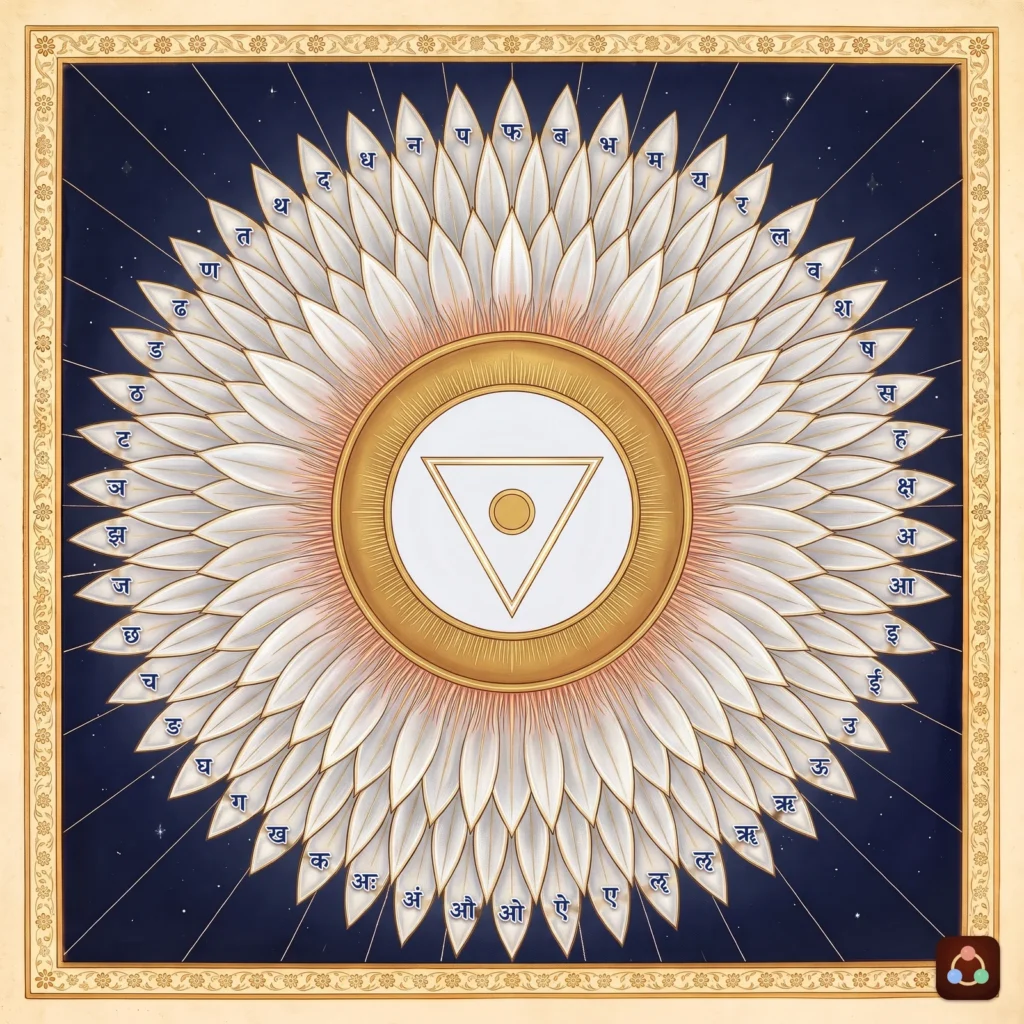
Rings upon rings of white petals, so fine and so many that the eye gives up counting them.
Round the outer ring run fifty letters, once. In the middle is a ring of gold, and inside it a white disc with a triangle that points down. In the triangle is a small gold disc, and it is empty.
This is the Sahasrara, the lotus “of a thousand petals”. It is not one of the six. The Shat-chakra-nirupana describes it after them, in ten verses of its own, 40 to 49. The Soundarya Lahari gives it no verse among the six that go down the centres, 36 to 41, but it is where verse 9 ends: the Devi, having pierced all six, sports in solitude with her lord.
On this pageThe name · Where it is · The lotus, as the texts describe it · What the Shat-chakra-nirupana says · What the Soundarya Lahari says · What the Lalita Sahasranama says · Three texts, one lotus · What it means for the inner life · What lies here in the body · Sources
The name
Sahasra means a thousand. The verse calls the lotus “the Lotus of a thousand petals”. The commentary, when it begins to describe it, calls it the Sahasrara. The hub page of this series gives the name as “a thousand spokes”, since ara means a spoke. The Lalita Sahasranama uses both forms: name 105 says she mounts the Sahasrara lotus, and name 528 says she dwells in the lotus of “a thousand petals”.
Other names for the place turn up in the books. A note quotes the Svachchhandasangraha, through Vishvanatha, which calls the Sahasrara Akula and the vacant space around it the Supreme Ether, Parama-vyoma. Woodroffe says that the world called Satyaloka is, in the human body, in the pericarp of the thousand-petalled lotus. The table in the 1937 commentary on verse 35 sets Satya against the Sahasrara. And the 1937 commentary on verse 9 calls the Sahasrara the Devi’s “permanent abode”, and the six lower centres “temporary stages”.
Where it is
Verse 40 puts it “above all these, in the vacant space wherein is Shankhini Nadi, and below Visarga”. The commentary says the vacant space is the place “where there are no Nadis”, above where the Sushumna ends, and that Visarga is in the upper part of the Brahmarandhra. The summary says the lotus is “above (the end) of the Sushumna Nadi”.
Texts that the commentator quotes say it is in the head. The Nirvana Tantra says: “In the Lotus in the head is Mahadeva, the Parama Guru”. The Annadi-kalpa Tantra speaks of “the white Lotus of a thousand petals in the head”. Woodroffe, in a footnote, writes that “the Sahasrara is at the top of the skull or upper brain”, and in his introduction he calls it the highest brain centre, the cerebrum. The hub page of this series says “above the crown of the head”. The texts I read say in the head, above the end of the channel, and I did not find one that says above the skull.
As with every lotus in these texts, it is a centre within the channel in the spine, at this level, and not a spot on the skin.
The lotus, as the texts describe it
| Petals | A thousand, white, the head turned downward (verse 40) |
| Letters on the petals | The fifty letters of the alphabet, A to ksha, going round the petals twenty times, white (the commentary and the summary) |
| What it holds | No element. The full moon, a triangle and the Great Void (verses 41 and 42) |
| Its shape | The full moon “without the mark of the hare” in the pericarp; inside it a triangle “shining like lightning”; inside that the Great Void (verse 41) |
| Bija | None in the verses. The commentary names Ham and Sah, the Hamsa |
| Deity | Parama Shiva, in the Void (verse 42), whom the commentary also calls the Guru. The Soundarya Lahari has the Devi sporting here with her lord (verse 9) |
| Ruling goddess | The Nirvana Shakti at the centre (verse 48). The Lalita Sahasranama names Yakini (534) |
| Bodily tissue | None in the verses. The Lalita Sahasranama’s name 531 is glossed “resides in the semen” |
| Knot | None. The last knot is at the Ajna, in Woodroffe’s account and in the 1937 commentary alike |
| Soundarya Lahari | Verses 9, 10, 14, 21, 32, 35, 36, 40, 41 and 99 (101 in the 1937 book) |
What the Shat-chakra-nirupana says
The Shat-chakra-nirupana gives the Sahasrara ten verses, 40 to 49. The commentary says so itself: wishing to describe it, the author “speaks of it in ten more verses”. Verse 39, just before, is still about the Mahanada above the Ajna. The summary at the end of the section is headed “verses 41 to 49”, though it also sums up the lotus of verse 40. Here is what the verses show, from the outside in.
The lotus. In verse 40 the lotus is “lustrous and whiter than the full Moon”. It has “its head turned downward”. It “charms”. Its “clustered filaments are tinged with the colour of the young Sun”. Its body is “luminous with the letters beginning with A”, and it is “the absolute bliss”. The summary puts it more plainly: it is white, its head is turned down, and its filaments are red. Our painting turns the lotus upward, as the other pages do, so that it can be read.
The letters. The commentary spends its longest discussion on a count. The letters are the fifty of the alphabet, going round the thousand petals twenty times, which makes a thousand. The commentator says there cannot be fifty-one: fifty-one letters repeated twenty times would be 1,020, and repeated nineteen times 969. He gets to fifty in a way that leaves out the second La, the Vedic La. The letters that remain are the sixteen vowels and the consonants ka to ksha, which are the same fifty that the six lower lotuses carry between them. He then quotes the Kankala-malini for a second way, in which the letter ksha is left out instead, and the letters end “with the last letter before Ksha”. The summary says the letters run “from A to La”. Both ways come to fifty. Our painting follows the first.
The commentary says nothing is said of the colour of the letters, and that as the letters of the alphabet are white, they are to be taken as white on the petals. It also says they “go round the Sahasrara from right to left”. A footnote that explains the direction is cut off in the copy I read, and I could not read it. So I cannot say which way round that is, and I do not claim it.
The moon, the triangle and the Great Void. In verse 41, within the lotus is “the full Moon, without the mark of the hare, resplendent as in a clear sky”. It “sheds its rays in profusion, and is moist and cool like nectar”. Inside the moon, “constantly shining like lightning”, is the triangle, and inside the triangle shines “the Great Void which is served in secret by all the Suras”. A note says the hare is the man in the moon. Another note gives the triangle as the A-ka-tha-di triangle, according to Vishvanatha. The commentary quotes the Kankala-malini for what lies in and above the pericarp: the Antaratma, above it the Guru, the circles of the Sun and Moon, then Mahavayu, then the Brahmarandhra, where Visarga is, and above that the Devi Shankhini, who “creates, maintains, and destroys”. It calls the Great Void “the body of the Parabindu”, the supreme point.
Parama Shiva. Verse 42 calls the Void “well concealed, and attainable only by great effort”. The commentary says that means long and unbroken practice of meditation, and that the Void is “like the ten millionth part of the end of a hair”. It is “the chief root of Liberation”. Here is the Deva “known to all as Parama Shiva”, who is the Brahman and the Self of all beings, and who is “the Sun which destroys the darkness of nescience and delusion”. In verse 43 he sheds a constant and profuse stream of nectar-like essence and teaches the pure-minded seeker the knowledge by which he realises that the individual self and the Supreme Self are one. The commentary takes Parama Shiva here to be the Guru. It quotes the Nirvana Tantra for that. It also says the Hamsa, the mantra Ham-Sah, is the same as the Antaratma. Exactly where the Guru sits is a matter on which the texts differ, and the summary ends by saying that texts that differ “refer to different methods and opinions”.
Names for the place. Verse 44 says the Shaivas call it the abode of Shiva, the Vaishnavas call it the place of Parama Purusha, others the place of Hari-Hara, those who are filled with a passion for the Devi’s feet the excellent abode of the Devi, and other great sages the pure place of Prakriti-Purusha. The commentary adds that, because every deity is in this pericarp, each kind of worshipper calls it the place of the deity of his own worship.
The fruit. Verse 45 promises that the best of men who has controlled his mind and known this place is never born again, that nothing in the three worlds binds him, that he has complete power to do what he wishes and to prevent what is against his will, that he moves ever towards the Brahman, and that his speech is pure and sweet. The commentary says the bonds are those of virtue and sin, that such a man is liberated while living, and that complete liberation comes when his body dissolves. It explains the power as the power to do all he desires, to turn aside harm, to move through the air (Kalicharana’s reading; the translation follows Vishvanatha, who reads the word as the Brahman) and to speak and write poetry well. A note adds that such a man “will not wrongly exercise it”. These are a tradition’s promises about a lifetime of meditation. They are not medical claims.
The two Kalas and the Nirvana Shakti. The next three verses go smaller and smaller. In verse 46 the sixteenth Kala of the moon, Ama-kala, is “pure” and “resembles (in colour) the young Sun”. She is “as thin as the hundredth part of a fibre in the stalk of a lotus”, “soft like ten million lightning flashes”, and turned down, and from her flows a stream of nectar. In verse 47, inside her is Nirvana-kala, the seventeenth, “as subtle as the thousandth part of the end of a hair”, in the shape of the crescent moon, and “as lustrous as the light of all the suns shining at one and the same time”. In verse 48, in her middle, shines the Supreme and Primordial Nirvana Shakti, “lustrous like ten million suns”, “the Mother of the three worlds”, “like unto the ten-millionth part of the end of a hair”, and “the life of all beings”. The commentary says that the individual soul comes out of her as sparks fly from a flame. Below her, it says, is Nibodhika, fiery and unmanifested sound.
The abode. Verse 49 says: “Within Her is the everlasting place called the abode of Shiva, which is free from Maya, attainable only by Yogis, and known by the name of Nityananda.” Some call it the Brahman, others the Hamsa. Wise men call it the abode of Vishnu, and righteous men “the ineffable place of knowledge of the Atma, or the place of Liberation”. A note quotes the Padma Purana, in which worshippers of every kind come to the one God “like rain water to the ocean”. The commentary says the empty space within the Nirvana Shakti, “more minute than the ten-millionth part of the end of a hair”, is the abode of the Brahman, and that this Bindu is the Brahman with attributes.
The summary. After verse 49 the summary gathers the picture. Above the end of the Sushumna is the white lotus with its head turned down and its filaments red, and the fifty letters go round it twenty times. On its pericarp is the Hamsa, and above it the Guru. Above the Guru are the circles of the Sun and Moon, then Mahavayu, the Brahmarandhra, and Shankhini. In the circle of the moon is the lightning-like triangle, with the sixteenth Kala in it and the Nirvana-kala in her lap, both red and turned down. Below the Nirvana-kala is the fire Nibodhika, and above it the Para Bindu, who is both Shiva and Shakti. Within the Bindu is the Void, the place of the Brahman. The summary then gives a second view, from the Agama-kalpa-druma, in which the triangle A-ka-tha with three Bindus is in the pericarp, and it says that placing the Guru above the Bindu and Visarga in that scheme “cannot be right”.
What our painting shows. It shows rings of white petals with rose-gold filaments, the fifty letters once round the outer ring, a gold ring for the pericarp, a plain white disc for the moon, a triangle, and a small empty gold disc for the Great Void. It does not count the petals, and the letters stand for the thousand. It does not paint Parama Shiva, the Hamsa, the Guru, the two Kalas, the Nirvana Shakti or Shankhini, which the texts make smaller than any picture could hold. The text does not say which way the triangle points, and we chose down. The moon has no mark of the hare. We set the letters in dark blue with a white edge so that they can be read on white petals; the commentary takes them to be white.
What the Soundarya Lahari says
The Soundarya Lahari gives the Sahasrara no verse among the six that go down the centres. It is the place those verses lead to, and the 1937 commentary brings it into many of them.
Verse 9 is where the lotus is named.
ಮಹೀಂ ಮೂಲಾಧಾರೇ ಕಮಪಿ ಮಣಿಪೂರೇ ಹುತವಹಂಸ್ಥಿತಂ ಸ್ವಾಧಿಷ್ಠಾನೇ ಹೃದಿ ಮರುತಮಾಕಾಶಮುಪರಿ ।ಮನೋಽಪಿ ಭ್ರೂಮಧ್ಯೇ ಸಕಲಮಪಿ ಭಿತ್ತ್ವಾ ಕುಲಪಥಂಸಹಸ್ರಾರೇ ಪದ್ಮೇ ಸಹ ರಹಸಿ ಪತ್ಯಾ ವಿಹರಸೇ
MeaningYou hold the earth element in the Muladhara, water in the Manipura, fire in the Svadhishthana, air in the heart at the Anahata, ether above it in the Vishuddhi, and the mind between the brows at the Ajna. (This placing of water and fire follows the Samaya tradition of Lakshmidhara.) Piercing all six, you rise along the kula path, the Sushumna, and in the thousand-petalled lotus, the Sahasrara, you sport in solitude with your lord. This is the rising of Kundalini to her union with Shiva. Read verse 9
The 1937 commentary says that here the Devi, in the form of the Kundalini of a person, breaks through the whole kula path with its six chakras, which stand for twenty-one tattvas, “to reach her Lord in the Sahasrara, the habitat of the four remaining sentient Tattvas”, to sport with him in secrecy. It reads the thousand-petalled lotus as “the upper Sri-chakra”, whose Bindu stands for Shiva and for the individual soul freed of Maya, the final resort, “the Nirvana of the accomplished seeker”. It says the Sahasrara is to be meditated on as the inner Sri-chakra “with all the fifty-one letters” of the alphabet, and that some hold that the Bindu has its own place and the other fifty letters go over the thousand petals twenty times. This differs from the Shat-chakra-nirupana, where the fifty go round and there is no fifty-first. The commentary also says that the Sahasrara is her permanent abode, that the practitioner should not be beguiled by the powers of the lower centres and lose sight of the goal, and that the Devi’s stay in the Sahasrara lasts as long as the strength of practice and the earlier experience of the practitioner allow, before she comes down again. Read verse 9
Verse 10 is the return. The nectar that streams from the Devi’s feet floods all the channels of the body and, the commentary says, “makes him realize the Supreme Bliss”. The app’s meaning says she then comes down from the Sahasrara and returns to rest in the Muladhara. Read verse 10
Verse 14 names the Devi’s pair of feet as “resting on the Sahasrara”. In its note the commentary says that the moon of the lower region, with its fifteen waxing and waning kalas, is only a reflection of the full moon, with its perpetual kalas, in the middle of the Sahasrara. Read verse 14
Verse 21. The commentary on this verse reads “the great forest of lotuses” as the thousand-petalled lotus “in the Dvadasanta”. It says the Kala called Para, in the form of the moon’s digit, is taken by the Devi in the Baindava-sthana, the seat of the Bindu, in the Sahasrara, when she is joined with Shiva. It calls this verse the inner meditation on the pure form of the Devi, as against the outer meditation of verse 19. Read verse 21
Verse 32. In the commentary the nectar that flows from the moon in the thousand-petalled lotus drenches the lunar region of the Ajna. Read verse 32
Verse 35. In the table in its commentary, the Sahasrara goes with the world of Satya and with Para-shakti.
Verse 36 ends its meditation in “that luminous region, which transcends the reach of the Sun, the Moon and Fire”. The commentary says the luminous region is the Sahasrara, “the abode of perpetual moonshine”, and the app’s meaning says the same. Read verse 36
Verses 40 and 41. In the long commentary on the last two centres, the 1937 book gives Lakshmidhara’s Samaya view, as it reports it. For the Samayins, it says, the worship of the six chakras is not essential, but worship in the Sahasrara is “the sine qua non” of the doctrine: to think of the disc of the moon in the middle of the Sahasrara as the quadrilateral that is the seat of the Bindu, and of the Bindu in it as the Sadakhya, the twenty-sixth tattva, which lies beyond the twenty-five. The book also says that the “nectar oozing out of the Sahasrara” fills all the channels. In the account of the worship that the book gives, after the Ajna, the Devi “suddenly, like a streak of lightning, flashes into the thousand-petalled lotus” and plays there with Sadashiva, in a pleasure garden, “in the middle of the ocean of nectar”. Then, it says, the screen is dropped, and the practitioner stands alone until the Devi comes out on her way back to the Muladhara. Read verse 41
Near the end of the poem, at verse 101 in the 1937 book’s numbering, which is verse 99 on this site, the commentary gives Lakshmidhara’s reading, as the book reports it, that the verse praises the worship of the Devi in the Sahasrara. Of the chakras, it says, the first two lie in a region of darkness and are not worthy of worship; the other five, the Sahasrara among them, are the ones to be taken into account. Worshippers of the Manipura, Anahata, Vishuddha and Ajna reach four lesser kinds of liberation, which the book calls gauna, or accessory, because only outer torments are warded off. “Worshippers of the Sahasrara alone” reach sayujya, “wherein even internal torments vanish”, and in which the worshipper “merges into the conjoint forms of Shiva and the Shakti”. The commentary on the same verse says there are a thousand petals to this lotus, and that the Bindu’s seat is in the middle of its pericarp, “with the four doors”. Read verse 99
What the Lalita Sahasranama says
The yogini of the Sahasrara (names 528 to 534). For this centre the Lalita Sahasranama names Yakini.
| No. | Name | Meaning |
|---|---|---|
| 528 | sahasra-dala-padma-sthā | Who dwells in the lotus of a thousand petals |
| 529 | sarva-varṇopaśobhitā | Radiant in many colours, in the page’s gloss (varṇa can also mean a letter) |
| 530 | sarvāyudha-dharā | Who holds all the known weapons |
| 531 | śukla-saṃsthitā | Who resides in the semen, in the page’s gloss |
| 532 | sarvato-mukhī | Whose faces are turned in all directions |
| 533 | sarvaudana-prīta-cittā | Pleased by offerings of every kind of food |
| 534 | yākinyambā-svarūpiṇī | Who is in the form of the goddess Yakini |
The Shat-chakra-nirupana verses I read name no Yakini. They name the Nirvana Shakti at the centre (verse 48) and, in a text the commentator quotes, Shankhini above. The Lalita Sahasranama says nothing of any of those, and it does not describe the Yakini’s form beyond the names above. The page I read glosses 529 as “radiant in many colours”; the word varna can also mean a letter, and I cannot tell which is meant. It glosses 531 as “resides in the semen”. I have not read a commentary on that name and do not explain it. In the list of seven tissues in the 1937 commentary on verse 9, semen (sukla) comes last, after marrow.
The rise (names 100 to 108). Names 105 to 108 are what the Lalita Sahasranama says about the Sahasrara itself.
| No. | Name | Meaning |
|---|---|---|
| 100 | brahma-granthi-vibhedinī | Who breaks the knot of Brahma |
| 102 | viṣṇu-granthi-vibhedinī | Who breaks the knot of Vishnu |
| 103 | ājñā-cakrāntarāla-sthā | Who stays at the centre of the Ajna chakra |
| 104 | rudra-granthi-vibhedinī | Who breaks the knot of Rudra |
| 105 | sahasrārāmbujārūḍhā | Who ascends to the thousand-petalled lotus |
| 106 | sudhā-sārābhivarṣiṇī | Who pours down streams of nectar |
| 107 | taḍillatā-sama-ruciḥ | As beautiful as a flash of lightning |
| 108 | ṣaṭ-cakropari-saṃsthitā | Who resides above the six chakras |
They come straight after the three knots: Brahma’s (100), Vishnu’s (102) and Rudra’s (104). In this list she is named at the Ajna (103) just before the last knot is broken (104), so the Sahasrara has no knot of its own. Woodroffe’s order puts Rudra’s knot at the Ajna and the 1937 commentary puts Brahma’s there; each way, the last knot is at the Ajna.
Other names touch this centre. Name 240 places her in the centre of the circle of the moon, and name 243 gives her a crescent moon that, in the page’s gloss, does not wax or wane. Names 591 to 593 place her in the head, bright as the moon, and in the forehead. Name 380 places her in the bindu circle, which the page glosses as the circle in the Sri Chakra, and 974 says she is pleased by offerings to the bindu. Name 879 calls her the source of nectar. The last names close the whole list: 999 calls her the union of Shiva and Shakti in one form, and 1000 gives her the name Lalita.
Three texts, one lotus
On the thousand petals, the white lotus and the nectar, the texts agree. They differ on the letters, on what lies at the centre, and on who dwells there.
| Shat-chakra-nirupana | Lalita Sahasranama | Soundarya Lahari | |
|---|---|---|---|
| Petals | A thousand, white, the head turned downward (verse 40) | The thousand-petalled lotus (105, 528) | The thousand-petalled lotus (verse 9); in the 1937 commentary on verse 99, a thousand petals with the seat of the Bindu in the middle of the pericarp |
| Letters | The fifty letters, A to ksha, with the second La left out, twenty times round (in another reading ksha is left out; the summary says “A to La”) | “Adorned with all varṇa” (529): colours or letters | Fifty-one letters, with the Bindu given its own place and the other fifty over the thousand petals, twenty times (1937 commentary on verse 9) |
| At the centre | The full moon, a triangle and the Great Void; the Bindu, the two Kalas and the Nirvana Shakti (verses 41 to 48) | The circle of the moon (240) and the bindu circle (380), not tied to this lotus by name | The Bindu as Shiva and the soul freed of Maya, “the upper Sri-chakra” (verse 9); the Baindava-sthana, the seat of the Bindu (verses 21, 40, 41 and 99) |
| Who dwells here | Parama Shiva in the Void (verse 42), the Guru (the commentary); the Hamsa | She dwells in the thousand-petalled lotus (528) | The Devi with her lord (verse 9); Sadashiva (1937 commentary on verse 41); Para-shakti, in the table on verse 35 |
| Ruling goddess | The Nirvana Shakti (verse 48); Shankhini above, in a text the commentator quotes | Yakini (534) | Not named: the Devi herself (verse 9) |
| Nectar | From the Ama-kala (verse 46) and from Parama Shiva (verse 43) | She pours down streams of nectar (106); she is the source of nectar (879) | From the Devi’s feet (verse 10); from the moon in the Sahasrara down to the Ajna (verse 32) |
| Its place among the centres | After the six, in ten verses of its own; no knot | Above the six chakras (108) | The permanent abode; the six are temporary stages (1937 commentary on verse 9) |
| Fruit of worship | No rebirth, no bond, power over one’s will, pure speech (verse 45) | Sayujya, merging in Shiva and Shakti, for worshippers of the Sahasrara alone (Lakshmidhara, as the book reports him, verse 99) |
What it means for the inner life
The texts read the Sahasrara in a few simple ways.
It is the end of the way. The Shat-chakra-nirupana describes it after the six, in its own ten verses. In the 1937 commentary on verse 9 it is the Devi’s permanent abode, and the six centres are temporary stages. The same commentary warns that the powers met at the lower centres are not the goal.
It is a place of cool light. The moon in it has no mark of the hare, shines “as in a clear sky”, and is “moist and cool like nectar”. The nectar streams down: from the Ama-kala in verse 46, from Parama Shiva in verse 43, and from the Devi’s feet in verse 10. The Lalita Sahasranama says she pours it out (106).
It is where counting stops. The thousand is not a count. It is the fifty letters, twenty times round. Then the sizes shrink: a hundredth of a lotus fibre, a thousandth of the end of a hair, a ten-millionth of it, and then a void.
It is the place of the Guru’s teaching. In verse 43 the nectar is the knowledge that the self and the Supreme are one, and it is given to a seeker whose mind is pure. The commentary says the Shiva there is the Guru. Verse 50, which follows, begins with the Guru’s instruction.
It holds every name. Verse 44 lets each tradition call it by its own deity, and verse 49 lets it be called the Brahman, the Hamsa, the abode of Vishnu, the knowledge of the Self or liberation. A note quotes the Padma Purana that all come to the one, “like rain water to the ocean”.
It is not for hurry. Verse 42 says it is “well concealed” and “attainable only by great effort”, which the commentary takes to mean long and unbroken meditation. Verse 50, the next, begins with rousing the Kundalini by control of the breath, under the Guru’s instruction. I do not describe any practice on this page.
What lies here in the body
I am a physician, so let me say plainly what sits at this level.
Under the crown of the head lie the scalp, the dome of the skull, and the coverings of the brain, and then the two halves of the cerebrum, the large upper part of the brain. The strip of brain surface that moves the opposite side of the body, and the strip that receives touch from it, run from side to side over the top of the head. The part for the legs and feet lies in the fold between the two halves. In a count of adult male brains, the brain was found to hold about 86 billion nerve cells, and about as many other cells again, which is a very different number from a thousand. The number in the texts is not a count of anything in the body. It is the commentary’s own sum, fifty letters twenty times. This is standard anatomy, and I have not tied it to a page of any one textbook here.
Woodroffe himself put the Sahasrara in the brain. He calls it the highest brain centre, the cerebrum, and in a footnote, disagreeing with a writer whose scheme he is describing, says it is at the top of the skull or the upper brain, and that the pineal gland is much lower, near the Ajna. A century ago some writers tried to match the chakras to nerve centres. Professor Sarkar’s list, which Woodroffe mentions, matches the six chakras to six plexuses and the Sahasrara to the medulla. Woodroffe says that last match cannot be right.
Is there any study of meditation for this part of the body? There is a good deal on the brain as a whole, though none of it looks for a thousand-petalled lotus. A 2014 review and meta-analysis of studies that measured brain structure pooled 21 studies of about 300 meditators. It found eight brain regions that differed, and a medium-sized overall difference, and its authors warned that bias in what gets published and weaknesses in the studies were serious concerns. Studies of this kind cannot, by themselves, say that meditation changed the brain. A 2016 review of 78 brain-scan studies, with 31 experiments and 527 people pooled, found different patterns of activity for four styles of meditation: focused attention, mantra recitation, open monitoring and compassion practice. Mantra recitation is the one nearest to chanting. A 2026 meta-analysis of 34 studies with 700 people, across four practices, found activity shared by all of them in the insula, the supplementary motor area, the hippocampus and a few other regions such as the rolandic operculum and the superior temporal gyrus. All of this tells us what brains look like during or after practice. It does not tell us that any region is a chakra.
Meditation is not free of risk. A 2020 systematic review of 83 studies with 6,703 people found that 55 of the studies reported at least one unwanted effect. Pooled together, 8.3 in every 100 people had one: 3.7 in 100 in the experimental studies and 33.2 in 100 in the observational ones. Among the 55 studies that reported any, anxiety was reported in 18, depression in 15, and unusual thinking or perception in 14. They can happen in people with no earlier mental health problem too. A 2026 review of Kundalini yoga, which combines breathing, movement, meditation and chanting, found 15 studies with about 1,370 people, no serious adverse events reported, and, its authors report, some benefit for memory, mood and sleep. Its authors say that larger and better trials, with active comparisons and longer follow-up, are needed. Those were yoga programmes as a whole, and they were not a test of the Sahasrara. If sitting practice leaves you frightened, unable to sleep, or feeling unlike yourself for days, please speak to a doctor, and to a teacher who knows the practice.
The one study I found that named the Sahasrara is the same sound-meditation study that named the other centres. It measured the “energy” of all seven chakras with a camera that reads the glow around the fingertips, in 15 volunteers after one session. I know of no evidence that this device measures any function of the body. I found no study that has tested the Sahasrara itself in a way medicine accepts.
Sources
- Arthur Avalon (Sir John Woodroffe), The Serpent Power, Ganesh and Co, Madras. Shat-chakra-nirupana, verses 40 to 49, with the commentary of Kalicharana, pp. 420 to 457, and the summary, pp. 457 to 459; verse 39, p. 416; the first lines of verse 50, p. 460; the introduction, pp. 19, 21, 26 to 27 and about 50; chapter V, pp. 126 to 127; pp. 153 to 159; and the pages on the knots and the rise of the Kundalini, near pp. 220 to 221, 236 and 238 (page numbers read from the running heads of an OCR text, and they may be one page out).
- Adi Shankaracharya, Saundarya-Lahari, with transliteration, English translation and commentary by S. Subrahmanya Sastri and T. R. Srinivasa Ayyangar, drawing on Lakshmidhara and other commentators. Theosophical Publishing House, Adyar, 1937. Verse 9, pp. 53 to 61; verse 10, p. 61; verse 14, pp. 76 and 79; verse 21, p. 94; verse 32, pp. 129 to 130; verse 35, p. 143; verse 36, pp. 145 to 146; verses 40 and 41, pp. 154 to 166; verse 101, pp. 250 to 257.
- The meanings of verses 9, 10, 14, 21, 32, 36, 41 and 99 on Jeevana Sutra, and in the Soundarya Lahari app.
- Lalita Sahasranama, names 100 to 108, 240, 243, 380, 528 to 534, 591 to 593, 879, 974, 999 and 1000. Numbers and meanings as in Sanskrit Documents, lalita1000.
- Azevedo FAC and others. Equal numbers of neuronal and nonneuronal cells make the human brain an isometrically scaled-up primate brain. Journal of Comparative Neurology 2009; 513(5): 532 to 541. doi:10.1002/cne.21974
- Fox KCR and others. Is meditation associated with altered brain structure? A systematic review and meta-analysis of morphometric neuroimaging in meditation practitioners. Neuroscience and Biobehavioral Reviews 2014; 43: 48 to 73. doi:10.1016/j.neubiorev.2014.03.016
- Fox KCR and others. Functional neuroanatomy of meditation: a review and meta-analysis of 78 functional neuroimaging investigations. Neuroscience and Biobehavioral Reviews 2016; 65: 208 to 228. doi:10.1016/j.neubiorev.2016.03.021
- Baten C and others. The functional neuroimaging of meditation: a quantitative whole-brain meta-analysis and systematic review. Neuroscience and Biobehavioral Reviews 2026; 186: 106709. doi:10.1016/j.neubiorev.2026.106709
- Farias M and others. Adverse events in meditation practices and meditation-based therapies: a systematic review. Acta Psychiatrica Scandinavica 2020; 142(5): 374 to 393. doi:10.1111/acps.13225
- Roy S and others. Evidence-based clinical effectiveness of Kundalini yoga: systematic review of RCTs across multiple health conditions. Alternative Therapies in Health and Medicine 2026; 32(1): 34 to 41. PubMed 40985958
- Veerabrahmachar R and others. Immediate effect of Nada Yoga meditation on energy levels and alignment of seven chakras as assessed by electro-photonic imaging: a randomized controlled crossover pilot study. Advances in Mind-Body Medicine 2023; 37: 11 to 16. PubMed 37119541