
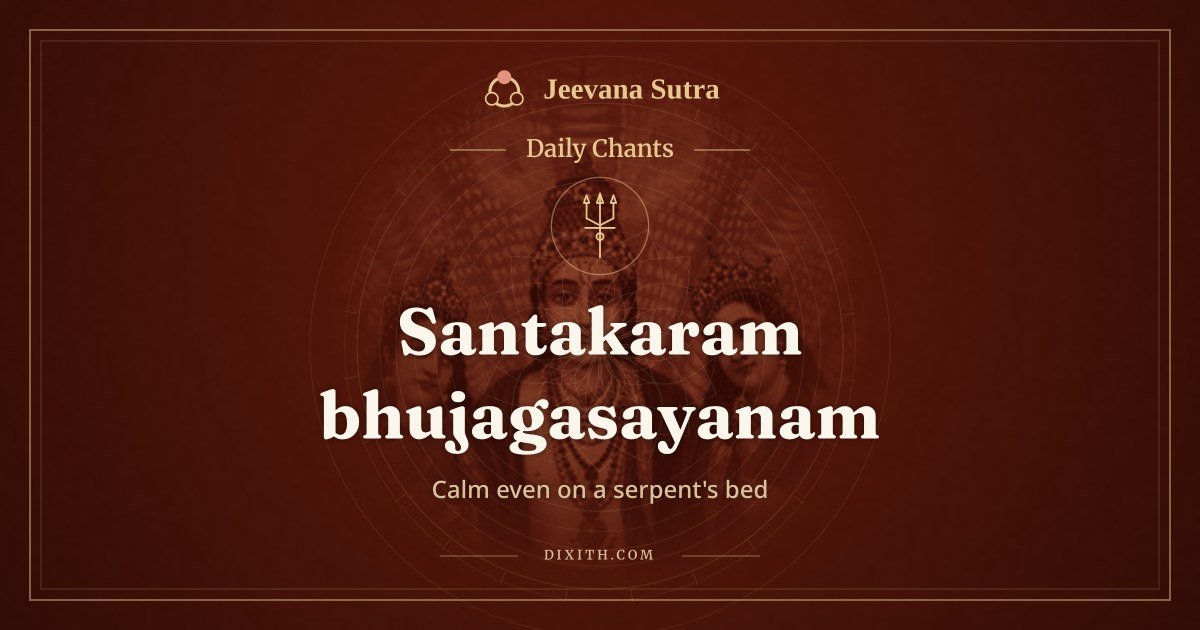
How can one lie on a venomous snake and stay calm? The first two words of this verse place that contrast side by side: śāntākāraṃ, bhujagaśayanaṃ.
Then the verse builds up the form of Vishnu one feature at a time: a lotus at the navel, a reach like the sky, the colour of a cloud, the husband of Lakshmi, the one seen in the hearts of yogis, the one who removes the fear of worldly existence.
Verse (Devanagari)
शान्ताकारं भुजगशयनं पद्मनाभं सुरेशं
विश्वाधारं गगनसदृशं मेघवर्णं शुभाङ्गम् ।
लक्ष्मीकान्तं कमलनयनं योगिभिर्ध्यानगम्यं
वन्दे विष्णुं भवभयहरं सर्वलोकैकनाथम् ॥
Verse (IAST)
śāntākāraṃ bhujagaśayanaṃ padmanābhaṃ sureśaṃ
viśvādhāraṃ gaganasadṛśaṃ meghavarṇaṃ śubhāṅgam |
lakṣmīkāntaṃ kamalanayanaṃ yogibhirdhyānagamyaṃ
vande viṣṇuṃ bhavabhayaharaṃ sarvalokaikanātham ||
Word by word
- शान्ताकारम् (śāntākāram) = of peaceful form
- भुजगशयनम् (bhujagaśayanam) = reclining on the serpent
- पद्मनाभम् (padmanābham) = with a lotus at his navel
- सुरेशम् (sureśam) = lord of the gods
- विश्वाधारम् (viśvādhāram) = support of the universe
- गगनसदृशम् (gaganasadṛśam) = like the sky
- मेघवर्णम् (meghavarṇam) = the colour of rain clouds
- शुभाङ्गम् (śubhāṅgam) = of auspicious body
- लक्ष्मीकान्तम् (lakṣmīkāntam) = beloved of Lakshmi
- कमलनयनम् (kamalanayanam) = lotus-eyed
- योगिभिर्ध्यानगम्यम् (yogibhirdhyānagamyam) = reached by yogis through meditation
- वन्दे (vande) = I salute
- भवभयहरम् (bhavabhayaharam) = remover of the fear of worldly existence
- सर्वलोकैकनाथम् (sarvalokaikanātham) = the one lord of all the worlds
Full meaning
I salute Vishnu, of peaceful form, reclining on the serpent, with a lotus at his navel, lord of the gods, support of the universe, vast as the sky, the colour of rain clouds, of auspicious body, beloved of Lakshmi, lotus-eyed, reached by yogis in meditation, remover of the fear of worldly existence, the one lord of all the worlds.
About this verse
It appears among the meditation verses that precede the Vishnu Sahasranama, but it is even better known sung on its own.
The third line is also said as yogihriddhyanagamyam, reached in the meditation of the yogi’s heart. Both readings fit the metre.
Many explain Adishesha’s hoods as a symbol of time. The idea is that one who rests at peace upon time itself can remove the fear of worldly existence.
Sources: several. Where versions differ, we have noted it here.
For life today
In a hospital emergency room the best doctors stay calm in the middle of the chaos. The picture of Vishnu resting on the serpent is the ideal of that quality.
Calm is not the absence of trouble. It is resting on the trouble with eyes still open.
Noticed a mistake or a different reading? Tell us.


Leave a comment