
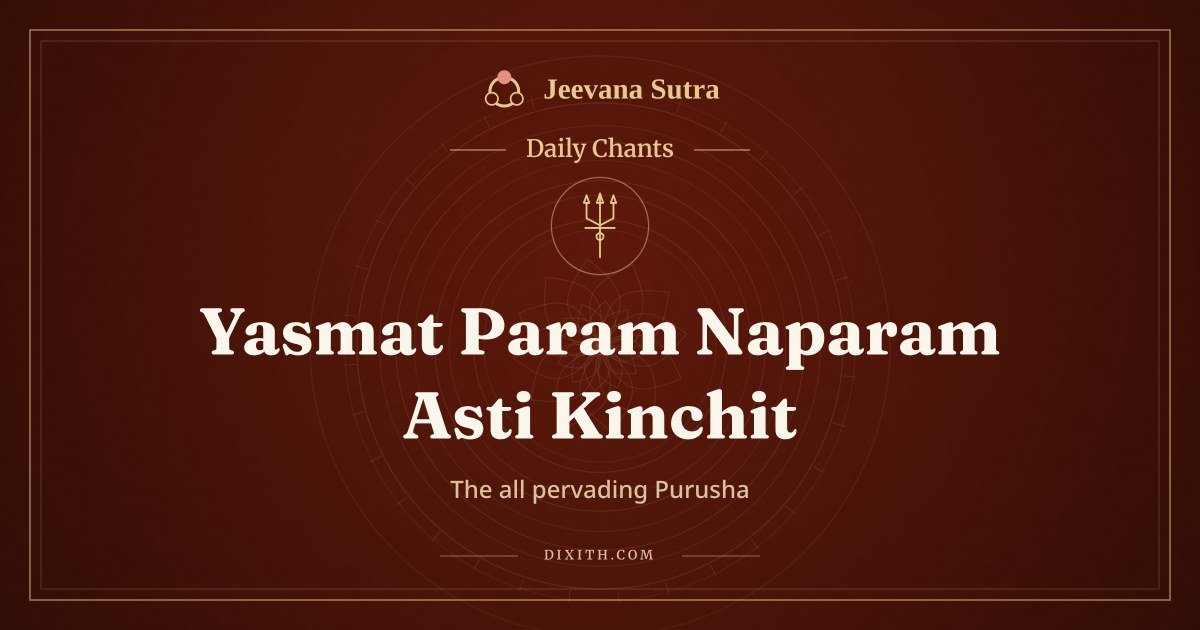
This is the ninth verse of the third chapter of the Shvetashvatara Upanishad. It describes the supreme Purusha, saying that there is nothing higher than him.
The word here is that he is subtler than the subtle and greater than the great. Standing still like a tree in the sky, he fills everything.
Verse (Devanagari)
यस्मात्परं नापरमस्ति किंचिद्यस्मान्नाणीयो न ज्यायोऽस्ति कश्चित् ।
वृक्ष इव स्तब्धो दिवि तिष्ठत्येकस्तेनेदं पूर्णं पुरुषेण सर्वम् ॥
Verse (IAST)
yasmātparaṃ nāparamasti kiṃcidyasmānnāṇīyo na jyāyo’sti kaścit |
vṛkṣa iva stabdho divi tiṣṭhatyekastenedaṃ pūrṇaṃ puruṣeṇa sarvam ||
Word by word
- यस्मात् (yasmāt) = than whom
- परं (paraṃ) = higher
- नापरमस्ति (nāparamasti) = nothing else exists (na + aparam + asti)
- किंचित् (kiṃcit) = anything
- यस्मान्नाणीयो (yasmānnāṇīyo) = than whom nothing is subtler (yasmat + na + aniyah)
- न (na) = not
- ज्यायोऽस्ति (jyāyo’sti) = greater exists (jyayah + asti)
- कश्चित् (kaścit) = anyone
- वृक्ष (vṛkṣa) = a tree
- इव (iva) = like
- स्तब्धो (stabdho) = still
- दिवि (divi) = in the luminous sky
- तिष्ठत्येकस्तेनेदं (tiṣṭhatyekastenedaṃ) = stands alone, by him this (tishthati + ekah + tena + idam)
- पूर्णं (pūrṇaṃ) = is filled
- पुरुषेण (puruṣeṇa) = by the Purusha
- सर्वम् (sarvam) = all
Full meaning
There is nothing higher than him, nothing subtler and nothing greater. He is one. He stands still in the luminous sky like a tree. By that Purusha all this is filled.
About this verse
This is Shvetashvatara Upanishad 3.9. The Upanishad belongs to the Krishna Yajurveda tradition. The verse is in the Anushtubh metre.
Most editions read kashchit in the first line’s end. Some texts show the variant kinchit. We have taken the most widely printed reading.
Commentators take the tree-like stillness as a sign of his steadiness.
Sources: several. Where versions differ, we have noted it here.
For life today
This verse brings the feeling that there is a steady support amid the noise of life.
Sitting still like a tree for a few minutes may give the mind some rest.
Noticed a mistake or a different reading? Tell us.
Leave a comment